
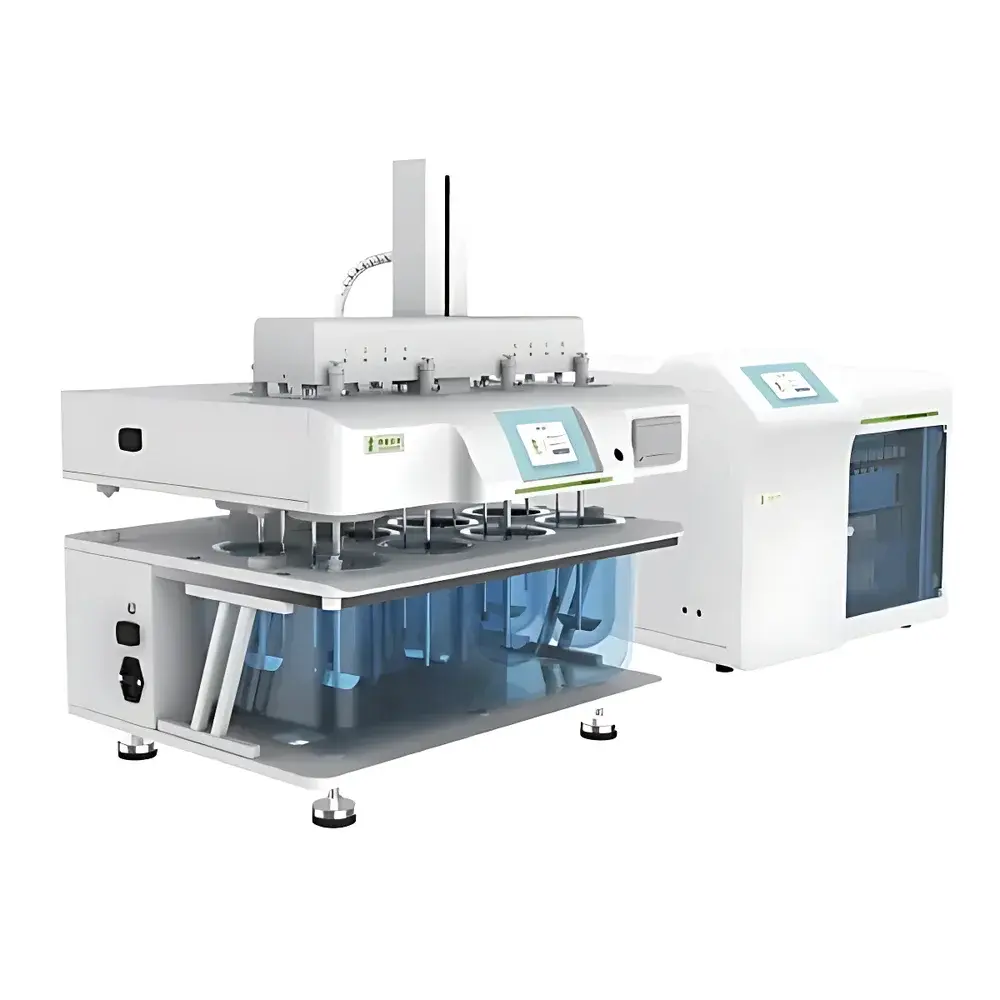
Haosoo D08 Automated Dissolution Sampling System
| Brand | Haosoo |
|---|---|
| Origin | Shandong, China |
| Model | D08 |
| Instrument Type | Offline Dissolution Tester |
| Actuation | 8-channel precision syringe pumps |
| Control Interface | 7-inch HD color touchscreen (Android OS) |
| Connectivity | USB, RS232, Wi-Fi |
| Sample Handling | 128-position 10 mL tube rack & 1.5 mL vial rack |
| Compliance Features | Audit trail, multi-level user permissions, fingerprint authentication |
| Thermal Control | Individual cup temperature sensing with calibration, real-time PID-controlled heating |
| Safety | Auto self-test, preheating, liquid level monitoring, dual overheat protection |
| Optional | Integrated camera system |
Overview
The Haosoo D08 Automated Dissolution Sampling System is an offline, modular dissolution testing platform engineered for pharmaceutical quality control and formulation development laboratories operating under GLP and GMP frameworks. It integrates two core subsystems—the DT08 Automated Dissolution Tester and the SC08 Automated Sampling Workstation—into a single coordinated architecture compliant with USP , , and , as well as ISO 16850 and ASTM D7812 standards for solid oral dosage form performance evaluation. The system employs classical paddle or basket apparatus configurations (USP Apparatus I and II), with precise mechanical alignment and fluid-dynamic optimization to ensure hydrodynamic reproducibility across all eight vessels. Dissolution kinetics are quantified via timed sampling of the dissolution medium, followed by quantitative analysis using external analytical instruments such as UV-Vis spectrophotometers or HPLC systems. Its offline architecture decouples sampling from real-time analysis, enabling flexible integration into existing lab workflows without requiring continuous instrument-to-analyzer synchronization.
Key Features
- Eight independently controlled, high-precision syringe pumps enabling fully automated filtration, sampling, medium replenishment, and on-deck dilution—each pump calibrated to ±0.5% volumetric accuracy per ISO 8570
- Individual vessel temperature monitoring with Pt100 RTD sensors and adaptive PID feedback loops; temperature uniformity maintained within ±0.2 °C across all positions at 37.0 °C
- Integrated UV-C sterilization module in recirculating fluid path to suppress microbial proliferation in water reservoirs during extended test protocols
- Real-time cup-level detection and dynamic volume compensation to maintain constant dissolution volume throughout multi-timepoint assays
- Comprehensive safety suite: automatic power-on diagnostics, programmable preheat ramping, redundant thermal cutoffs, and leak-resistant fluidic design
- Android-based 7-inch capacitive touchscreen interface with intuitive icon-driven navigation, customizable method templates, and on-device method storage (≥500 protocols)
- Built-in thermal printer for immediate hardcopy generation of test logs, including timestamped parameters, operator ID, and deviation flags
- Native support for electronic records and signatures per FDA 21 CFR Part 11: audit trail with immutable timestamps, user-specific access logging, and biometric (fingerprint) authentication
Sample Compatibility & Compliance
The D08 accommodates standard USP-compliant dissolution vessels (1,000 mL or 900 mL), baskets, paddles, sinkers, and disk holders. It supports immediate filtration through 0.45 µm or 0.22 µm membrane filters integrated into the sampling line. Sample containers include a motorized 128-position rack for 10 mL glass or polypropylene tubes and a dedicated 1.5 mL crimp-top vial tray compatible with autosampler-ready formats for HPLC or LC-MS injection. All wetted materials comply with USP Class VI biocompatibility requirements. System validation documentation includes IQ/OQ templates aligned with Annex 15 and EU GMP guidelines. Data integrity controls satisfy ALCOA+ principles (Attributable, Legible, Contemporaneous, Original, Accurate, Complete, Consistent, Enduring, Available).
Software & Data Management
The embedded Android OS hosts a validated dissolution control application supporting method creation, scheduling, parameter locking, and version-controlled protocol management. Data export is available in CSV, PDF, and XML formats via USB mass storage or network transfer. Wi-Fi connectivity enables remote firmware updates, centralized method deployment across multiple instruments, and secure data forwarding to LIMS or ELN platforms using TLS 1.2 encryption. All user actions—including login, method modification, run initiation, and result review—are captured in a tamper-evident audit trail with hash-secured entries. Role-based permissions (Administrator, Supervisor, Analyst, Viewer) enforce procedural segregation of duties.
Applications
- Regulatory dissolution testing for ANDA, NDA, and DMF submissions to FDA, EMA, PMDA, and NMPA
- Comparative dissolution profiling (f1/f2 analysis) for generic product equivalence studies
- Excipient interaction screening and formulation robustness assessment under variable pH, surfactant, or agitation conditions
- Stability-indicating dissolution method development and validation per ICH Q2(R2)
- Extended-release tablet and capsule characterization using sequential time-point sampling up to 24 hours
- Teaching and method transfer in academic and contract research laboratory settings
FAQ
Does the D08 support both USP Apparatus I (basket) and II (paddle)?
Yes—mechanical mounting fixtures and drive calibration routines are configurable for either apparatus type, with speed range from 25 to 200 rpm and resolution of 0.1 rpm.
Can the system perform automated dilution prior to HPLC injection?
Yes—each of the eight syringe pumps can be programmed to aspirate sample, dispense into a secondary vial, and deliver precise volumes of diluent, enabling 2-fold to 100-fold serial dilutions without manual intervention.
Is the audit trail compliant with FDA 21 CFR Part 11?
Yes—the system implements electronic signatures, role-based access control, immutable event logging, and cryptographic hashing of all critical data entries to meet Part 11 technical and procedural requirements.
What maintenance intervals are recommended for the fluidic system?
Syringe pump tubing should be replaced every 6 months or after 500 cycles; filter cartridges require replacement after each 20-test batch; temperature sensor calibration verification is advised quarterly using NIST-traceable reference thermometers.
Is the optional camera system used for real-time tablet erosion imaging?
Yes—the high-resolution, macro-capable camera module provides synchronized top-down imaging of dissolution vessels at user-defined intervals, supporting qualitative assessment of disintegration kinetics and surface erosion patterns.






