
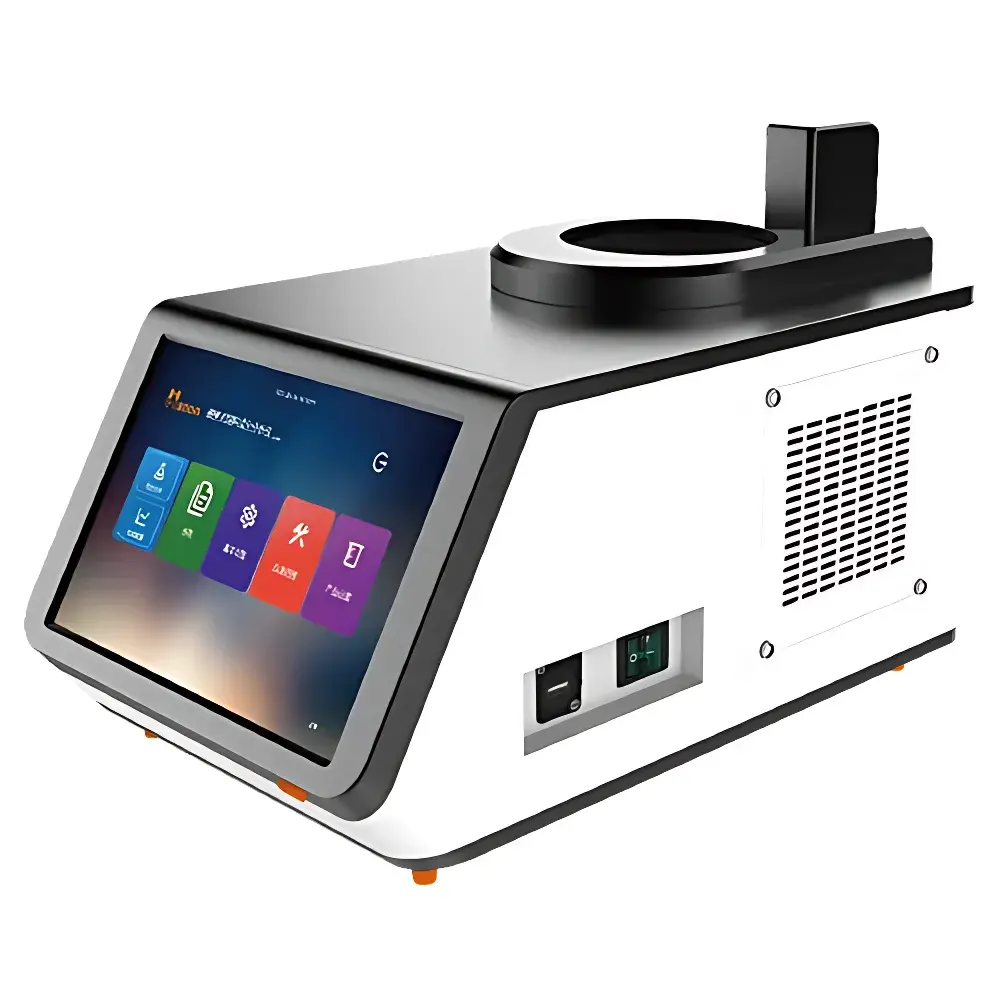
Hanon N550 MEMS-Based Near Infrared Spectrometer
| Brand | Hanon |
|---|---|
| Origin | Shandong, China |
| Model | N550 |
| Instrument Type | Laboratory NIR Spectrometer |
| Principle | MEMS Micro-Electro-Mechanical Systems Spectral Modulation |
| Wavelength Range | 900–1700 nm |
| Detector | Thermoelectrically Cooled InGaAs Array (256 pixels) |
| Slit Width | 50 nm |
| Wavelength Accuracy | ±1 nm |
| Wavelength Repeatability | ±0.2 nm |
| Signal-to-Noise Ratio | ≥3000 |
| Measurement Time per Sample | <30 s |
| Sampling Mode | Diffuse Reflectance |
| Sample Holders | 10 cm wide-mouth cup & 3 cm powder cup |
| Dimensions (L×W×H) | 450 × 280 × 228 mm |
| Weight | 15 kg |
| Compliance | ASTM E1655, ISO 12099, USP <857>, GLP/GMP-ready software architecture |
| Chemometrics Software | MEMS Quantitative Analysis Suite |
Overview
The Hanon N550 MEMS-Based Near Infrared Spectrometer is a laboratory-grade, solid-state near-infrared analytical instrument engineered for rapid, non-destructive quantitative analysis of organic materials. It operates on the principle of diffuse reflectance spectroscopy in the 900–1700 nm spectral region, where overtones and combination bands of C–H, N–H, and O–H bonds yield chemically informative absorption features. The core optical engine integrates a micro-electro-mechanical systems (MEMS) spectral modulator with a thermoelectrically cooled InGaAs photodiode array detector (256 pixels), enabling high spectral fidelity, low thermal drift, and robust inter-unit reproducibility. Unlike grating- or FT-NIR systems, the MEMS architecture eliminates moving parts, significantly enhancing mechanical stability and long-term calibration retention—critical for routine QC environments in feed mills, grain elevators, and food processing labs.
Key Features
- MEMS-Driven Optical Architecture: Solid-state spectral modulation ensures minimal wavelength shift over time (50,000 measurements without recalibration under standard operating conditions.
- Optimized Diffuse Reflectance Optics: Dual-sample interface design accommodates both bulk granular materials (e.g., whole corn kernels, soybean meal pellets) and fine powders via dedicated 10 cm wide-mouth and 3 cm precision powder cups—ensuring representative light scattering and minimizing particle-size bias.
- Integrated Chemometrics Platform: Pre-loaded, validated calibration models for corn, soybean meal, wheat, and alfalfa hay are embedded in the MEMS Quantitative Analysis Suite and updated quarterly via secure firmware patches—eliminating user-dependent model development and maintenance overhead.
- Touch-First Human Interface: A 10.1-inch capacitive touchscreen with anti-glare coating supports glove-compatible operation; all workflows—including spectrum acquisition, quantitative prediction, result export, and audit log review—are accessible within three taps.
- Regulatory-Ready Software Framework: Full 21 CFR Part 11 compliance support includes electronic signatures, role-based access control (admin/operator/observer tiers), immutable audit trails, and encrypted local database storage—all configurable without third-party middleware.
Sample Compatibility & Compliance
The N550 is optimized for heterogeneous agricultural and feed matrices including but not limited to: ground cereal grains (corn, barley, sorghum), protein concentrates (soybean meal, canola meal), oilseeds, dried distillers grains (DDGS), and premixes. Its diffuse reflectance geometry inherently mitigates surface texture effects common in irregular particulates. All factory-installed calibrations are developed and verified per ASTM E1655 (Standard Practices for Infrared Multivariate Quantitative Analysis) and ISO 12099 (Animal feeding stuffs — Guidelines for the application of near infrared spectroscopy). Instrument validation documentation—including IQ/OQ protocols, wavelength accuracy verification reports, and detector linearity assessments—is provided with each unit to support GLP and GMP audits.
Software & Data Management
The MEMS Quantitative Analysis Suite is a native Windows 10/11 application built on a SQLite-based relational database with automatic daily backup and optional network share synchronization. Core modules include: (1) Model Manager for version-controlled import/export of PLS, PCR, and SVM regression models; (2) Spectrum Viewer with baseline correction, Savitzky-Golay smoothing, and derivative transformation tools; (3) Batch Quantitation Engine supporting scheduled unattended runs with pass/fail flagging against user-defined specification limits; (4) Report Generator compliant with ISO/IEC 17025 requirements—exporting PDF, CSV, and XML formats with embedded spectral metadata and measurement timestamps. Audit logs record every user action (login, model load, result edit, report print) with IP address, timestamp, and session ID.
Applications
- Routine quality control of crude protein, moisture, fat, fiber, and starch content in animal feed formulations per AOAC 2011.01 and ISO 21542.
- Raw material verification at intake points—detecting adulteration or substitution in soybean meal using spectral fingerprint matching algorithms.
- In-process monitoring of drying, pelleting, and extrusion operations by tracking real-time moisture and starch gelatinization indices.
- Research-grade spectral library expansion for novel feed ingredients (e.g., insect meal, single-cell proteins) using the instrument’s built-in model development wizard and cross-validation tools.
- Compliance reporting for EU Regulation (EC) No 1831/2003 and FDA Title 21 CFR Part 579 on feed additive registration.
FAQ
Does the N550 require annual factory recalibration?
No. Due to its MEMS-based fixed-wavelength architecture and integrated reference channel, the N550 maintains wavelength accuracy (±1 nm) and photometric stability for ≥24 months under typical lab conditions. Users perform daily performance checks using the included ceramic reflectance standard.
Can third-party chemometric models be imported?
Yes. The MEMS software accepts .csv and .mat model files generated in MATLAB, Unscrambler, or Pirouette, provided they conform to the ASTM E1655-compliant prediction equation format and contain full spectral preprocessing metadata.
Is remote diagnostics supported?
Yes. With customer consent and IT approval, Hanon-certified engineers may initiate secure, read-only remote sessions via TLS-encrypted TeamViewer channels to review system logs, verify calibration status, and assist with troubleshooting—without accessing raw sample data.
What is the minimum sample mass required for accurate measurement?
For the 10 cm cup: ≥50 g of homogenized granular material; for the 3 cm powder cup: ≥5 g of uniformly sieved (<250 µm) powder. Sample homogeneity is more critical than mass—vibratory leveling is recommended for particulate samples.
How is data integrity ensured during power interruption?
All measurement sessions write to non-volatile flash memory in real time. If AC power fails, the system retains the last 100 spectra and associated prediction results, which auto-sync to the main database upon reboot.




