
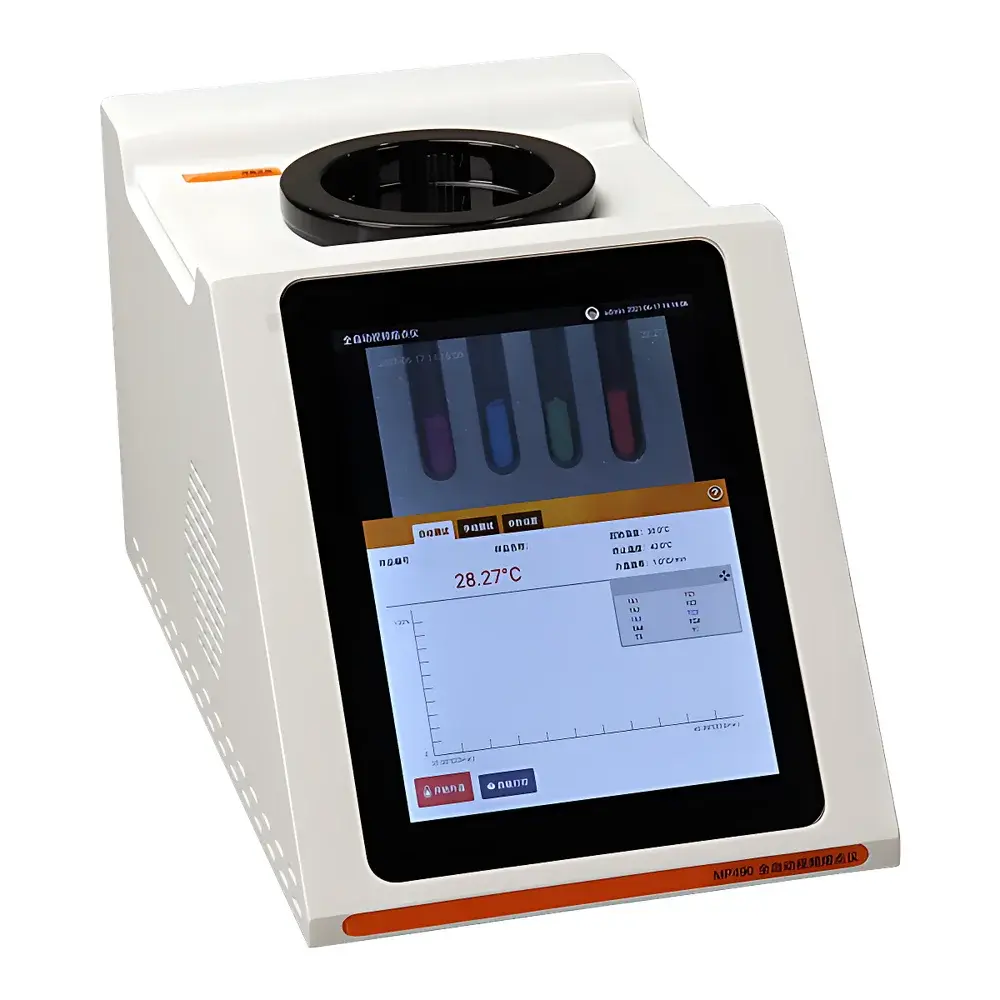
Hanon MP490 Automated Video Melting Point Apparatus
| Brand | Hanon |
|---|---|
| Origin | Shanghai, China |
| Model | MP490 |
| Temperature Range | Ambient to 400 °C |
| Heating Rate | 0.1–20 °C/min |
| Temperature Repeatability | ±0.2 °C (at 0.20 °C/min) |
| Temperature Accuracy | ±0.4 °C (<200 °C), ±0.7 °C (<300 °C) |
| Capillary Dimensions | Sealed-end, OD 1.3–1.4 mm, L 110 mm |
| Sample Capacity | 4 samples per run |
| Temperature Resolution | 0.01 °C |
| Data Storage | 128 GB internal (≥40,000 min video capacity) |
| Display | 8-inch capacitive TFT touchscreen (Android OS) |
| Camera | 720p HD, 8× optical zoom |
| Compliance | FDA 21 CFR Part 11 (audit trail enabled), GLP/GMP-ready |
Overview
The Hanon MP490 Automated Video Melting Point Apparatus is a high-precision thermal analysis instrument engineered for regulatory-compliant determination of melting onset (onset), clear point (end point), and decomposition behavior of crystalline organic solids. It employs real-time video imaging coupled with dynamic transmittance analysis—based on high-resolution CCD detection and pixel-level intensity thresholding—to objectively identify phase transitions without operator bias. Unlike traditional capillary-based systems relying solely on optical extinction or manual visual observation, the MP490 quantifies melt progression by continuously monitoring light transmission through the sample column at sub-degree temperature increments. This approach ensures robust detection of dark-colored, turbid, or low-contrast materials that are frequently mischaracterized by photodiode-only instruments. The system operates across an extended temperature range (ambient to 400 °C) with 0.01 °C digital resolution and thermally stabilized heating blocks featuring multi-layer insulation architecture—minimizing ambient drift while enabling rapid thermal ramping (≤5 min from ambient to 350 °C; ≤7 min from 350 °C to 50 °C).
Key Features
- Android-based 8-inch capacitive touchscreen interface with intuitive, icon-driven navigation—designed for seamless integration into modern laboratory workflows and compatible with ISO/IEC 17025 and FDA 21 CFR Part 11 operational requirements.
- Integrated 720p HD camera with 8× optical zoom and real-time video encoding (H.264), delivering high-fidelity visualization of morphological changes—including color shifts, sintering, bubbling, and charring—synchronized precisely with temperature and time stamps.
- Four independent sample positions with simultaneous automated measurement, each monitored via dedicated optical path and thermal sensor—ensuring inter-sample comparability and statistical reproducibility.
- Configurable melt detection logic: user-defined initial/final transmittance thresholds allow optimization for diverse material classes (e.g., dyes, APIs, polymers, natural products) without hardware modification.
- Comprehensive data integrity framework: immutable audit trail logging all user actions (login/logout, method edits, calibration events, report generation); watermark-embedded videos showing real-time temperature and timestamp; password aging and complexity policies aligned with NIST SP 800-63B.
- Multi-tier user management (Administrator, Supervisor, Operator, IT Support) with granular permission assignment per module (e.g., calibration access restricted to Supervisor level; report export disabled for entry-level users).
Sample Compatibility & Compliance
The MP490 accommodates standard sealed-end capillaries (1.3–1.4 mm OD, 110 mm length), compatible with widely adopted reference standards including USP , ASTM E324, ISO 6383-1, and Ph. Eur. 2.2.17. Its video-based detection eliminates reliance on sample color or refractive index, enabling accurate characterization of highly pigmented pharmaceutical intermediates, metallorganic complexes, and carbon-black-loaded polymers—materials often problematic for photometric-only systems. All firmware and software modules undergo periodic validation against ICH Q2(R2) guidelines for analytical instrument qualification (AIQ). The device supports full 3Q documentation (IQ/OQ/PQ) packages and includes pre-validated calibration routines using certified reference materials traceable to NIST SRMs (e.g., indium, tin, zinc, bismuth).
Software & Data Management
Built on a hardened Android 9.0 platform, the MP490’s embedded software provides native support for FDA 21 CFR Part 11 compliance—including electronic signatures, role-based access control, and tamper-evident audit logs stored in encrypted SQLite databases. Data storage capacity exceeds 128 GB SSD (supporting >40,000 minutes of compressed video), with automated backup to USB drives or network shares via Wi-Fi or RJ45 Ethernet. Search functionality enables multi-parameter retrieval (e.g., “API name + date range + operator ID + melt range 152–155 °C”) across decades of archived experiments. Export formats include PDF reports (with embedded video thumbnails), CSV (temperature/time/transmittance arrays), and MP4 video files containing synchronized thermal metadata. Remote printing via Wi-Fi-enabled laser or thermal printers is supported, including shared printer pools across multiple MP490 units in centralized QC labs.
Applications
The MP490 serves as a primary tool in pharmaceutical quality control laboratories for identity confirmation and purity assessment of active pharmaceutical ingredients (APIs) and excipients per USP monographs. It is routinely deployed in fine chemical synthesis R&D to monitor reaction endpoints and polymorph screening, particularly where thermal degradation precedes melting. Regulatory submissions (e.g., ANDA, MAA) benefit from its Part 11–compliant data package generation, including raw video, annotated melt curves, calibration certificates, and audit trail exports. Additional use cases include: verification of polymer crystallinity in packaging materials; stability testing of nutraceuticals under accelerated conditions; forensic analysis of illicit substance purity; and teaching applications in university chemistry curricula requiring demonstrable, repeatable thermal transition data.
FAQ
Does the MP490 comply with FDA 21 CFR Part 11 requirements?
Yes—the system implements full electronic signature capability, audit trail immutability, user authentication with password lifecycle controls, and secure data storage. Validation documentation and IQ/OQ/PQ protocols are available upon request.
Can the instrument detect decomposition events distinct from melting?
Yes—by analyzing deviations in transmittance slope, discoloration onset, gas evolution (bubbling), or structural collapse (sintering) in synchronized video, the MP490 distinguishes decomposition from true melting, especially critical for thermally labile compounds.
What calibration standards are recommended for routine verification?
NIST-traceable reference materials such as indium (156.6 °C), tin (231.9 °C), and zinc (419.5 °C) are recommended. The MP490 supports up to six-point calibration across its operating range.
Is method transfer possible between MP450/MP470 and MP490 models?
Yes—method files (.mpm) are backward-compatible across the MP4xx series. However, only the MP490 supports 0.01 °C resolution and full audit trail functionality required for regulated environments.
How is data integrity maintained during power interruption?
The system uses journaling file system (ext4) with automatic transaction rollback. Video and thermal data streams are written in atomic blocks; partial writes are discarded on restart, preserving dataset consistency.



