
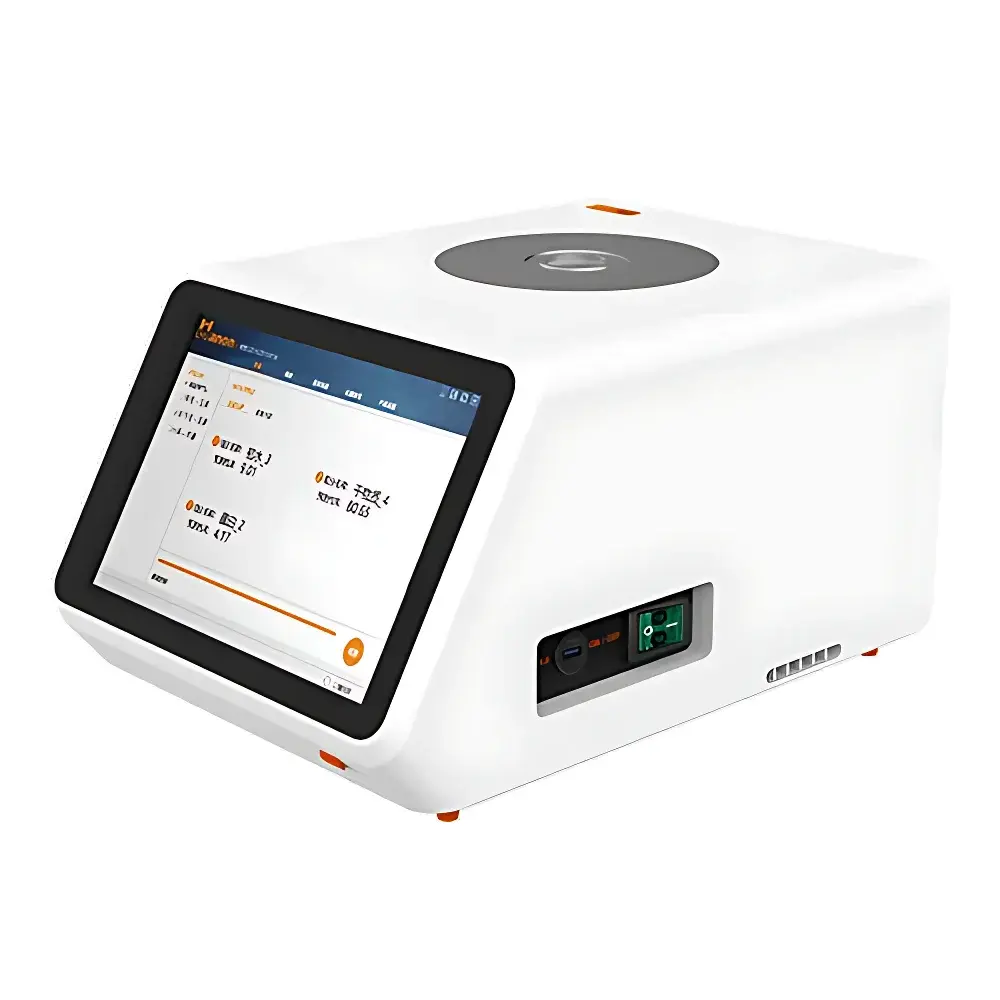
Hanon N500 Portable Near-Infrared Spectrometer
| Brand | Hanon |
|---|---|
| Origin | Shandong, China |
| Model | N500 |
| Instrument Type | Portable |
| Principle | Micro-Electro-Mechanical Systems (MEMS)-based Fabry–Pérot Interferometer (FPI) |
| Wavelength Range | 1750–2150 nm (extendable to 2450 nm) |
| Detector | InGaAs |
| Wavelength Resolution (FWHM) | ≤20 nm (≤1% of operating wavelength) |
| Wavelength Accuracy | ±1 nm |
| Signal-to-Noise Ratio (SNR) | ≥3000 |
| Sample Measurement Time | <30 s |
| Light Source Lifetime | 5000 h |
| Measurement Mode | Diffuse Reflectance |
| Dimensions (L×W×H) | 395 × 280 × 215 mm |
| Weight | 5.5 kg |
| Included Computing Platform | Microsoft Surface tablet |
| Software | MEMS Chemometrics Suite |
Overview
The Hanon N500 Portable Near-Infrared Spectrometer is an engineered solution for rapid, non-destructive, multi-component quantitative analysis in field and laboratory environments. Built upon a solid-state Micro-Electro-Mechanical Systems (MEMS)-driven Fabry–Pérot Interferometer (FPI) optical architecture, the N500 eliminates moving mechanical parts commonly found in grating- or scanning-based NIR systems—resulting in enhanced mechanical robustness, long-term spectral stability, and superior inter-unit reproducibility. Its diffuse reflectance measurement geometry enables direct analysis of heterogeneous, opaque, or granular samples without preparation, making it especially suitable for routine quality control and compositional screening in feed, grain, food, and agricultural research settings. The instrument operates within the critical long-wave near-infrared region (1750–2150 nm), where fundamental overtones and combination bands of C–H, N–H, and O–H bonds exhibit high sensitivity—enabling accurate prediction of moisture, protein, fat, starch, and fiber content. With factory-calibrated, pre-loaded chemometric models for corn and soybean meal—and scheduled periodic updates—the N500 delivers immediate analytical readiness without requiring users to develop or validate calibration models.
Key Features
- MEMS-FPI core optics: High-integration, solid-state interferometer ensures low inter-instrument variability (<±1.5 nm wavelength shift across units), excellent thermal stability, and resistance to mechanical shock.
- Pre-validated chemometric models: Embedded predictive models for corn and soybean meal are maintained under strict model lifecycle protocols—including performance monitoring, outlier detection, and revalidation against reference wet chemistry data per ASTM E1655 and ISO 12099 guidelines.
- Integrated computing platform: Bundled Microsoft Surface tablet with Windows OS provides full local execution of the MEMS Chemometrics Suite—no external PC or network dependency required.
- Intuitive touch interface: 10.6-inch high-resolution capacitive touchscreen supports gesture-driven workflow navigation; all core functions—including spectrum acquisition, quantitative prediction, result review, and report export—are accessible via single-tap interaction.
- Modular sampling flexibility: Standard configuration supports bulk solid analysis via integrated sample cup; optional accessories include liquid transmission cells, powder holders, and custom-designed probes for in-situ or conveyor-belt applications.
- Extended spectral capability: Native range covers 1750–2150 nm; firmware-upgradable architecture supports extension to 2450 nm for enhanced quantification of carbohydrate-rich matrices.
Sample Compatibility & Compliance
The N500 is validated for diffuse reflectance analysis of particulate, powdered, and pelleted samples typical in agri-food QC labs—including whole grains, ground feed, flour, dried fruits, and roasted coffee beans. It complies with key methodological standards for NIR spectroscopy: ASTM E1655 (standard practices for NIR quantitative analysis), ISO 12099 (animal feeding stuffs—guidelines for NIR calibration and validation), and AOAC Official Method 2011.02 (NIR analysis of protein in cereal products). While not certified for regulated GMP environments out-of-the-box, its software architecture supports audit-trail-enabling configurations (e.g., user authentication, version-controlled model deployment, and immutable result logging) compatible with GLP/GMP-aligned workflows when deployed with appropriate IT governance controls.
Software & Data Management
The MEMS Chemometrics Suite is a purpose-built application designed exclusively for the N500 platform. It implements a role-based access control (RBAC) framework compliant with ISO/IEC 27001 principles—allowing administrators to define user roles (e.g., Operator, Analyst, Administrator) with granular permissions for model loading, result editing, report generation, and system configuration. All spectral acquisitions and quantitative outputs are timestamped, digitally signed, and stored in an encrypted SQLite database with automatic daily backup to external USB media. Reporting functions support PDF export with embedded spectral plots, prediction confidence intervals, and reference method correlation statistics. The software includes built-in tools for spectral preprocessing (Savitzky–Golay smoothing, multiplicative scatter correction, first-derivative transformation), outlier identification (Mahalanobis distance >3.0), and residual analysis—facilitating transparent model diagnostics without third-party packages.
Applications
- Routine moisture and crude protein determination in corn, soybean meal, wheat bran, and distillers’ dried grains with solubles (DDGS) per AOAC and AACC methods.
- On-site verification of incoming raw material composition at feed mills and grain elevators—reducing reliance on off-site wet chemistry labs.
- Process monitoring in food manufacturing: real-time tracking of starch gelatinization, fat oxidation, or Maillard reaction progression during drying or roasting.
- Academic research in plant breeding programs: high-throughput phenotyping of seed composition traits using handheld NIR screening.
- Extension service support: portable deployment for farmer cooperatives conducting field-level grain quality assessment prior to storage or sale.
FAQ
Does the N500 require user-developed calibration models?
No. The instrument ships with pre-validated, factory-loaded models for corn and soybean meal. Hanon provides scheduled model updates based on ongoing collaborative validation studies with accredited reference laboratories.
Can the N500 be used for liquid samples?
Yes—via optional transmission-mode accessories including quartz cuvette holders and fiber-optic immersion probes compatible with standard 1-cm pathlength geometries.
Is the software compliant with FDA 21 CFR Part 11 requirements?
Out-of-the-box, the MEMS Chemometrics Suite meets foundational elements (electronic signatures, audit trail, role-based access); full Part 11 compliance requires site-specific validation documentation and integration with enterprise identity management systems.
What is the recommended maintenance schedule?
No routine optical alignment or lamp replacement is required. Users should perform weekly dark-current and reference-white checks using supplied ceramic tiles; annual verification against NIST-traceable standards is advised for regulatory environments.
How is spectral data secured and backed up?
All measurements are stored locally in an encrypted database with automatic daily backups to connected USB storage devices. Exported reports include digital watermarks and cryptographic hashes for data integrity verification.





