
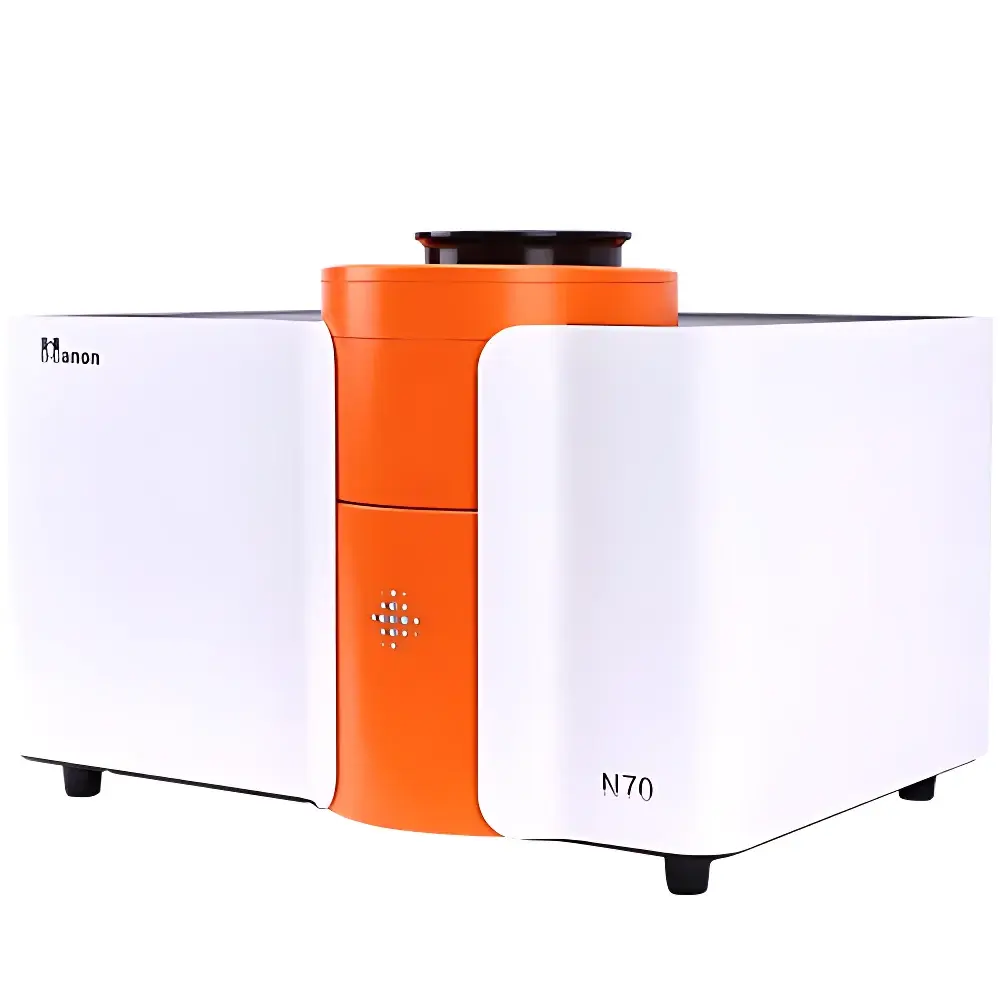
Hanon N70 Fourier Transform Near-Infrared Spectrometer
| Brand | Hanon |
|---|---|
| Origin | Shandong, China |
| Model | N70 |
| Instrument Type | Laboratory FT-NIR Spectrometer |
| Principle | Fourier Transform Interferometry |
| Wavenumber Range | 3750–12500 cm⁻¹ |
| Scan Speed | <1 s (at 8 cm⁻¹ resolution) |
| Data Sampling Intervals | 2, 4, 8, or 16 cm⁻¹ |
| Measurement Modes | Integrating Sphere Diffuse Reflectance / Transflectance |
| Chemometrics Software | PLSQ — Partial Least Squares Spectral Modeling System |
| Detector | TEC-cooled InGaAs (2-stage thermoelectric cooling) |
| Resolution | <2 cm⁻¹ @ 7306.74 cm⁻¹ |
| Wavenumber Accuracy | <0.1 cm⁻¹ @ 7306.74 cm⁻¹ |
| Wavenumber Reproducibility | <0.04 cm⁻¹ @ 7306.74 cm⁻¹ |
| Inter-instrument Wavenumber Reproducibility | <0.05 cm⁻¹ @ 7306.74 cm⁻¹ |
| Absorbance Precision | ±0.1% T |
| Sample Measurement Time | <30 s |
| Dimensions | 445 × 237 × 320 mm |
| Weight | 20 kg |
| Power Consumption | 60 W |
Overview
The Hanon N70 Fourier Transform Near-Infrared (FT-NIR) Spectrometer is a laboratory-grade analytical instrument engineered for high-fidelity, non-destructive molecular characterization across diverse solid and liquid matrices. Operating on the principle of Michelson interferometry with a stabilized He–Ne laser reference, the N70 acquires interferograms in the spectral range of 3750–12500 cm⁻¹ (approximately 800–2680 nm), conforming to the ASTM E1252 definition of the near-infrared region. Its optical architecture centers on a RUBY™ three-dimensional corner-cube interferometer featuring dual rotating mirror assemblies, eliminating mechanical wear, friction, and shear-induced errors—ensuring long-term wavenumber stability (98%) to maximize signal throughput and minimize scattering artifacts, particularly critical for heterogeneous particulate or granular samples common in feed, food, and agricultural applications.
Key Features
- RUBY™ Interferometer Architecture: A vibration-insensitive, self-aligning, dual-corner-cube design delivering sub-2 cm⁻¹ resolution and intrinsic wavenumber accuracy (<0.1 cm⁻¹) under variable thermal and mechanical conditions.
- High-Sensitivity Detection: Dual-stage thermoelectrically cooled (TEC) InGaAs detector with large active area ensures superior signal-to-noise ratio (SNR) and low dark current drift over extended acquisition periods.
- Intelligent Optical Modulation: Motorized automatic aperture control dynamically optimizes energy throughput across spectral regions; integrated internal validation module enables automated OQ/PQ verification against certified reference standards.
- Modular Sample Handling: Rotating sample stage combined with wide-mouth sample cup and optional transflectance liquid cell supports reproducible analysis of powders, pellets, flakes, pastes, and liquids without preprocessing.
- Laser-Stabilized Metrology: Helium–neon laser reference provides absolute wavenumber traceability independent of ambient temperature or humidity—essential for inter-instrument model transfer and regulatory compliance.
Sample Compatibility & Compliance
The N70 accommodates a broad spectrum of physical sample forms—including granular feeds, milled grains, dairy powders, pharmaceutical tablets, polymer pellets, and viscous liquids—without chemical digestion, solvent extraction, or derivatization. Its diffuse reflectance and transflectance measurement geometries comply with ISO 12099:2017 (Animal feeding stuffs — General guidelines for near-infrared spectroscopic analysis) and align with ASTM E1655 (Standard Practices for Infrared Multivariate Quantitative Analysis). The instrument’s performance verification protocols satisfy the Chinese National Standard T/CIS 17006–2022 (“General Technical Specification for Fourier Transform Near-Infrared Spectrometers”), including mandatory tests for wavenumber accuracy, photometric linearity, and inter-unit reproducibility. Full audit trail logging, user-level access control (three-tier permissions), and electronic signature support ensure adherence to GLP and GMP environments per FDA 21 CFR Part 11 requirements.
Software & Data Management
The N70 is operated via an intuitive, touch-optimized Windows-based software suite supporting both local and cloud-integrated workflows. The core chemometrics engine—PLSQ—implements partial least squares (PLS) regression with robust outlier detection, residual analysis, and cross-validation diagnostics. All spectral data and prediction results are stored in a relational database schema compatible with LIMS integration (ODBC/JDBC drivers provided). Built-in OQ/PQ modules execute standardized performance checks aligned with T/CIS 17006–2022, generating PDF reports with digital signatures. For enterprise deployment, the Intelligent NIR Cloud Platform (INCP) enables centralized model lifecycle management: cloud-based PLS modeling leverages ensemble learning algorithms to enhance predictive robustness; models trained remotely can be securely downloaded and deployed locally. INCP supports multi-vendor instrument aggregation, facilitating cross-platform model portability between Hanon N70, N550, and third-party FT-NIR systems.
Applications
The N70 delivers validated quantitative analysis across regulated and industrial sectors. In animal feed quality control, it quantifies moisture, crude protein, crude fat, crude fiber, ash, and starch within <30 seconds per sample—replacing AOAC 984.13, 991.20, and 978.10 wet chemistry methods. In dairy processing, it monitors fat, protein, lactose, and total solids in milk powder and whey concentrates. For pharmaceutical manufacturing, it verifies blend uniformity (per USP ), active pharmaceutical ingredient (API) content, and tablet hardness. In petrochemical QA/QC, it predicts octane number, cetane number, distillation endpoints, and aromatic content in gasoline and diesel fractions. Polymer laboratories use it to assess density, melt index surrogates, crosslink density, and monomer conversion—supporting rapid release testing and real-time process analytics (PAT).
FAQ
Does the N70 support method transfer between instruments?
Yes. Its laser-referenced interferometer and rigorous inter-unit wavenumber reproducibility (<0.05 cm⁻¹) enable direct model transfer across N70 units and compatibility with legacy Hanon platforms (e.g., N550) and select third-party FT-NIR spectrometers.
Is the software compliant with FDA 21 CFR Part 11?
Yes. The software includes role-based authentication, electronic signatures, immutable audit trails, and secure data export—all configurable to meet Part 11 and Annex 11 requirements.
Can the N70 analyze wet or sticky samples?
Yes. The gold-coated integrating sphere and optional heated sample cup accessory mitigate moisture condensation and surface adhesion effects, enabling stable measurements of hygroscopic or semi-solid materials.
What chemometric validation metrics does PLSQ provide?
PLSQ reports RMSEC/RMSEP, R², bias, slope/intercept of calibration vs. validation sets, leverage plots, Hotelling’s T², and Q-residuals—supporting full ICH Q2(R2) validation documentation.
Is cloud-based modeling mandatory?
No. All modeling, validation, and prediction functions operate fully offline. Cloud connectivity is optional and encrypted (TLS 1.2+); raw spectral data never leaves the instrument unless explicitly uploaded by the user.




