
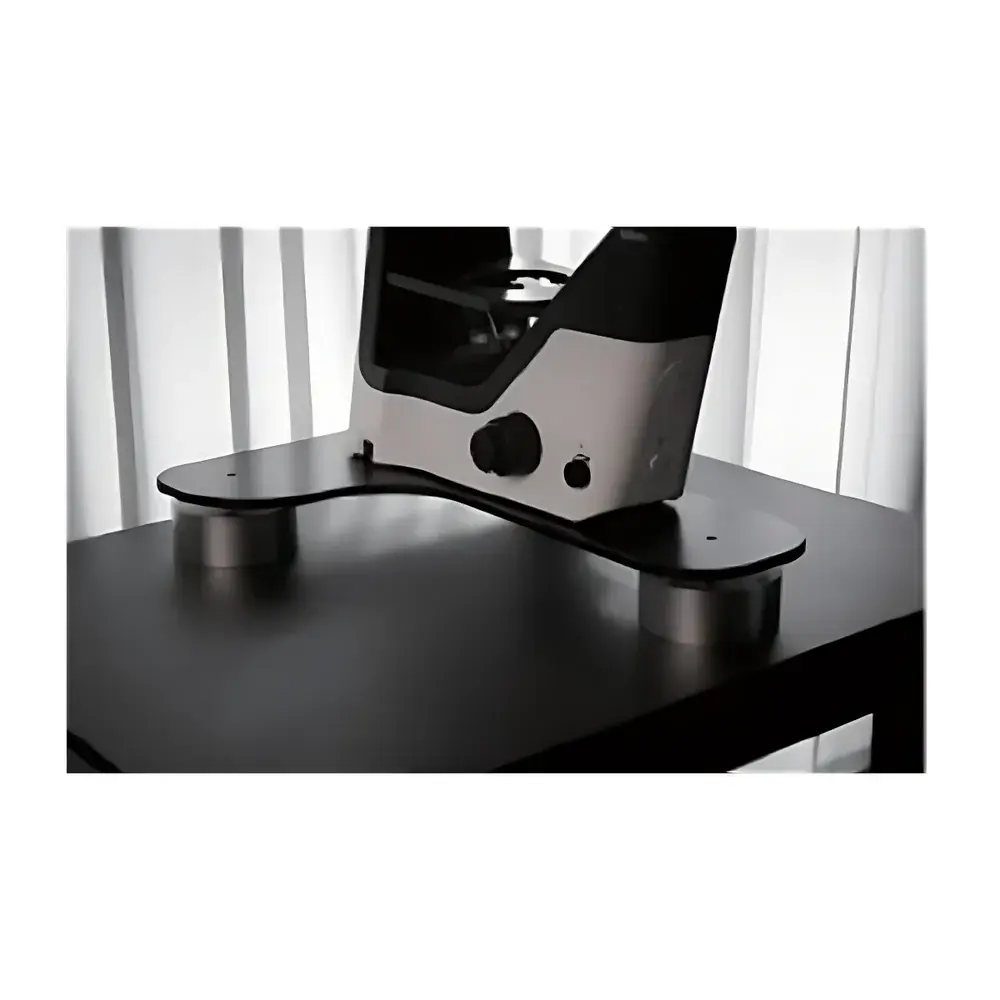
LCI MagLevit Active Vibration Isolation Platform
| Brand | LCI (Live Cell Instrument) |
|---|---|
| Origin | South Korea |
| Model | MagLevit |
| Type | Hybrid Magnetic-Spring Passive Vibration Isolation Platform |
| Application | High-Sensitivity Optical Microscopy, Interferometry, Nanoscale Imaging, and Precision Metrology |
| Compliance | Designed for ISO 20483 Class 1–2 laboratory environments |
| Mounting Interface | Standard M8 threaded holes (grid spacing: 25 mm) |
| Static Load Capacity | Up to 150 kg (distributed load) |
| Resonant Frequency | <1.2 Hz (vertical), <1.5 Hz (horizontal) |
| Damping Mechanism | Non-contact magnetic repulsion + low-hysteresis elastomeric springs |
| Noise Floor Reduction | ≥30 dB attenuation from 1–100 Hz |
Overview
The LCI MagLevit Active Vibration Isolation Platform is an engineered solution for laboratories requiring ultra-stable mechanical support in optical metrology, super-resolution microscopy, laser interferometry, and single-molecule imaging. Unlike conventional air tables or passive elastomeric isolators, the MagLevit integrates a hybrid magnetic-spring architecture that delivers sub-1.5 Hz resonant frequencies in both vertical and horizontal axes—critical for maintaining phase coherence in long-exposure optical measurements and minimizing drift-induced artifacts in nanometer-scale positioning systems. Its core principle relies on non-contact magnetic repulsion between permanent neodymium magnets and ferromagnetic base plates, combined with precision-tuned elastomeric springs that provide broadband damping without hysteresis or creep. This dual-mode isolation mechanism decouples sensitive instruments—including inverted microscopes, atomic force microscopes (AFMs), and optical coherence tomography (OCT) systems—from both ground-borne vibrations (e.g., building HVAC, footfall, nearby machinery) and self-generated disturbances (e.g., motor-driven stages, centrifugal actuators). The platform is not actively servo-controlled; rather, it operates as a high-performance passive system with inherent stability, zero power requirement, and immunity to electromagnetic interference (EMI)—a key advantage in EM-sensitive optical setups.
Key Features
- Hybrid magnetic-spring isolation architecture delivering resonant frequencies below 1.2 Hz (vertical) and 1.5 Hz (horizontal), exceeding performance benchmarks of standard pneumatic isolators
- Non-contact magnetic levitation elements eliminate mechanical wear, lubrication needs, and gas supply dependencies—ensuring long-term calibration stability
- Integrated M8-threaded mounting grid (25 mm pitch) compatible with standard optical breadboards, microscope stages, and OEM instrument footprints
- Static load capacity up to 150 kg with uniform weight distribution; optimized center-of-gravity alignment for asymmetric payloads
- No external power, compressed air, or control electronics required—ideal for cleanroom, RF-shielded, or explosion-proof environments
- Low acoustic signature: magnetically damped structure attenuates structure-borne noise transmission by ≥30 dB across 1–100 Hz
Sample Compatibility & Compliance
The MagLevit platform supports a wide range of optical and precision instrumentation, including but not limited to: confocal and STED microscopes, holographic interferometers, femtosecond laser alignment stations, ellipsometers, and wafer inspection tools. It conforms to mechanical interface requirements defined in ISO 10360-2 (coordinate measuring machines) and ISO 20483-1 (vibration criteria for optical laboratories). While not certified to ISO 14000 series environmental standards, its material composition complies with RoHS Directive 2011/65/EU and REACH Annex XVII restrictions. The platform is routinely deployed in GLP-compliant analytical labs where vibration-induced measurement uncertainty must be minimized per ISO/IEC 17025:2017 Clause 7.2.2 (method validation) and USP guidelines for analytical instrument qualification.
Software & Data Management
As a purely passive mechanical system, the MagLevit requires no firmware, drivers, or software integration. However, its performance can be empirically validated using industry-standard vibration analysis tools such as Brüel & Kjær PULSE LabShop or PCB Piezotronics EnDAQ sensors. Laboratory QA/QC protocols may document baseline vibration spectra pre- and post-installation using FFT-based spectral analysis, with traceable calibration against NIST-traceable accelerometers. Audit trails for platform commissioning—including load configuration, leveling verification, and ambient vibration mapping—are maintained within lab’s instrument history records per 21 CFR Part 11-compliant electronic data management systems when paired with validated acquisition software.
Applications
- Stabilization of upright and inverted optical microscopes during time-lapse live-cell imaging and TIRF experiments
- Vibration mitigation for scanning probe microscopy (SPM) systems operating in ultra-high vacuum or cryogenic conditions
- Isolation of laser cavities and frequency-doubling crystals in nonlinear optics setups
- Support for photolithography alignment stages and mask inspection platforms in semiconductor R&D
- Decoupling of quantum optics testbeds—including cold atom traps and squeezed light sources—from facility-level seismic noise
FAQ
Does the MagLevit require compressed air or electrical power to operate?
No. It is a fully passive isolation platform relying solely on magnetic repulsion and elastomeric spring mechanics.
Can it isolate both incoming and outgoing vibrations?
Yes. Its bidirectional isolation capability addresses both ground-coupled disturbances and equipment-generated reaction forces.
What is the maximum payload for optimal performance?
For resonant frequency stability and uniform damping, the recommended operational load is ≤120 kg with center-of-gravity deviation <±15 mm from platform center.
Is the platform compatible with cleanroom Class 100 (ISO 5) environments?
Yes. All surface materials are non-outgassing stainless steel and anodized aluminum; no adhesives or volatile organics are used in construction.
How often does it require maintenance or recalibration?
None—no scheduled maintenance is specified. Periodic visual inspection for structural integrity and leveling verification every 6 months is recommended per ISO 5327:2019 guidance for optical platform upkeep.




