
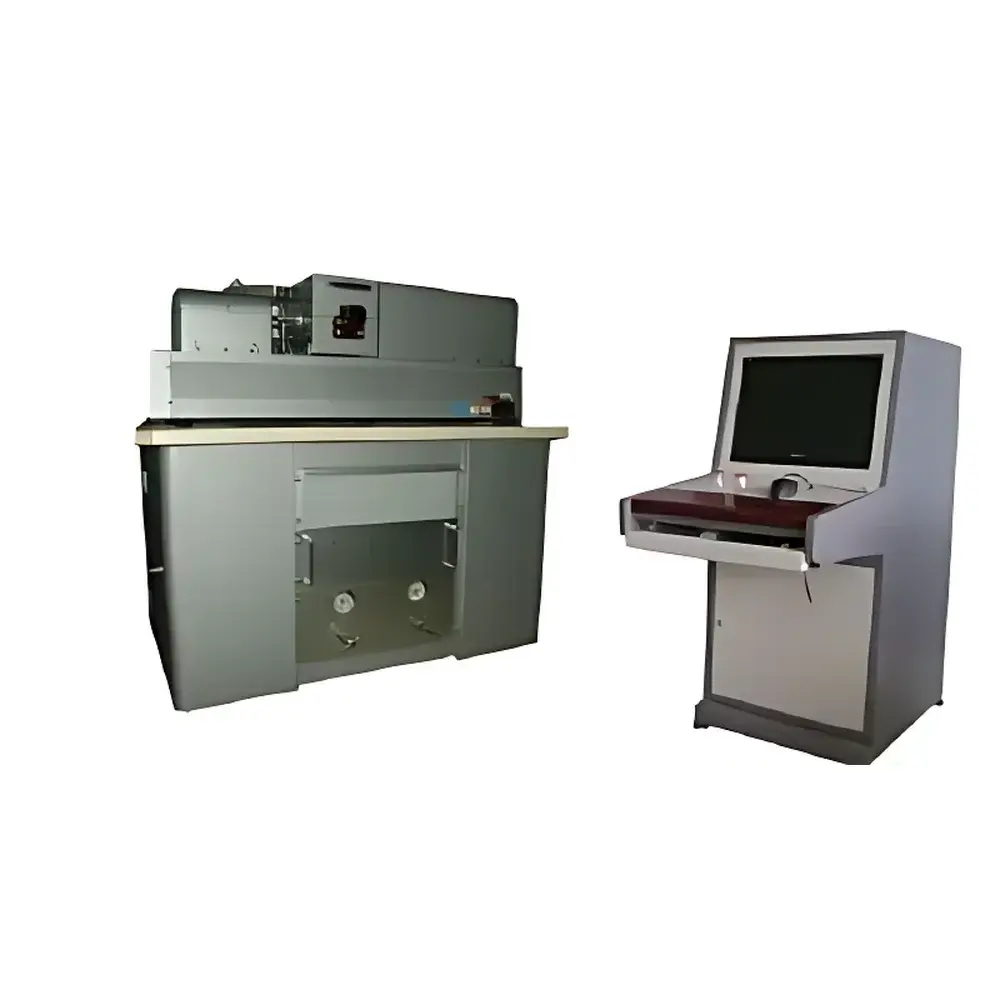
Dynamic Viscoelastic Spectrometer DDV-II
| Origin | Jilin, China |
|---|---|
| Manufacturer Type | Distributor |
| Origin Category | Domestic |
| Model | DDV-II |
| Pricing | Upon Request |
Overview
The Dynamic Viscoelastic Spectrometer DDV-II is a precision thermomechanical analyzer engineered for high-resolution dynamic mechanical thermal analysis (DMTA) of polymeric, elastomeric, and composite materials. Operating on the principle of forced oscillatory deformation under controlled temperature and frequency conditions, the system measures complex viscoelastic responses—including storage modulus (G′), loss modulus (G″), tan δ (damping factor), and phase angle—across a broad thermal and dynamic spectrum. Designed specifically for R&D laboratories focused on vibration damping, noise reduction, and structural integrity validation in automotive suspension components, aerospace composites, and advanced rubber formulations, the DDV-II delivers traceable, reproducible data aligned with ASTM D4065, ISO 6721, and ISO 11357 standards. Its modular architecture integrates electromagnetic actuation, cryogenic temperature control down to −120 °C, and real-time dual-channel force/displacement feedback—enabling rigorous characterization of time–temperature superposition behavior and glass transition dynamics.
Key Features
- Electromagnetic drive system with precise frequency control from 0.1 to 100 Hz, supporting both single-frequency sweeps and multi-harmonic excitation protocols
- Wide thermal operating range: −120 °C to +250 °C, achieved via integrated liquid nitrogen cooling and PID-regulated heating; programmable ramp rates of 0.5, 1, 2, and 3 °C/min
- High-stiffness horizontal frame with precision linear guideways, coaxial elastic support mounts, and rigid load train—minimizing parasitic compliance and ensuring mechanical stability during high-amplitude, low-frequency testing
- Dual-servo displacement control with ±1.5 mm stroke (amplitude-dependent, e.g., ±0.15 mm at 100 Hz), coupled with calibrated force sensing from ±10 g to ±5 kg full scale
- Comprehensive hardware protection suite: overload cutoff (force and amplitude), mechanical end-stop limits (left/right), over/under-voltage monitoring, and ground-fault interruption
- Modular electrical architecture including dedicated control cabinets for high-power actuation, temperature regulation, signal conditioning, and frequency synthesis—optimized for EMI resilience and long-term calibration stability
Sample Compatibility & Compliance
The DDV-II accommodates standard rectangular specimens measuring 70 × 10 × 5 mm³, compatible with ASTM D7028 and ISO 6721-4 specimen geometry requirements. It supports tension, compression, and shear modes through interchangeable fixtures, enabling evaluation of anisotropic composites and layered viscoelastic laminates. All thermal and mechanical calibrations are traceable to NIST-maintained reference standards. The system architecture conforms to GLP-compliant data integrity practices: audit trails, user access controls, and electronic signature readiness align with FDA 21 CFR Part 11 expectations when deployed in regulated quality assurance environments.
Software & Data Management
Controlled by EN-DDVIII-TEST—proprietary software developed in-house—the DDV-II provides synchronized acquisition of force, displacement, temperature, and phase data at up to 1 kHz sampling rate. The interface supports automated test sequencing (e.g., frequency sweeps at fixed T, temperature ramps at fixed ω), real-time Lissajous plotting, and automatic calculation of complex modulus components. Raw data export is available in ASCII (.txt) and HDF5 formats for third-party analysis (e.g., MATLAB, Python SciPy). Software modules include master curve construction using Williams–Landel–Ferry (WLF) fitting, relaxation spectrum deconvolution, and isoconversional activation energy estimation per ASTM E1641.
Applications
- Quantification of damping performance in automotive bushings, engine mounts, and NVH (noise, vibration, harshness) materials
- Characterization of polymer glass transitions, crystallinity effects, and crosslink density in thermosets and thermoplastics
- Thermo-rheological modeling of fiber-reinforced composites for aerospace structural health monitoring
- Accelerated aging studies via time–temperature superposition to predict long-term creep and stress relaxation behavior
- Quality control of production batches against modulus/tan δ specifications per internal material specifications or OEM engineering standards
FAQ
What temperature control method is used for sub-ambient operation?
Liquid nitrogen cooling integrated with a dual-zone environmental chamber enables stable operation from −120 °C to 250 °C.
Is the system compliant with FDA 21 CFR Part 11 for regulated labs?
Yes—the EN-DDVIII-TEST software supports electronic signatures, audit trails, and role-based access control when configured per GxP validation protocols.
Can the DDV-II perform multi-frequency testing within a single temperature step?
Yes, the frequency generator supports discrete or logarithmic sweeps across 0.1–100 Hz without interrupting thermal ramping.
What is the maximum allowable sample thickness deviation for valid modulus calculation?
Specimen thickness must be measured to ±0.02 mm using calibrated micrometers; deviations exceeding ±2% require recalibration of geometric correction factors.
Does the system provide raw analog output for integration with external DAQ systems?
Yes—dedicated BNC outputs deliver conditioned force, displacement, and temperature signals with 16-bit resolution and galvanic isolation.



