
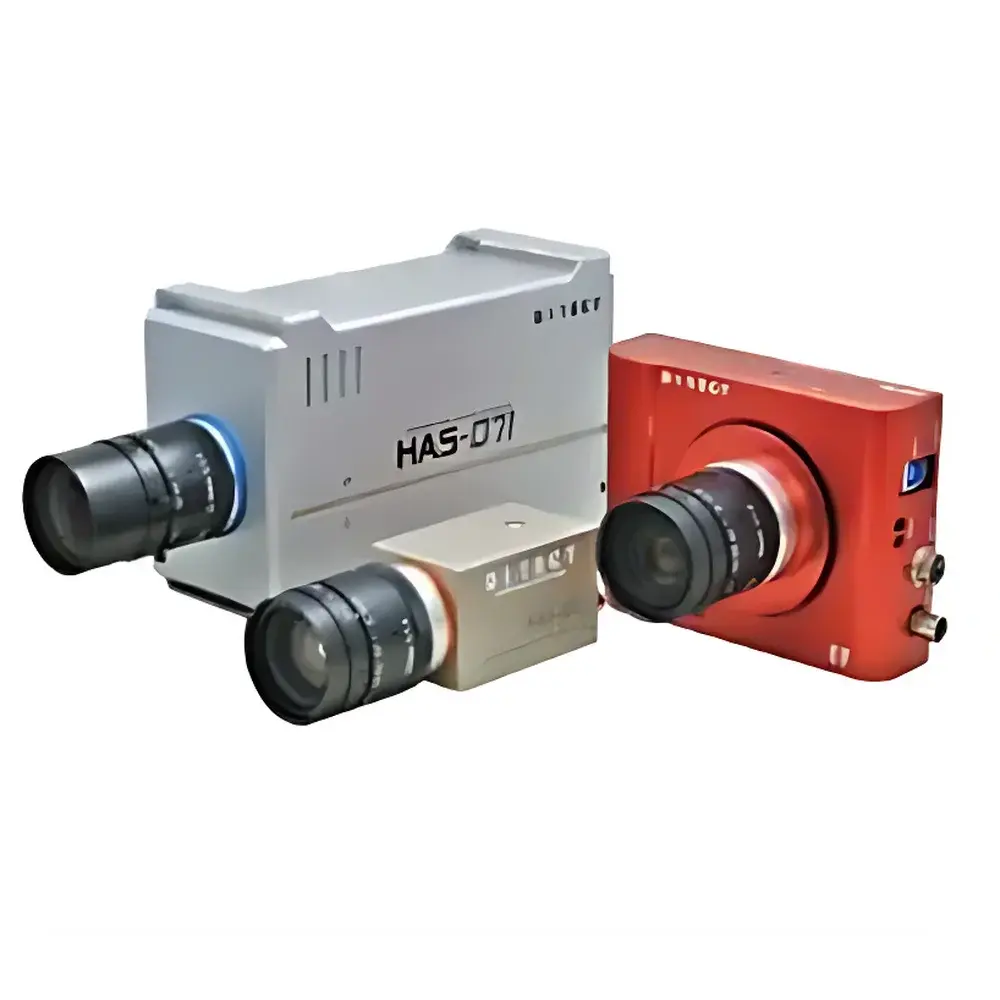
DITECT HAS Series High-Speed CMOS Camera
| Brand | DITECT |
|---|---|
| Origin | Japan |
| Manufacturer Type | Authorized Distributor |
| Origin Category | Imported |
| Model Series | HAS Series |
| Price Range | USD 7,000 – 14,000 (FOB Japan) |
| Pixel Size | 10.8 µm (standard configuration) |
| Max Frame Rate | 120,000 fps (at reduced ROI) |
| Min Frame Rate | 30 fps (full resolution) |
| Sensor Type | Global Shutter CMOS |
| Interface | Camera Link HS / CoaXPress 2.0 |
| Onboard Memory | Up to 64 GB DDR4 |
| Trigger Input/Output | TTL, LVDS, Optical Isolation Supported |
Overview
The DITECT HAS Series High-Speed CMOS Camera is an industrial-grade imaging platform engineered for quantitative motion analysis under transient, high-acceleration, or microsecond-scale dynamic conditions. Built around a high-sensitivity global shutter CMOS sensor with native 10.8 µm pixel pitch, the system delivers synchronized, distortion-free capture across a wide operational frame rate spectrum—from 30 fps at full sensor resolution (up to 2.3 MP) to 120,000 fps at region-of-interest (ROI) cropping. Its optical architecture supports C-mount and F-mount lens interfaces, enabling integration with standard macro, telecentric, or long-working-distance optics used in precision metrology and microfluidic observation. Designed for laboratory and production-floor deployment, the HAS Series adheres to IEC 60950-1 safety standards and meets IP40 environmental rating for controlled indoor environments.
Key Features
- Global shutter CMOS sensor with >70% quantum efficiency in visible to near-IR range (400–900 nm), minimizing motion blur during ultra-fast event capture.
- Configurable frame rates spanning six orders of magnitude—enabling both slow-motion documentation and shockwave propagation analysis without hardware reconfiguration.
- Dual high-bandwidth interfaces: Camera Link HS (for deterministic low-latency acquisition) and CoaXPress 2.0 (supporting up to 12.5 Gbps per lane), ensuring compatibility with real-time FPGA-based processing systems.
- Onboard 64 GB DDR4 memory buffer with lossless compression (optional) for sustained recording at >20,000 fps over multi-second durations—critical for capturing unpredictable transient phenomena.
- Hardware-level trigger synchronization with sub-microsecond jitter (<500 ns), supporting external event locking via TTL, LVDS, or optically isolated inputs for integration into multi-sensor test benches.
- Rugged aluminum chassis with passive thermal management; operating temperature range: 0–40 °C ambient, non-condensing.
Sample Compatibility & Compliance
The HAS Series accommodates diverse optical configurations—including collimated illumination paths for schlieren imaging, backlit setups for particle tracking velocimetry (PTV), and fluorescence-compatible excitation filters for bio-imaging applications. It complies with CE marking requirements (EMC Directive 2014/30/EU and Low Voltage Directive 2014/35/EU) and satisfies RoHS 3 (EU Directive 2015/863) material restrictions. For regulated industries, firmware supports time-stamped metadata embedding (ISO 8601 format), audit-ready logging of acquisition parameters, and optional NIST-traceable timing calibration reports—facilitating alignment with GLP and ISO/IEC 17025 quality frameworks.
Software & Data Management
DITECT provides the HAS Control Suite—a cross-platform (Windows/Linux) SDK supporting C/C++, Python (via ctypes bindings), and MATLAB APIs. The suite enables programmable control of exposure, gain, binning, ROI, and onboard memory allocation. Acquired sequences are saved in industry-standard formats: uncompressed TIFF stacks, HDF5 (with embedded metadata per frame), or segmented AVI (Motion JPEG 2000). All software modules support DICOM header extension for medical R&D use cases and include built-in tools for intensity profiling, centroid tracking, and temporal FFT analysis. Audit trail functionality logs user actions, parameter changes, and system events in encrypted SQLite databases—meeting FDA 21 CFR Part 11 requirements when deployed with validated IT infrastructure.
Applications
- Mechanical engineering: Impact deformation analysis, vibration mode identification, and valve actuation dynamics in hydraulic/pneumatic systems.
- Automated manufacturing: Real-time inspection of high-speed packaging lines, solder-joint formation during reflow, and robotic end-effector kinematics validation.
- Biomechanics & sports science: Gait cycle decomposition, tendon strain mapping, and sprint-start kinetics using markerless pose estimation pipelines.
- Microfluidics & lab-on-chip: Droplet generation frequency analysis, bubble coalescence dynamics, and electrophoretic mobility quantification.
- Academic R&D: Combustion flame front propagation, laser-induced breakdown spectroscopy (LIBS) plasma evolution, and MEMS resonator characterization.
FAQ
What is the minimum exposure time supported by the HAS Series?
The shortest controllable exposure duration is 100 ns, achievable in high-speed ROI modes with appropriate lighting synchronization.
Can the camera be operated in external trigger mode with variable inter-frame intervals?
Yes—hardware-triggered burst acquisition supports irregular timing patterns via programmable delay generators or TTL pulse trains with jitter <1 µs.
Is remote configuration and monitoring possible over Ethernet?
The HAS Series includes a Gigabit Ethernet port for web-based status monitoring, firmware updates, and basic parameter adjustment—though high-bandwidth image streaming requires Camera Link HS or CoaXPress.
Does DITECT provide calibration certificates for photometric or geometric accuracy?
NIST-traceable flat-field and temporal response calibration reports are available as optional add-ons, compliant with ISO 15739 and ISO 12232 standards.
How is data integrity ensured during extended continuous recording sessions?
The system implements cyclic redundancy checking (CRC-32) on all memory writes and includes automatic checksum verification upon file export—preventing silent corruption in long-duration datasets.




