
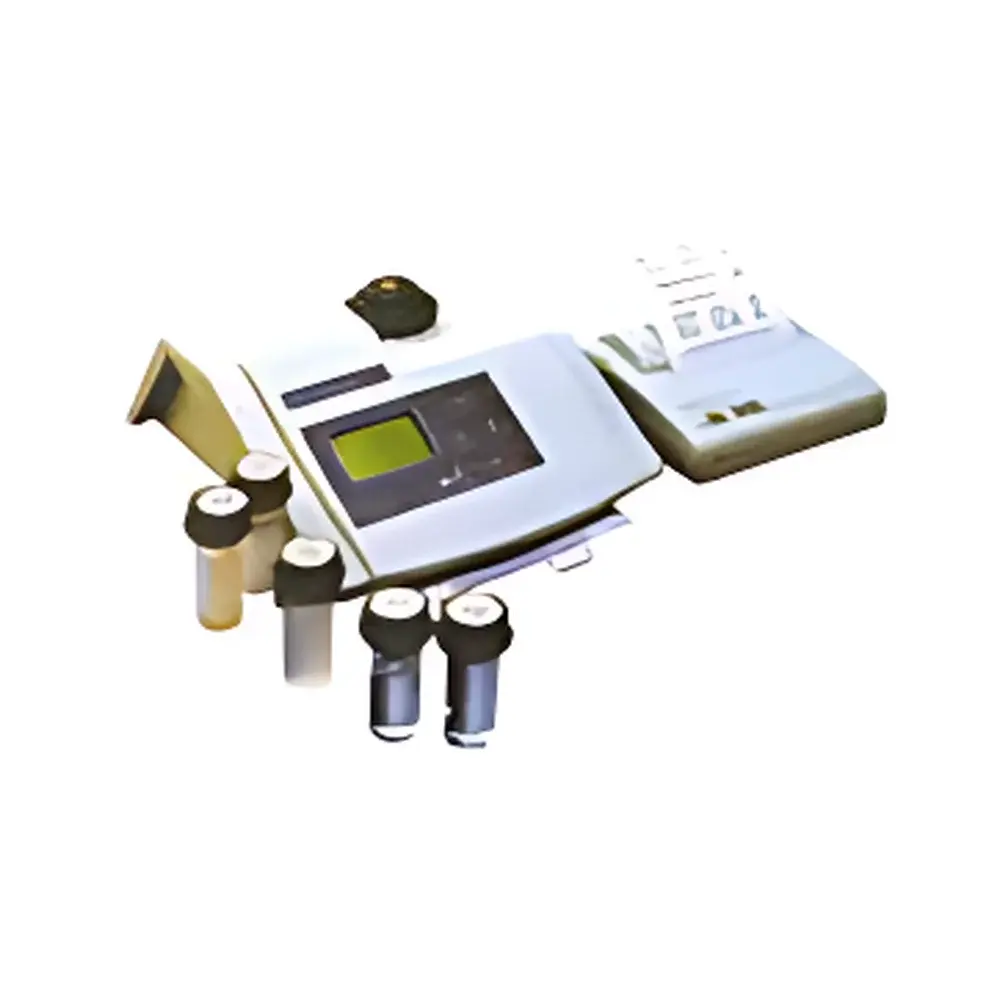
Merck Turb 550 Desktop Turbidimeter
| Origin | Germany |
|---|---|
| Manufacturer Type | Authorized Distributor |
| Origin Category | Imported |
| Pricing | Upon Request |
| Measurement Principle | 90° Nephelometric Scattering |
| Light Source | Tungsten Lamp (Turb 550) / Infrared LED (Turb 550 IR) |
| Range | 0.01–1000 NTU, Auto-ranging |
| Resolution | 0.01 NTU (0.00–9.99), 0.1 NTU (10.0–99.9), 1 NTU (100–1000) |
| Accuracy | ±2% of reading or ±0.01 NTU |
| Repeatability | <±1% of reading or ±0.01 NTU |
| Calibration | Auto 1–3-point with user-definable intervals |
| Response Time | 3 s |
| Display | Dual-line LCD with special character support |
| Sample Cell | 28 × 70 mm round glass vial |
| Sample Volume | 25 mL |
| Interface | RS232 serial output |
| Real-time Clock & Calendar | Integrated |
| GLP Compliance | Calibration due-date alert, operator ID logging, measurement timestamping |
| Dimensions (L×W×D) | 250 × 290 × 110 mm |
| Operating Temperature | 10–40 °C |
| Power Supply | 90–250 VAC via external transformer |
| Certifications | CE, UL, cUL, TÜV/GS |
| Standard Kit | Universal power adapter, three blank cuvettes, English operating manual, quick-reference guide |
Overview
The Merck Turb 550 Desktop Turbidimeter is an ISO 7027-compliant nephelometric instrument engineered for precise, traceable turbidity measurement in laboratory and quality control environments. It operates on the internationally standardized 90° scattered light detection principle—where incident light from a tungsten lamp (Turb 550) or infrared LED (Turb 550 IR) interacts with suspended particles in aqueous samples, generating scattered photons captured by a photodetector positioned at a right angle to the incident beam. This geometry minimizes interference from absorption and coloration, ensuring robust performance across diverse sample matrices—from potable water and pharmaceutical process streams to wastewater effluents and bioprocess broths. The instrument’s auto-ranging capability spans 0.01 to 1000 NTU without manual range selection, enabling seamless transition between ultra-low-turbidity applications (e.g., purified water per USP or EP 2.2.2) and high-solids industrial effluents.
Key Features
- ISO 7027-compliant 90° nephelometry with dual optical configurations: visible-light (tungsten) and infrared (IR) variants for optimized interference rejection in colored or absorbent samples
- Three-point automated calibration with programmable interval alerts—supporting GLP-mandated verification schedules and audit-ready calibration history
- Dual-line LCD display showing real-time measurement alongside previous result or reference value—facilitating rapid trend assessment and intra-batch comparison
- Integrated real-time clock with date/time stamping on every measurement record—essential for 21 CFR Part 11–compliant data integrity in regulated labs
- RS232 serial interface for direct connection to LIMS, ELN, or custom data acquisition systems—enabling automated report generation and centralized data archiving
- Rugged benchtop architecture with CE, UL, cUL, and TÜV/GS safety certifications—validated for continuous operation in ISO/IEC 17025-accredited testing laboratories
Sample Compatibility & Compliance
The Turb 550 accepts standard 28 × 70 mm round glass cuvettes with a nominal 25 mL fill volume, compatible with both method-defined blanks and sample-specific matrix-matched standards. Its optical design accommodates mildly turbid, colored, or temperature-variable samples (10–40 °C ambient operating range) without drift-induced error. The instrument complies with ASTM D6508, ISO 7027-1:2016, and EN ISO 7027-1, and supports validation protocols aligned with USP , EP 2.2.2, and APHA Standard Methods 2130 B. All calibration events—including date, operator ID, standard values used, and deviation metrics—are stored internally and exportable via RS232, satisfying GLP documentation requirements and facilitating internal audits or regulatory inspections.
Software & Data Management
While the Turb 550 operates as a standalone instrument, its RS232 interface enables bidirectional communication with third-party software platforms. Raw measurement data—including NTU value, timestamp, calibration status flag, and cuvette ID (if encoded)—is transmitted in ASCII format with configurable baud rate and parity. When integrated into a validated laboratory network, the device contributes to full electronic record traceability under FDA 21 CFR Part 11, including operator authentication, audit trail generation, and immutable data storage. Optional PC-based utilities (available through Merck-certified distributors) provide batch reporting, statistical process control (SPC) charting, and PDF certificate generation compliant with ISO/IEC 17025 clause 7.8.
Applications
- Drinking water and wastewater treatment plants performing routine compliance monitoring per EPA Method 180.1 or ISO 7027
- Pharmaceutical manufacturing units verifying clarity of Water for Injection (WFI) and Purified Water (PW) per USP and EU GMP Annex 1
- Food & beverage QA labs assessing suspension stability in juices, dairy products, and brewing intermediates
- Academic and contract research laboratories conducting colloid stability studies, flocculation kinetics, or filtration efficiency validation
- Environmental testing facilities analyzing sediment-laden surface waters and stormwater runoff
FAQ
Does the Turb 550 require annual factory recalibration?
No—routine user-performed 1–3 point calibration using NIST-traceable formazin or polymer standards satisfies ISO/IEC 17025 and pharmacopeial requirements. Annual verification by an accredited service provider is recommended but not mandatory unless specified by internal SOPs.
Can the instrument store measurement history internally?
It retains the most recent measurement and calibration timestamps locally, but long-term data logging requires external capture via RS232; no onboard memory for historical datasets is provided.
Is the IR variant (Turb 550 IR) suitable for yellow-colored samples?
Yes—the 850 nm infrared LED minimizes absorbance-related bias in samples with chromophores absorbing visible light, delivering improved accuracy for tea-colored waters, humic-rich groundwater, or certain fermentation broths.
What GLP functions are embedded in the firmware?
Calibration due-date prompting, operator ID entry (via keypad), automatic timestamping, and pass/fail indication against user-defined limits—all logged in non-volatile memory and exportable for audit review.
Are replacement cuvettes supplied with certified tolerance specifications?
Yes—Merck-certified 28 × 70 mm glass cuvettes (Cat. No. 1.09227.0001) are supplied with individual tolerance certificates (±0.002 NTU path-length consistency) and are required for metrological traceability.





