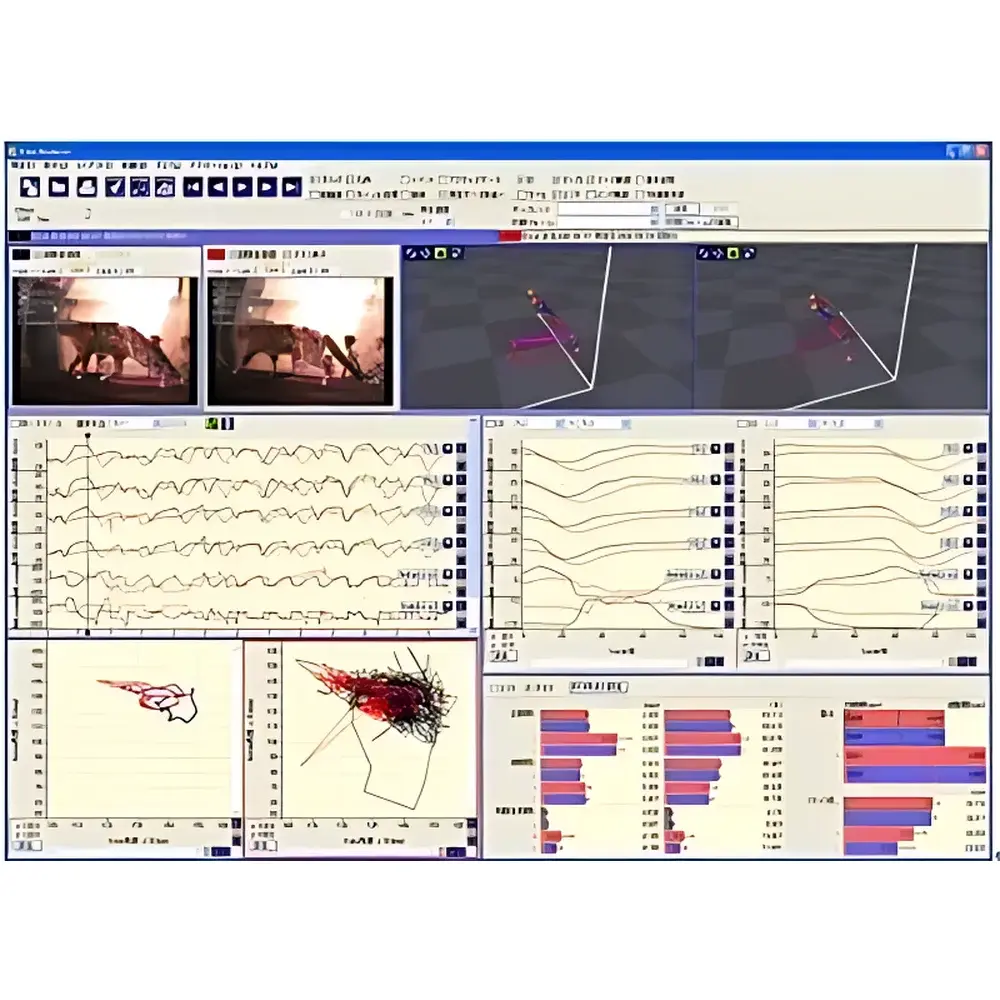
Kissei Kinema Tracer 3D Animal Gait Analysis System
| Brand | KISSEI |
|---|---|
| Origin | Japan |
| Manufacturer Type | Authorized Distributor |
| Import Status | Imported |
| Model | Kinema Tracer |
| Pricing | Upon Request |
Overview
The Kissei Kinema Tracer 3D Animal Gait Analysis System is a high-precision, marker-based motion capture platform engineered for quantitative biomechanical assessment of locomotion in preclinical rodent and feline models. Utilizing synchronized stereo-vision principles with calibrated dual- or quad-camera arrays (IEEE 1394/FireWire interface), the system reconstructs three-dimensional kinematic trajectories via Direct Linear Transformation (DLT) and modified DLT algorithms—incorporating lens distortion correction to ensure geometric fidelity across the capture volume. Designed explicitly for translational neuroscience and musculoskeletal research, it delivers objective, repeatable gait metrics without requiring specialized walkways or external synchronization hardware. Its non-invasive, marker-based architecture enables longitudinal monitoring of dynamic motor function in models of spinal cord injury, Parkinson’s disease, peripheral neuropathy, orthopedic impairment, and neurodegenerative disorders—supporting both exploratory phenotyping and therapeutic intervention studies.
Key Features
- Compact FireWire camera architecture: Four (or optionally two) VGA-resolution (640 × 480) cameras operating at 60 Hz native frame rate—enabling high-temporal-resolution capture without external sync generators.
- Automated marker detection and tracking: Spherical, color-coded passive markers are identified in real time; system supports multi-marker auto-tracking, reverse auto-tracking, position prediction, and intelligent gap-filling via cubic spline interpolation.
- Comprehensive 3D kinematic computation: Outputs full XYZ spatial coordinates, linear velocity and acceleration vectors, joint angles (e.g., hip, knee, ankle), angular velocities, and angular accelerations—calculated per anatomical segment using user-defined coordinate systems.
- Modular software architecture: All analysis modules—including temporal-spatial parameter extraction, statistical normalization, and visualization—are decoupled and configurable via XML-based templates, ensuring auditability and protocol reproducibility.
- Hardware-agnostic calibration workflow: Implements DLT-based volumetric calibration with integrated lens distortion modeling—validated against known physical reference frames to maintain sub-pixel spatial accuracy across the working volume.
Sample Compatibility & Compliance
The Kinema Tracer accommodates a wide range of small-animal subjects—including rats, mice, and domestic cats—through scalable marker placement protocols and adjustable color-threshold segmentation. Marker size, hue, and luminance thresholds are user-configurable to accommodate fur pigmentation, lighting variability, and subject size. The system complies with ISO/IEC 17025 requirements for measurement traceability in preclinical instrumentation and supports GLP-compliant data integrity through immutable raw video archiving, timestamped metadata logging, and version-controlled analysis pipelines. While not FDA-cleared for human diagnostic use, its analytical framework aligns with ASTM F3022–17 (Standard Guide for Gait Analysis in Rodent Models) and NIH behavioral assay reporting standards.
Software & Data Management
The Kinema Tracer software suite provides end-to-end data handling—from acquisition to publication-ready output. All processed data (kinematic time-series, statistical summaries, normalized gait cycles) are stored in HDF5 format with embedded metadata (camera parameters, calibration residuals, subject ID, session timestamp). Reporting is fully customizable: users define report structure, layout, and content via drag-and-drop template editors—supporting inclusion of synchronized video playback windows, stick-figure animations, Lissajou plots, time-series overlays, and normalized stride diagrams. Export options include CSV (for SPSS/R/MATLAB integration), PDF (with embedded vector graphics), and PNG/TIFF (publication-grade raster output). Audit trails record all processing steps—including manual corrections, interpolation events, and parameter adjustments—ensuring full traceability per ALF/AAALAC and institutional IACUC requirements.
Applications
- Quantification of gait deficits in spinal cord injury models—measuring stance/swing phase asymmetry, interlimb coordination loss, and weight-bearing redistribution.
- Longitudinal evaluation of dopaminergic degeneration in MPTP- or 6-OHDA-treated rodents—tracking progressive reductions in stride length, swing velocity, and cadence regularity.
- Assessment of peripheral nerve regeneration following sciatic crush—monitoring recovery of double-support duration, paw placement precision, and joint angle range-of-motion.
- Orthopedic intervention studies—including post-fracture rehabilitation, arthroplasty outcomes, and anti-inflammatory drug efficacy—via standardized temporal-spatial parameter sets aligned with published rodent gait ontologies.
- Validation of novel neuromodulation devices (e.g., epidural stimulators, closed-loop DBS) by correlating electrophysiological signals with real-time kinematic outputs.
FAQ
What camera interface does the Kinema Tracer use?
The system employs IEEE 1394a (FireWire 400) digital video interface—ensuring deterministic low-latency transmission and plug-and-play enumeration under Windows-based host PCs.
Is calibration required before each session?
A full volumetric calibration is performed once per experimental setup; subsequent sessions require only verification checks using a reference wand—reducing daily setup time to under 90 seconds.
Can the software export data compatible with MATLAB or Python?
Yes—raw and processed kinematic data are exported in CSV and HDF5 formats with column headers compliant with SciPy and Pandas conventions, including sample-rate metadata and coordinate system definitions.
Does the system support automated detection of gait events (e.g., initial contact, toe-off)?
Yes—event detection is algorithmically derived from vertical ground reaction force proxies (via foot trajectory curvature and Z-axis velocity zero-crossings), with manual override and refinement tools available for edge-case validation.
Is the Kinema Tracer validated for use in regulatory submissions?
While the system itself is not CE-marked or FDA-listed, its analytical outputs have been cited in peer-reviewed publications supporting IND-enabling toxicology and pharmacodynamics studies—and its data management features meet ALF and AAALAC documentation standards for preclinical research.