
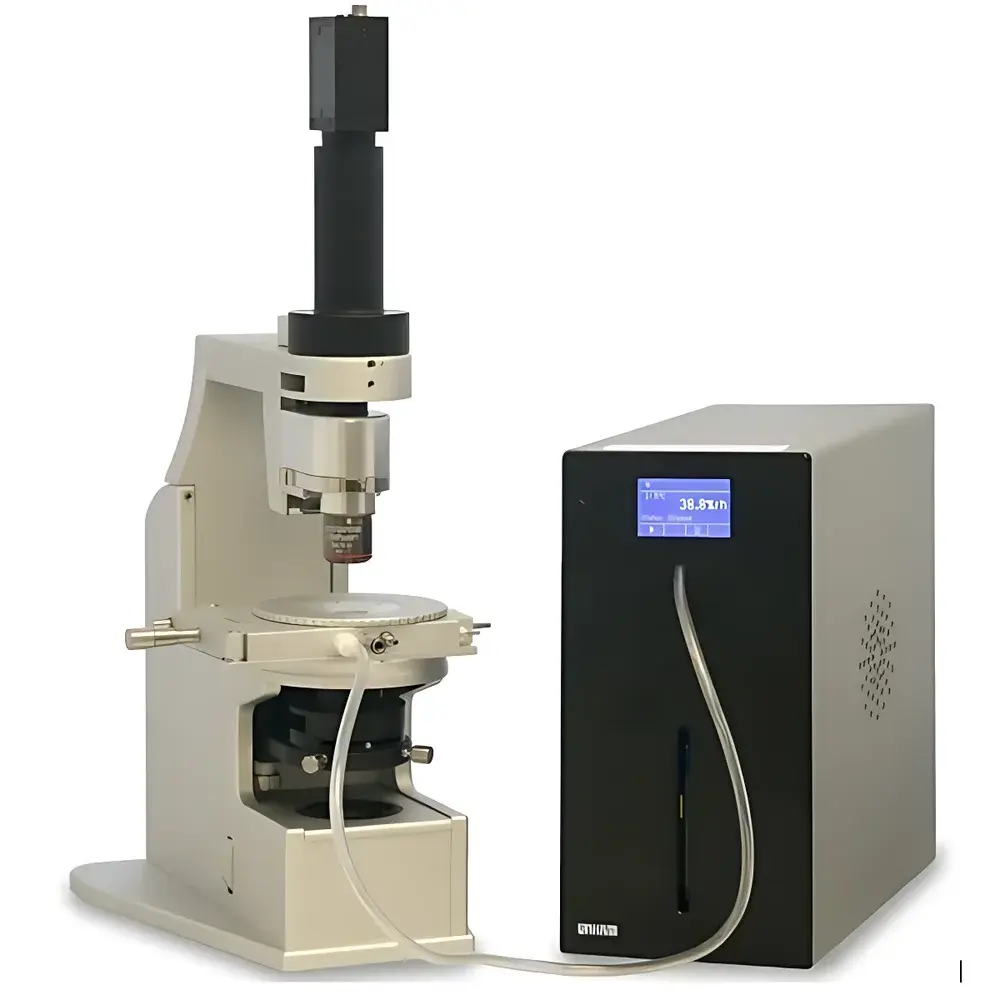
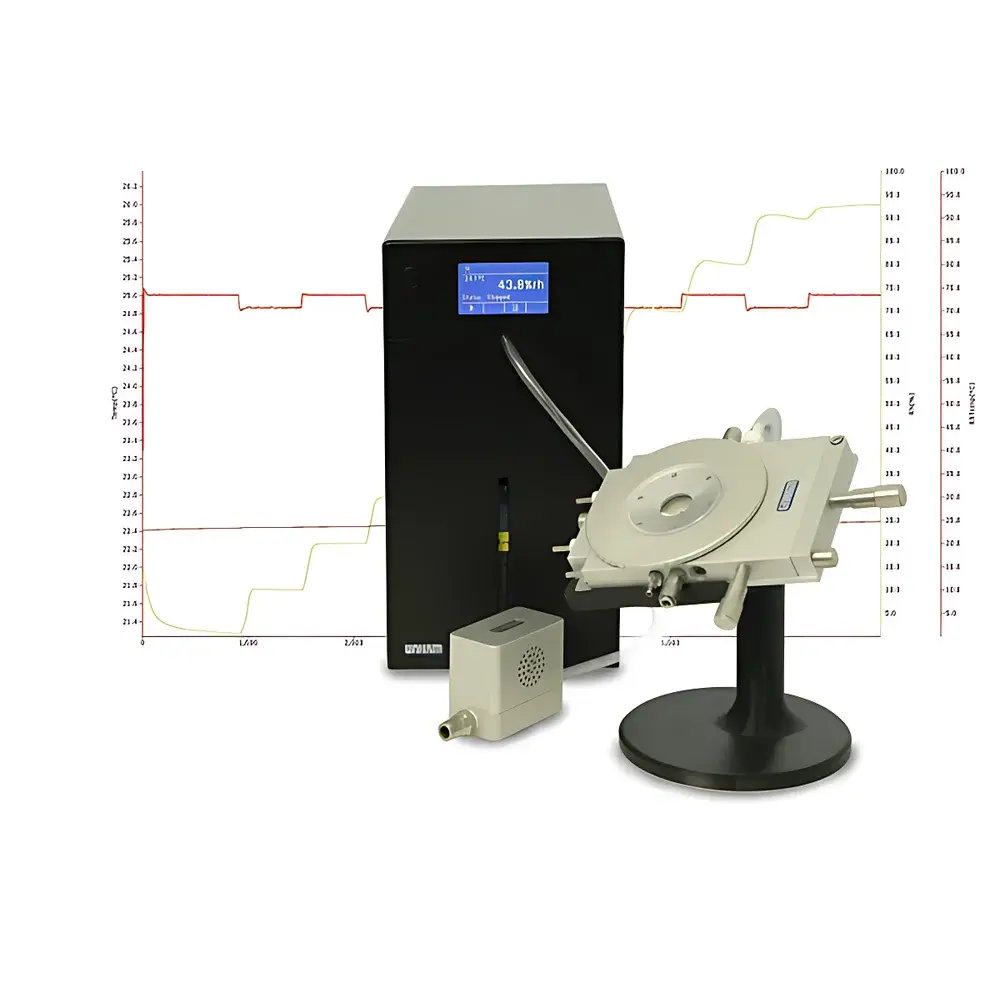
Linkam RH95 Humidity-Controlled Heating and Cooling Stage
| Brand | Linkam |
|---|---|
| Origin | United Kingdom |
| Model | RH95 |
| Compatible Stages | THMSG600, MFS, LTS420, HFS600 |
| Max Controlled Volume | 2000 cm³ |
| RH Range | 5–90% RH |
| RH Stability | ±0.5% RH at setpoint |
| RH Ramp Rate | ~7% RH/min |
| Sensor Response Time | ~8 s |
| Sensor Type | Integrated Digital Capacitive T/RH Sensor |
| Inert Gas Input | Up to 5 bar (optional regulator module) |
Overview
The Linkam RH95 is a precision-engineered humidity-controlled heating and cooling stage designed for integration with optical microscopes—particularly polarizing and transmitted-light systems—where simultaneous, dynamic control of temperature, relative humidity (RH), and atmospheric composition is critical to material behavior analysis. Unlike standalone environmental chambers, the RH95 employs a closed-loop capacitive sensing architecture coupled with active vapor generation and inert gas purging to maintain high-fidelity RH conditions directly within the microscope’s observation volume. Its operation is grounded in gravimetrically calibrated salt-saturated humidity standards and real-time digital feedback, enabling stable, traceable RH environments from 5% to 90% RH across temperatures ranging from –196 °C to +600 °C (when paired with compatible Linkam stages such as the THMSG600 or LTS420). This makes it indispensable for studies involving hygroscopic phase transitions, crystal hydration/dehydration kinetics, polymer moisture sorption, and geological fluid inclusion behavior under controlled thermo-hygrometric stress.
Key Features
- Integrated dual-parameter digital capacitive sensor for simultaneous, high-resolution temperature and relative humidity measurement with ±0.5% RH stability at setpoint
- Touchscreen interface for direct RH setpoint entry, real-time monitoring, and manual override—no external PC required for basic operation
- Modular design supporting stand-alone use or full synchronization with Linkam’s LINK software for time-stamped data logging, multi-channel correlation (e.g., RH + stage temperature + camera trigger), and automated protocol execution
- Validated sensor calibration chamber included, supplied with NIST-traceable salt ampoules (e.g., LiCl, MgCl₂, NaCl, KCl) for on-site verification per ISO 8503-2 and ASTM E2067 practices
- Optional sensor regeneration module enables periodic recovery of sensor performance after prolonged exposure to condensing or contaminant-rich atmospheres
- Optional inert gas regulator module supports nitrogen or argon carrier gas delivery at up to 5 bar inlet pressure—essential for oxygen-sensitive samples or dew-point suppression in low-RH regimes
- Maximum controllable sample volume of 2000 cm³ ensures compatibility with standard microscope stages and large-area sample holders while maintaining uniform RH distribution
Sample Compatibility & Compliance
The RH95 is optimized for use with Linkam’s modular cold/hot stages—including the THMSG600 (heating/cooling/vacuum), MFS (magnetic field stage), LTS420 (liquid nitrogen cooling), and HFS600 (high-temperature furnace)—enabling seamless co-control of thermal, magnetic, and hygrometric parameters. Its sealed, chemically inert internal pathway accommodates samples in standard microscope slides, capillaries, custom gaskets, or environmental cells without cross-contamination. The system complies with GLP-aligned operational documentation requirements; LINK software optionally supports 21 CFR Part 11-compliant audit trails, electronic signatures, and secure user access levels when deployed in regulated QC/QA laboratories. All humidity control logic adheres to ISO 12238 (hygrometry) and supports traceability via embedded calibration logs and salt validation records.
Software & Data Management
When operated with Linkam LINK software (v4.0+), the RH95 delivers synchronized, multi-parameter acquisition—including RH, stage temperature, ramp rates, and external device triggers (e.g., camera exposure, spectroscopic readouts). Data are stored in open CSV and HDF5 formats, facilitating post-acquisition analysis in MATLAB, Python (Pandas/H5Py), or industry-standard LIMS platforms. The software includes preconfigured humidity ramp profiles (e.g., stepwise hydration, cyclic drying–rehydration), alarm thresholds with email/SNMP notification, and exportable compliance reports containing sensor drift history, validation timestamps, and environmental deviation summaries. All logged data retain embedded metadata: operator ID, instrument serial number, firmware version, and calibration certificate expiry dates.
Applications
- Real-time observation of hydrate formation and dissociation in pharmaceutical APIs during hot-stage microscopy
- In situ characterization of clay swelling, shale diagenesis, and pore-fluid migration under geologically relevant RH–T paths
- Moisture-induced cracking and interfacial delamination in thin-film coatings and encapsulated optoelectronic devices
- Hygroscopicity mapping of battery electrode materials using polarized light contrast under controlled ambient aging
- Validation of desiccant performance and packaging barrier integrity via dynamic water vapor transmission rate (WVTR) assays
- Fundamental studies of ice nucleation kinetics in supercooled aqueous aerosols under precisely defined supersaturation conditions
FAQ
Can the RH95 operate independently of a Linkam temperature stage?
Yes—the RH95 functions as a stand-alone humidity generator and controller. However, precise RH control at non-ambient temperatures requires coupling with a thermally regulated stage to prevent condensation or thermal gradient-induced RH drift.
Is the RH sensor factory-calibrated and user-verifiable?
Yes. Each sensor ships with a calibration certificate traceable to UKAS-accredited standards. Users perform routine verification using the supplied salt ampoule kit in the dedicated validation chamber—procedures align with ISO 8503-2 Annex B.
What inert gases are supported, and how is flow regulated?
Nitrogen and argon are routinely used. The optional Inert Gas Regulator module provides fine pressure control (0–5 bar input) and integrates seamlessly with LINK software for coordinated gas flow–RH ramp sequences.
Does the RH95 support automated long-term experiments?
Yes. With LINK software scheduling and uninterruptible power supply (UPS) integration, the system supports unattended operation for weeks—validated by >30-day continuous RH stability logs under GMP pilot studies.
How is sensor drift mitigated during extended use?
The optional Sensor Regeneration Module applies controlled thermal–vacuum treatment to restore baseline capacitance response, extending functional sensor lifetime beyond 18 months in high-cycle applications.





