
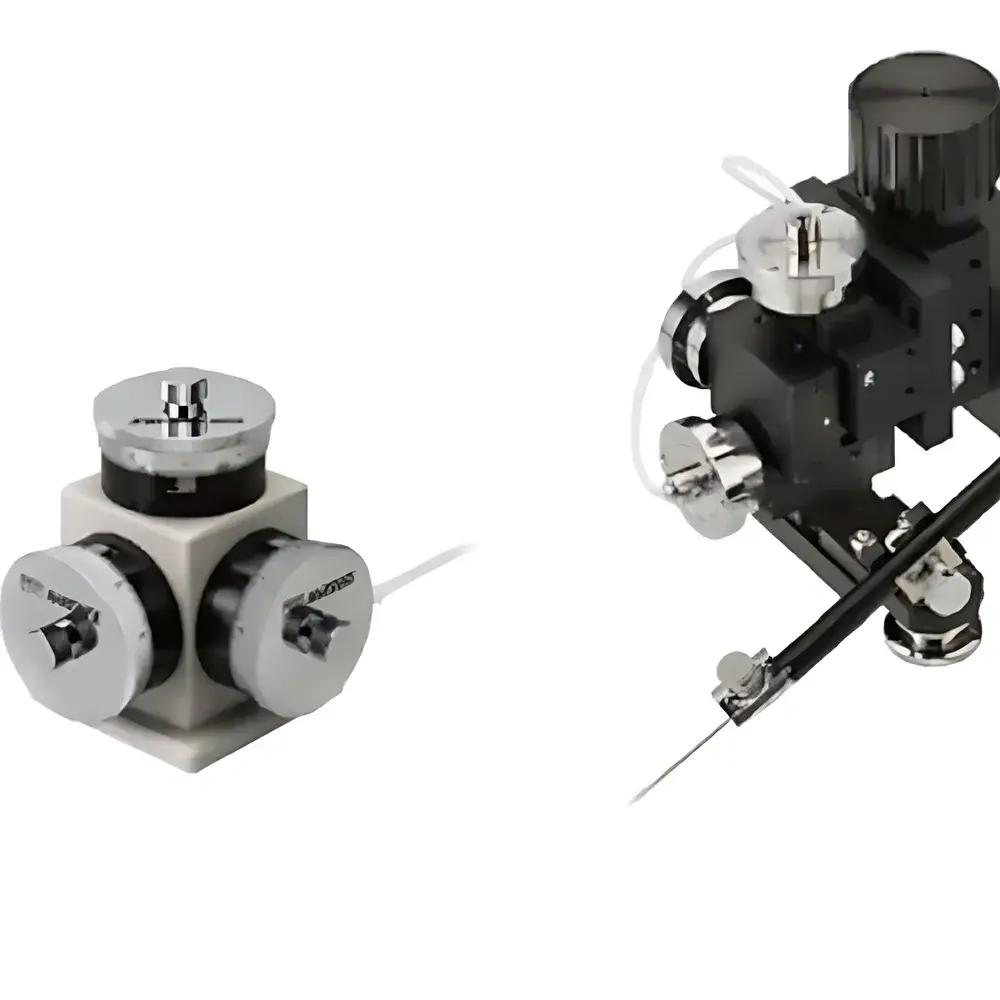
Narishige MHW-3 Three-Axis Hydraulic Micromanipulator
| Brand | Narishige |
|---|---|
| Origin | Japan |
| Model | MHW-3 |
| Drive Principle | Hydraulic (Water-Based) |
| Coefficient of Thermal Expansion | Lower than oil-based systems |
| Integrated Reservoir Ratio | 5:1 |
| Coarse Travel Range (X/Y/Z) | 30 mm each axis |
| Fine Travel Range (X/Y/Z) | 2 mm each axis |
| Fine Adjustment Resolution | 0.2 µm per step |
| Full Rotation of Fine Knob | 50 µm |
| Minimum Increment | 0.2 µm |
| Ball-and-Socket Joint | B-9 included |
| Electrode Holder | H-12 included |
| Control Unit Dimensions | 115 × 115 × 132 mm, 1.6 kg |
| Drive Unit Dimensions | 155 × 155 × 100 mm, 0.9 kg |
| Hydraulic Tubing Length | 0.9 m |
| Compatibility | Compatible with UST-1 universal tilt adapter, NR-35 rotary clamp, MHW-A tilt adapter, and B-9 spherical joint |
Overview
The Narishige MHW-3 is a precision-engineered three-axis hydraulic micromanipulator designed specifically for demanding electrophysiological applications—particularly patch-clamp recording, intracellular injection, and single-cell manipulation in live-tissue preparations. Unlike pneumatic or motorized alternatives, the MHW-3 employs a water-based hydraulic actuation system, leveraging water’s significantly lower coefficient of thermal expansion compared to silicone oil. This intrinsic material property minimizes thermally induced drift during extended recordings—critical for sub-micron positional stability over hours-long experiments. Its dual-stage architecture integrates a rigid coarse drive unit (30 mm travel per axis) with a high-resolution fine drive mechanism (2 mm range, 0.2 µm minimum step), both mechanically decoupled via a robust ball-and-socket joint (B-9) and isolated mounting interfaces. The system’s structural rigidity is further enhanced by a large-diameter drum-style control unit featuring oversized ergonomic knobs, delivering high linearity and repeatable displacement across all three orthogonal axes (X, Y, Z).
Key Features
- Water-hydraulic actuation ensures superior thermal stability and minimal long-term drift—essential for high-fidelity patch-clamp seal formation and maintenance.
- Integrated 5:1 reservoir ratio optimizes pressure transmission efficiency while dampening mechanical oscillations and operator-induced tremor.
- Dual-range motion control: coarse adjustment (30 mm/axis) for rapid positioning; fine adjustment (2 mm/axis, 0.2 µm resolution) for subcellular targeting.
- Rigid aluminum alloy drive unit with reinforced spherical joint interface (B-9) enables precise angular alignment without compromising mechanical hysteresis.
- Modular attachment design supports isolation from vibration sources—compatible with anti-vibration tables and double-isolation platforms via optional dual-adapter mounts.
- Ergonomic drum-style control unit (115 × 115 × 132 mm, 1.6 kg) provides tactile feedback and consistent torque response across full knob rotation (50 µm per revolution).
Sample Compatibility & Compliance
The MHW-3 is routinely deployed in GLP- and GMP-aligned neurophysiology labs where traceability and mechanical reproducibility are mandated. Its hydraulic architecture avoids volatile organic fluids, eliminating contamination risk in sterile or low-particulate environments (e.g., cleanroom-based brain slice facilities). While not a regulated medical device, its mechanical specifications align with ISO 13485–informed laboratory equipment validation protocols. The system supports standard 1.2 mm OD glass micropipettes (via H-12 holder) and integrates seamlessly with commercial patch-clamp amplifiers (e.g., Axon Instruments, HEKA), digitizers (e.g., National Instruments USB-6363), and microscope stages compliant with DIN 29700 optical rail standards. All metallic components undergo anodized surface treatment for corrosion resistance in humid physiological saline environments.
Software & Data Management
The MHW-3 operates as a fully manual, analog-positioning instrument—intentionally omitting digital encoders or firmware to maximize signal integrity and eliminate electromagnetic interference near low-noise amplifier inputs. Consequently, it requires no driver installation, firmware updates, or software licensing. Positional metadata must be recorded manually or synchronized externally via third-party motion-tracking systems (e.g., uManager + MicroManager with custom stage-plugin integration). For laboratories requiring audit trails under FDA 21 CFR Part 11, position logs can be captured through time-stamped video microscopy (e.g., Hamamatsu ORCA-Fusion BT) or integrated with LabArchives ELN using timestamped annotation overlays. Calibration certificates for mechanical resolution (0.2 µm step verification) are available upon request and conform to ISO/IEC 17025-accredited metrology practices.
Applications
- Whole-cell and cell-attached patch-clamp recordings in acute brain slices, cultured neurons, and retinal explants.
- Precision microinjection of dyes (e.g., Alexa Fluor conjugates), CRISPR ribonucleoproteins, or mRNA into oocytes and early embryos.
- Targeted ablation or stimulation using infrared laser-coupled electrodes guided by real-time MHW-3 positioning.
- Four-dimensional manipulation (XYZ + diagonal tilt) achieved via modular add-ons: UST-1 universal tilt adapter, MHW-A inclination module, or NR-35 rotary clamp for electrode retraction and sample exchange.
- Combined use with upright or inverted fixed-stage microscopes equipped with motorized focus drives—enabling coordinated Z-axis compensation during deep-tissue penetration.
FAQ
Is the MHW-3 compatible with inverted microscopes?
Yes—the compact drive unit footprint (155 × 155 × 100 mm) and flexible mounting options (including vertical orientation kits) allow integration beneath most inverted microscope stages without obstructing objective clearance.
Can I achieve sub-micron repeatability over multi-hour sessions?
Yes—water-based hydraulics combined with the 5:1 reservoir ratio reduce thermal drift to <0.5 µm/hour under controlled ambient conditions (±0.5°C), verified per ASTM E2554 statistical process control guidelines.
What maintenance does the hydraulic system require?
Annual replacement of deionized water in the reservoir and inspection of O-rings on hydraulic couplings is recommended; no lubrication or recalibration is required between service intervals.
Does Narishige provide calibration documentation?
Yes—traceable mechanical calibration reports (including step-resolution verification at 0.2 µm and linearity assessment per ISO 230-2 Annex B) are issued with each unit or available as a post-purchase service.
How is vibration isolation implemented?
The MHW-3 lacks built-in active damping but is engineered for passive isolation—mounting via dual-interface adapters (e.g., B-9 + UST-1) onto granite optical tables or pneumatic isolation platforms meeting ISO 2631-2 vibration transmissibility thresholds.



