Leica DM6 B Fully Automated Research-Grade Upright Microscope
| Brand | Leica |
|---|---|
| Origin | Germany |
| Model | DM6 B |
| Microscope Type | Upright |
| Camera Port Diameter | 19 mm |
| Illumination Options | Halogen and LED |
| Objective Compatibility | >300 High-Performance Objectives Including 1.25× Overview Lens |
| Automation Level | Full Motorized Control (Focus, Filter Turret, Condenser, Illumination Intensity, Contrast Mode) |
| Software Platform | LAS X Navigator |
| Compliance | Designed for GLP/GMP-aligned workflows |
| Imaging Interface | Native sCMOS integration (e.g., Leica DFC9000), optimized for high-dynamic-range, low-noise acquisition |
Overview
The Leica DM6 B is a fully motorized upright research-grade microscope engineered for reproducible, high-fidelity imaging in life science laboratories conducting advanced cell biology, histopathology, neuroscience, and in vivo tissue analysis. Built on Leica’s proven optical architecture, it implements precision Köhler illumination, infinity-corrected optics, and modular contrast mechanisms—including brightfield, phase contrast, differential interference contrast (DIC), and fluorescence—within a single platform. Its core design philosophy centers on workflow integrity: reducing manual intervention without compromising optical fidelity or experimental traceability. The system integrates seamlessly with modern digital imaging pipelines, supporting quantitative image analysis, multi-position tile scanning, and time-lapse acquisition—all under centralized software control. As an import-class instrument manufactured in Wetzlar, Germany, the DM6 B adheres to ISO 9001-certified production standards and meets CE marking requirements for laboratory instrumentation in the European Economic Area and globally recognized regulatory frameworks.
Key Features
- Fully automated optical train: motorized focus, nosepiece, filter turret, condenser height, and aperture diaphragm enable repeatable alignment across users and sessions.
- 19-mm field-of-view camera port engineered for optimal fill factor with industry-standard sCMOS sensors (e.g., Leica DFC9000), minimizing vignetting and maximizing signal-to-noise ratio in wide-field acquisition.
- Intelligent illumination management: Fluorescence Intensity Manager (FIM) and Excitation Manager (ExMan) dynamically adjust lamp power and filter exposure to maintain consistent photon flux—critical for longitudinal studies and comparative quantification.
- Köhler illumination auto-alignment routine ensures rapid, operator-independent setup of critical illumination parameters per objective, reducing setup variability in multi-user environments.
- Modular contrast flexibility: interchangeable contrast modules allow seamless switching between BF, PH, DIC, and fluorescence without realignment—ideal for correlative multimodal imaging.
- One-touch workflow presets: save and recall complete configurations—including magnification, contrast mode, illumination intensity, and camera settings—for standardized acquisition across experiments and personnel.
Sample Compatibility & Compliance
The DM6 B accommodates standard glass slides (26 × 76 mm), petri dishes (up to 100 mm diameter), and multi-well plates (6–96-well formats) via optional stage adapters. Its mechanical stage offers 76 × 52 mm travel range with sub-micron repeatability, enabling precise navigation during large-area mosaic acquisition. All optical components are certified free of lead and cadmium per RoHS Directive 2011/65/EU. For regulated environments, LAS X Navigator supports 21 CFR Part 11-compliant electronic signatures, role-based access control, and immutable audit trails—including timestamps for every hardware adjustment and image acquisition event. The system is routinely validated for use in GLP-compliant histology labs and ISO 13485-aligned IVD development workflows.
Software & Data Management
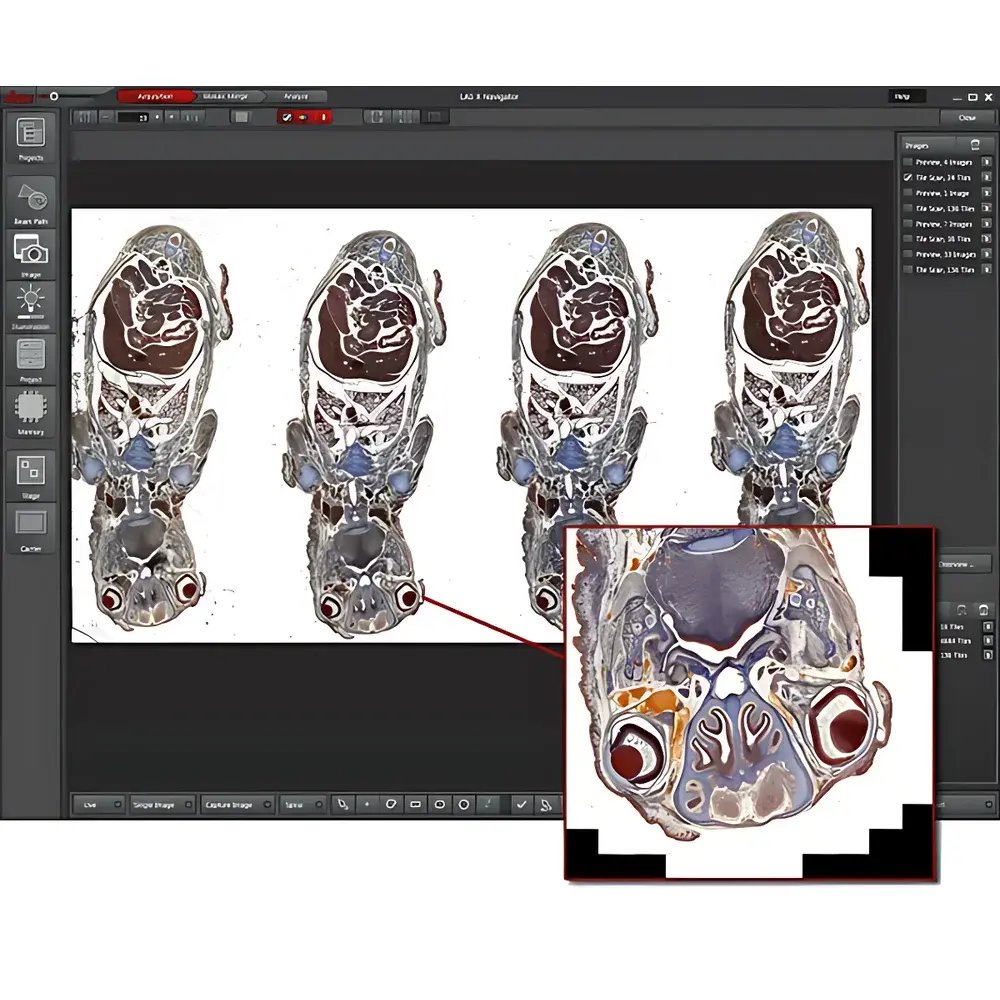
LAS X Navigator serves as the unified interface for instrument control, image acquisition, and metadata-rich data curation. It enables automatic generation of overview maps (macro-stitching) at low magnification followed by targeted high-resolution imaging of regions of interest—eliminating manual stage repositioning. All acquired images embed EXIF-like metadata (objective ID, exposure time, gain, illumination mode, z-stack position), ensuring full experimental provenance. Data export supports TIFF (uncompressed), OME-TIFF (for multidimensional compatibility), and HDF5 (for AI-ready volumetric datasets). Integration with third-party analysis platforms—including Imaris, HALO, and Python-based scikit-image pipelines—is supported via open API and standardized file formats.
Applications
- High-content screening in drug discovery: automated multi-field acquisition across compound-treated cell cultures with integrated focus mapping and Z-stack reconstruction.
- Clinical histopathology: rapid digitization of H&E- and IHC-stained sections with color-calibrated rendering suitable for telepathology review and digital pathology archives.
- Neuroscience: long-term live-cell imaging of primary neurons using temperature- and CO2-controlled environmental chambers coupled to the DM6 B stage interface.
- Tissue clearing and light-sheet correlation: compatibility with iDISCO, CLARITY, and CUBIC protocols due to extended working distance objectives and adjustable illumination geometry.
- Education and core facility deployment: intuitive touchscreen interface and preset-driven operation reduce training overhead while maintaining full technical access for advanced users.
FAQ
Does the DM6 B support objective lenses from third-party manufacturers?
Yes—via standardized RMS (Royal Microscopical Society) thread mount and mechanical tube length compatibility. However, full motorized functionality (e.g., lens identification, parfocal correction, and magnification reporting) is guaranteed only with Leica HC PL APO and HCX series objectives.
Can LAS X Navigator be deployed in a networked lab environment with centralized license management?
Yes—LAS X supports concurrent user licensing models and integrates with Windows Active Directory for domain-wide authentication and policy enforcement.
Is the 19-mm camera port compatible with scientific CMOS cameras from other vendors (e.g., Hamamatsu, Andor, or Photometrics)?
Yes—the port conforms to the standard C-mount flange distance (17.526 mm) and provides mechanical and electrical interfaces for trigger synchronization and sensor cooling control where supported.
How does the DM6 B ensure consistency in fluorescence intensity across multiple sessions or users?
Via the Fluorescence Intensity Manager (FIM), which references a built-in photodiode to calibrate lamp output in real time and compensates for LED aging or halogen filament drift—ensuring <±3% intensity variation over 12 months under typical usage conditions.