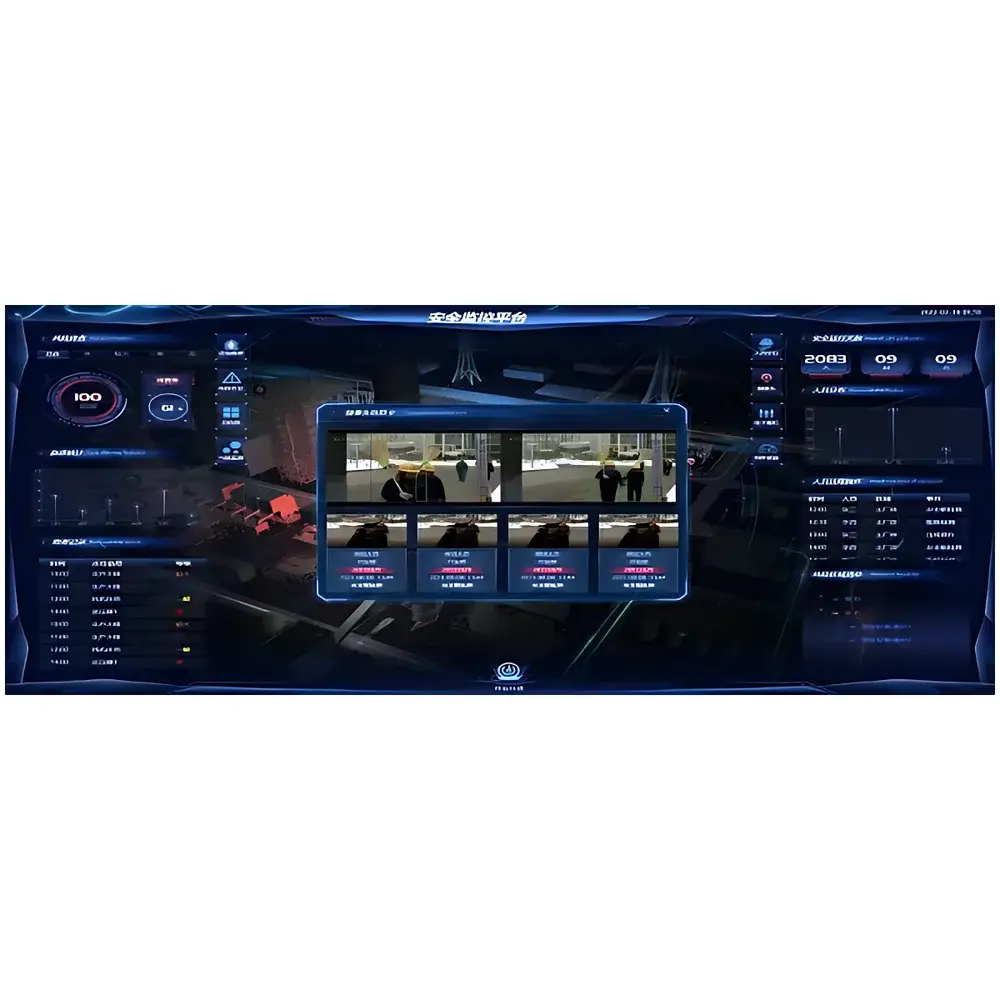
PERIC Industrial Safety Monitoring Platform
| Brand | PERIC |
|---|---|
| Origin | Hebei, China |
| Manufacturer Type | Manufacturer |
| Product Category | Domestic |
| Model | Custom Software Solution |
| Pricing | Upon Request |
Overview
The PERIC Industrial Safety Monitoring Platform is a purpose-built software system engineered for integrated process safety management in hazardous chemical (HazChem) manufacturing and storage facilities. It operates as a unified digital infrastructure that converges real-time operational data—sourced from distributed sensors, DCS/SCADA systems, PLCs, GPS-enabled wearables, and permit-to-work (PTW) databases—into a centralized, context-aware safety intelligence layer. Built upon industrial IoT (IIoT) architecture and compliant with ISA-95 and IEC 62443-3-3 cybersecurity frameworks, the platform implements a layered safety model grounded in the hierarchy of controls and aligned with OSHA 1910.119 (Process Safety Management), CCPS Risk-Based Process Safety (RBPS) elements, and ISO 45001 occupational health and safety requirements. Its core function is to enable continuous, dynamic risk assessment across the entire safety lifecycle—from hazard identification and risk characterization through to incident investigation and management-of-change (MOC) validation.
Key Features
- Dynamic Dual Prevention System: Integrates hazard identification (HAZID), risk matrix evaluation, and control effectiveness verification into an automated workflow; supports bow-tie analysis and barrier integrity monitoring with configurable thresholds and escalation logic.
- Intelligent Patrol Management: Leverages geofenced mobile checklists, AI-assisted image recognition for equipment anomaly detection (e.g., valve position, leakage signs), and offline-capable field reporting with time-stamped GPS coordinates and photo/video evidence.
- Real-Time Personnel Localization: Supports multi-technology positioning (UWB + BLE + Wi-Fi RTT) for sub-3-meter indoor accuracy; enforces proximity-based alarms, zone access control, and automatic muster roll-up during emergency evacuation drills or incidents.
- Digital Permit-to-Work (PTW) Lifecycle Control: Enforces role-based electronic authorization workflows for hot work, confined space entry, energy isolation (LOTO), and excavation; includes pre-job hazard assessment, gas detector integration, real-time atmospheric monitoring overlay, and auto-expiry enforcement.
- Major Hazard Source Surveillance: Aggregates real-time telemetry from pressure, temperature, level, and toxic/gas sensors on tanks, reactors, and pipelines; applies predictive thresholding, deviation trend analysis, and automatic alarm correlation per IEC 61511 SIL requirements.
- Incident & Near-Miss Analytics Engine: Structured root cause analysis (RCA) templates aligned with TapRooT® and Fishbone methodologies; integrates with ERP and CMMS systems to trace maintenance history, training records, and procedural deviations.
Sample Compatibility & Compliance
The platform is protocol-agnostic and natively supports Modbus TCP/RTU, OPC UA (PubSub and Client/Server), MQTT v3.1.1/v5.0, and RESTful API integrations. It accepts structured data streams from third-party analyzers (e.g., gas chromatographs, FTIR spectrometers, ultrasonic thickness gauges) and legacy DCS vendors including Honeywell Experion, Emerson DeltaV, Yokogawa CENTUM VP, and Siemens PCS7. All audit trails, user actions, and configuration changes are recorded with immutable timestamps and SHA-256 hashing to satisfy GLP/GMP documentation integrity requirements. The system design conforms to NIST SP 800-53 Rev. 5 controls for medium-impact systems and includes built-in support for FDA 21 CFR Part 11 electronic signature and audit trail compliance when deployed in regulated pharmaceutical or fine chemical environments.
Software & Data Management
Deployed as a containerized microservices architecture on-premises or in private cloud (VMware vSphere, OpenShift, or Azure Stack HCI), the platform features role-based access control (RBAC) with SAML 2.0 and LDAP/AD federation. Historical data is retained in a time-series database (InfluxDB or TimescaleDB) optimized for high-frequency sensor ingestion (>10,000 tags/sec), while relational metadata (permits, personnel, assets) resides in PostgreSQL with point-in-time recovery. All reports—including safety performance indicators (SPIs), lagging/leading metric dashboards, and regulatory submission packages (e.g., EPA RMP updates, OSHA 300 logs)—are exportable in PDF, CSV, and XLSX formats. A dedicated API gateway enables bi-directional integration with enterprise EHS platforms (e.g., Intelex, Sphera, ETQ Reliance) and ERP systems (SAP S/4HANA, Oracle Cloud EPM).
Applications
- Continuous monitoring and automated compliance reporting for Tier II/III chemical facilities under EPA Risk Management Program (RMP) and Clean Air Act Section 112(r).
- Integration with mechanical integrity programs to correlate inspection findings (e.g., NDT reports, corrosion maps) with real-time process conditions for predictive maintenance scheduling.
- Supporting Process Hazard Analysis (PHA) revalidation cycles by automatically aggregating operational deviation data, near-miss trends, and change management logs.
- Enabling remote expert oversight via secure web-based console with live video feed overlays from fixed and drone-mounted cameras synchronized to asset location and alarm state.
- Facilitating regulatory audits through pre-generated compliance evidence packs—including user access logs, configuration baselines, and alarm rationalization documentation—aligned with CCPS RBPS Element 11 (Mechanical Integrity) and Element 14 (Management of Change).
FAQ
Is the platform certified for use in SIL2 or SIL3 safety instrumented systems (SIS)?
No—the PERIC Industrial Safety Monitoring Platform is a non-SIL-rated supervisory and decision-support system. It does not perform safety shutdown functions but may interface with certified SIS controllers (e.g., Triconex, DeltaV SIS) for alarm annunciation and diagnostic data exchange.
Can the platform be deployed in air-gapped industrial networks?
Yes—on-premises deployment with optional air-gap compatibility is supported, including offline map caching, local certificate authority (CA) integration, and periodic batch synchronization via encrypted USB media.
Does the system support multilingual user interfaces and audit documentation?
Yes—UI localization is available for English, Chinese, Spanish, and Arabic; all generated reports and audit trails maintain language-consistent metadata and comply with ISO/IEC 17025 clause 7.8 documentation requirements.
What is the typical implementation timeline for a mid-sized chemical plant?
Standard deployment—including site assessment, data interface engineering, role-based configuration, UAT, and operator training—requires 12–16 weeks, contingent upon existing instrumentation coverage and IT/OT network readiness.
How is software versioning and patch management handled?
All releases follow semantic versioning (SemVer 2.0); critical security patches are delivered within 72 hours of CVE disclosure, with full change logs, regression test summaries, and rollback procedures provided in advance of scheduled maintenance windows.