
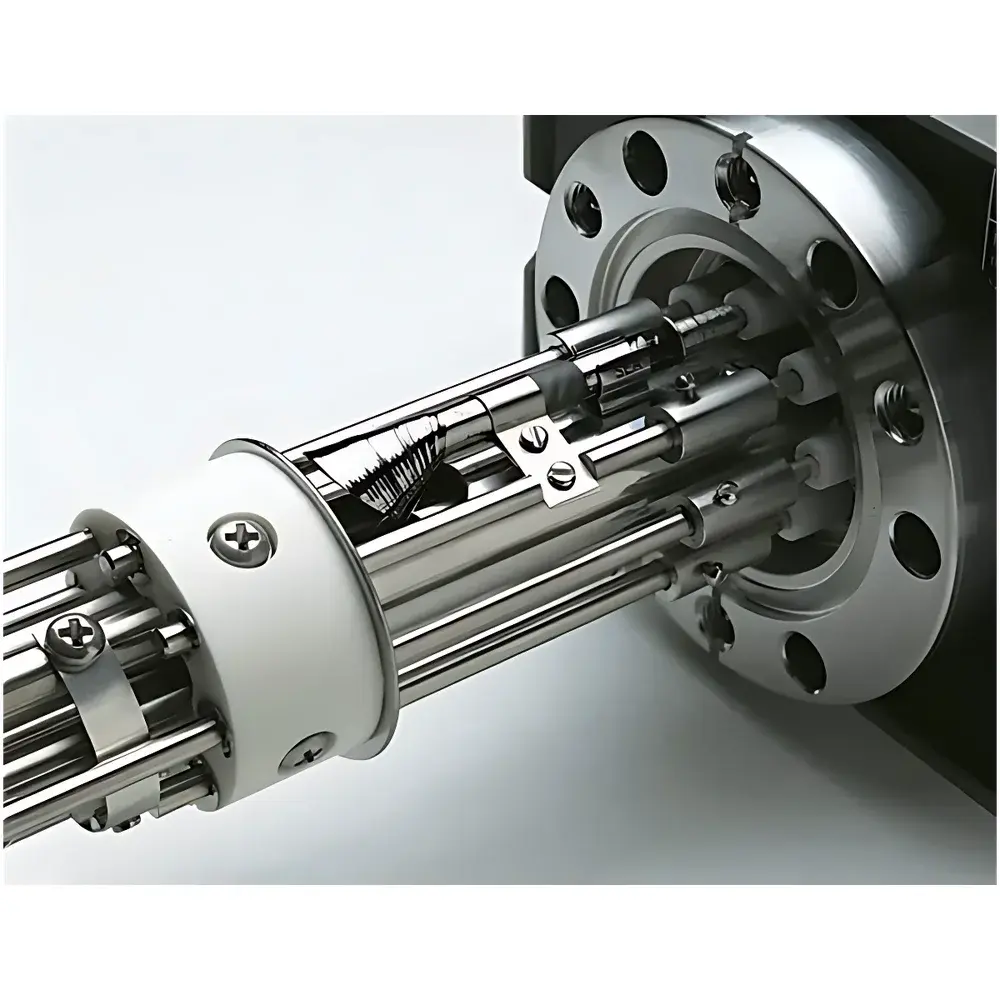
PERIC RGA100/200 Residual Gas Analyzer
| Brand | PERIC |
|---|---|
| Origin | Hebei, China |
| Manufacturer Type | Original Equipment Manufacturer (OEM) |
| Product Category | Domestic |
| Model | RGA100 / RGA200 |
| Principle | Electron Ionization (EI) Quadrupole Mass Spectrometry |
| Mass Range | 0–200 amu |
| Minimum Sampling Interval | 0.05 amu |
| Mass Resolution (FWHM) | < 0.5 amu |
| Ion Source | EI Source with Yttria-Coated Iridium Filament (Filament Current: 0–4 A) |
| Detector | Electron Multiplier (Gain > 10³) |
| Scan Speed | 5–1000 ms per data point |
| Compliance | Designed for UHV and HV vacuum environments |
Overview
The PERIC RGA100/200 Residual Gas Analyzer is a compact, high-stability quadrupole mass spectrometer engineered for real-time, in-situ analysis of residual gas composition in vacuum systems. Operating on the principle of electron ionization (EI) coupled with mass-selective filtering via a radio-frequency (RF)/direct-current (DC) driven quadrupole mass filter, the instrument delivers quantitative and qualitative identification of gaseous species across a mass range of 0–200 atomic mass units (amu). Its core architecture comprises three integrated functional modules: a robust EI ion source with yttria-coated iridium filament for stable electron emission under ultra-high vacuum (UHV) conditions; a precision-machined single quadrupole mass analyzer optimized for unit-mass resolution and low peak tailing; and a high-gain electron multiplier detector enabling detection limits in the low 10−14 Torr partial pressure range. The system is designed for continuous operation in vacuum chambers ranging from rough vacuum (10−2 mbar) to UHV (<10−9 mbar), supporting both diagnostic and process-critical monitoring applications.
Key Features
- Mass scanning capability from 0 to 200 amu with programmable step resolution down to 0.05 amu, ensuring fine discrimination between isotopic peaks (e.g., 16O2 vs. 14N2) and trace contaminants.
- High mass resolution (full width at half maximum < 0.5 amu), verified per ASTM E1936 Annex A1 test protocols, minimizing interferences from adjacent masses during multi-component analysis.
- Fast scan speed configurable from 5 ms to 1000 ms per data point—enabling transient event capture such as pump-down dynamics, leak evolution, or plasma ignition sequences.
- Yttria-coated iridium filament with adjustable emission current (0–4 A) provides extended operational lifetime (>6000 hours) and consistent ionization efficiency across varying vacuum pressures and gas matrices.
- Modular hardware design supports field-replaceable ion source, quadrupole assembly, and detector—reducing mean time to repair (MTTR) and aligning with semiconductor fab maintenance schedules.
- Embedded control firmware compliant with SEMI E10 (Definition and Measurement of Equipment Reliability and Availability) and capable of integration into factory automation networks via RS-232, RS-485, or optional Ethernet/IP interface.
Sample Compatibility & Compliance
The RGA100/200 is validated for analysis of permanent gases (N2, O2, Ar, H2, He), reactive species (H2O, CO, CO2, NH3), and volatile organics (CH4, C2H4, C2H6) commonly encountered in vacuum deposition, etching, and thin-film processing environments. It meets mechanical and electrical safety requirements per IEC 61000-6-2 (immunity) and IEC 61000-6-3 (emissions), and its vacuum flange interface conforms to ISO-KF 40 and CF 63 standards. While not certified for Class 10 cleanroom operation, the analyzer has been successfully deployed in ISO Class 5–7 controlled environments at Huahong Semiconductor and Zhongke Kemai, where it supports GLP-aligned process documentation through audit-trail-enabled software logging.
Software & Data Management
Control and data acquisition are managed via PERIC’s proprietary RGA Control Suite v3.2—a Windows-based application supporting real-time spectral display, time-resolved partial pressure trending, library-assisted peak identification (NIST MS Search 2.3-compatible), and customizable alarm thresholds. All raw spectral data (m/z vs. intensity) and metadata (timestamp, filament status, scan parameters) are stored in HDF5 format with embedded SHA-256 checksums. The software implements role-based access control (RBAC), electronic signature support, and full 21 CFR Part 11 compliance—including operator authentication, audit trail generation, and immutable record retention—for regulated manufacturing environments. Export options include CSV, ASCII, and direct OPC UA server publishing for MES/SCADA integration.
Applications
- Leak detection and localization via helium sniffing or residual gas fingerprinting in UHV systems (e.g., synchrotron beamlines, fusion diagnostics).
- In-situ process monitoring during PVD, CVD, and ALD chamber conditioning—tracking H2O, O2, and hydrocarbon outgassing to validate bake-out efficacy.
- Plasma process endpoint detection by monitoring reaction byproducts (e.g., SiF4 in fluorine-based etch, CFx fragments in polymer etch).
- Residual gas profiling in space simulation chambers to verify outgassing compliance per ECSS-Q-ST-70-02C.
- Accelerator vacuum diagnostics, including beam-induced desorption studies and photon-stimulated desorption (PSD) characterization.
FAQ
What vacuum compatibility does the RGA100/200 support?
The analyzer operates continuously from 1×10⁻² mbar to <1×10⁻⁹ mbar, with differential pumping stages integrated into the sensor head for optimal signal-to-noise ratio in UHV environments.
Is the quadrupole mass filter temperature-controlled?
No—thermal stabilization is achieved through passive thermal mass design and low-power RF drive electronics; active oven control is omitted to minimize power draw and vibration coupling, consistent with ISO 20483 recommendations for portable RGA systems.
Can the system be calibrated using standard gas mixtures?
Yes—calibration routines support multi-point sensitivity calibration using certified N2/Ar/CO2/H2O reference blends traceable to NIST SRM 1620a, with automated gain normalization across the mass range.
Does the RGA100/200 meet semiconductor industry cybersecurity requirements?
Firmware includes TLS 1.2 encryption for remote configuration, disabled default credentials, and secure boot with signed firmware updates—aligned with SEMI E177-0723 (Cybersecurity Guidelines for Semiconductor Manufacturing Equipment).
What is the expected service life of the ion source assembly?
Under typical semiconductor tool monitoring duty cycles (8 h/day, 5 days/week), the yttria-iridium filament demonstrates >6000 h MTBF, and the entire ion source module is rated for ≥20,000 h before refurbishment.
Related Products




