
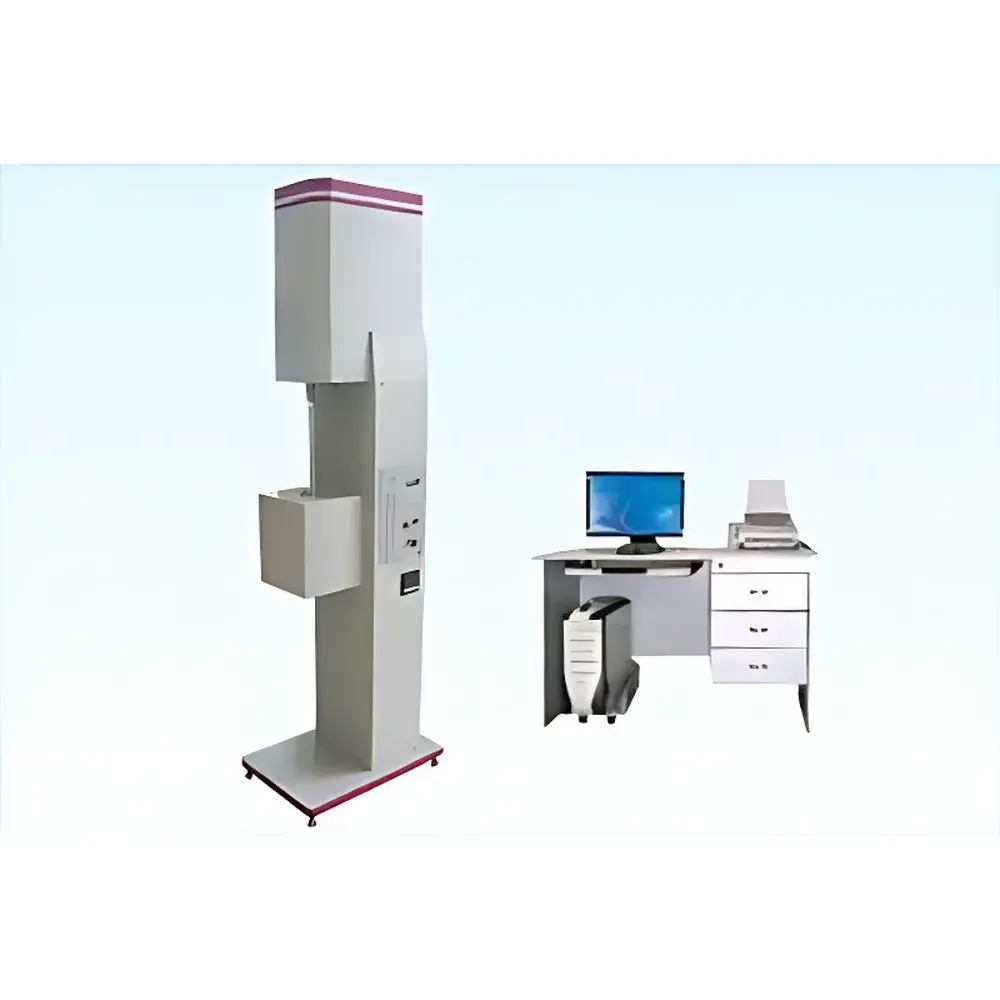
Changchun Intelligent MLW-90 Explosion-Proof Capillary Rheometer
| Brand | Changchun Intelligent |
|---|---|
| Origin | Jilin, China |
| Model | MLW-90 |
| Temperature Range | Ambient to 90 °C ±1 °C |
| Heating Rate | 0.5–6 °C/min (adjustable) |
| Temperature Resolution | 0.1 °C |
| Temperature Accuracy | <±0.5 °C (computer-displayed) |
| Pressure Range | 1–50 MPa ±1% |
| Load Cell Capacity | 500 kg |
| Load Accuracy | ±1% |
| Load Resolution | 20,000 counts |
| Piston Area | 1 cm² |
| Sample Mass | 15 g |
| Sample Density | 1.34 g/cm³ |
| Die Dimensions (ID × L) | φ1.5 mm × 5/10/20/40 mm |
| Die Material | Tungsten Carbide |
| Piston Speed Range | 0.001–100 mm/min |
| Die Quantity | 12 sets included |
| Piston Options | Steel or copper with polyethylene sheathing |
| Heating Method | Water Bath |
| Safety Architecture | Explosion-proof enclosure + operator-isolated control station |
Overview
The Changchun Intelligent MLW-90 Explosion-Proof Capillary Rheometer is a computer-controlled, constant-pressure capillary rheological testing system engineered for the precise characterization of polymer melts and thermoplastic materials under high-pressure extrusion conditions. It operates on the principle of capillary rheometry—measuring the volumetric flow rate of molten material forced through standardized dies under controlled temperature and pressure—to derive shear viscosity, apparent shear stress, and flow activation energy. Designed specifically for laboratories handling volatile, heat-sensitive, or potentially flammable polymer compounds, the MLW-90 integrates a certified explosion-proof mechanical enclosure, water-bath thermal regulation (eliminating open-heating elements), and fully remote human-machine interface operation. This architecture ensures compliance with IEC 60079-0 (Explosive Atmospheres – General Requirements) and supports safe execution of ASTM D3835, ISO 11443, and GB/T 3680.1 test protocols in industrial R&D, quality assurance, and process development environments.
Key Features
- Explosion-proof certified housing with intrinsically safe electrical routing and sealed water-bath heating chamber—enabling safe testing of PVC, nitrocellulose, peroxide-cured elastomers, and other decomposition-prone resins.
- Dual-mode temperature control: PID-regulated water bath (ambient to 90 °C ±1 °C) with programmable ramp rates from 0.5 to 6 °C/min; real-time digital monitoring at 0.1 °C resolution and <±0.5 °C system accuracy.
- High-fidelity load measurement: 500 kg capacity load cell with ±1% full-scale accuracy and 20,000-count resolution, calibrated traceably to national standards.
- Modular die system: Twelve interchangeable tungsten carbide dies (φ1.5 mm × 5/10/20/40 mm) provided as standard—ensuring wear resistance, dimensional stability, and consistent entrance geometry per ISO 11443 Annex A.
- Programmable piston actuation: Servo-driven displacement control (0.001–100 mm/min) via Fuji servo amplifier and motor, synchronized with pressure and temperature acquisition at 100 Hz sampling rate.
- Integrated safety interlocks: Automatic shutdown on overpressure (>50 MPa), overtemperature (>92 °C), or water-level deficiency; physical separation between test zone and operator console.
Sample Compatibility & Compliance
The MLW-90 accommodates solid granules or pellets (15 g typical charge, density up to 1.34 g/cm³) requiring melt processing—including polyolefins, engineering thermoplastics (e.g., PC, POM), thermoplastic elastomers, and filled composites. Its water-bath heating eliminates thermal runaway risk associated with oil- or air-heated systems, making it suitable for materials with low decomposition onset temperatures (<200 °C). All mechanical and electrical components meet CE marking requirements for machinery safety (2006/42/EC) and electromagnetic compatibility (2014/30/EU). The system supports audit-ready documentation per GLP and GMP frameworks, with timestamped raw data logs, user-access controls, and electronic signature capability in the supplied software.
Software & Data Management
The proprietary Windows-based rheology software provides full instrument orchestration: automated test sequencing, real-time parameter visualization (pressure vs. time, temperature vs. time, piston displacement vs. time), and on-the-fly calculation of apparent viscosity (ηapp), shear rate (γ̇), and shear stress (σ) using Bagley and Rabinowitsch corrections. Export formats include CSV, PDF, and XML for integration into LIMS or statistical analysis platforms (e.g., JMP, Minitab). Audit trail functionality records all user actions, method modifications, calibration events, and data exports—fully compliant with FDA 21 CFR Part 11 requirements when configured with electronic signatures and role-based access levels.
Applications
- Quality control of polymer resin batches against viscosity specifications (e.g., MFI correlation, shear-thinning index).
- Processing window definition for extrusion and injection molding—determining optimal barrel temperature profiles and screw speed ranges.
- Formulation screening of additives (plasticizers, flame retardants, nanofillers) via comparative flow curves.
- Thermal stability assessment through isothermal hold tests at multiple shear stresses.
- Constitutive modeling input generation for computational fluid dynamics (CFD) simulations of polymer processing equipment.
FAQ
What safety certifications does the MLW-90 hold for use in hazardous locations?
The system complies with IEC 60079-0 general requirements for explosive atmospheres and incorporates Class I, Division 2 / Zone 2-rated components. Full ATEX or IECEx certification documentation is available upon request for site-specific hazard assessments.
Can the MLW-90 perform Bagley and Rabinowitsch corrections automatically?
Yes—the software applies both corrections in real time using user-input die geometry and measured pressure drop data, outputting corrected shear viscosity values referenced to true wall shear stress.
Is the water bath system compatible with long-duration thermal stability tests?
The recirculating water bath maintains temperature stability within ±0.3 °C over 8-hour continuous operation; optional external chiller integration extends operational range to sub-ambient conditions.
How is traceability ensured for calibration and maintenance records?
All calibration certificates (load cell, RTD, pressure transducer) are digitally embedded in the software database with expiry alerts; maintenance logs are time-stamped, user-identified, and exportable as PDF audit packages.
Does the system support multi-die sequential testing without manual intervention?
Yes—die selection is automated via motorized turret (optional upgrade); otherwise, manual die change is guided by software prompts with automatic parameter reconfiguration based on selected die dimensions.



