
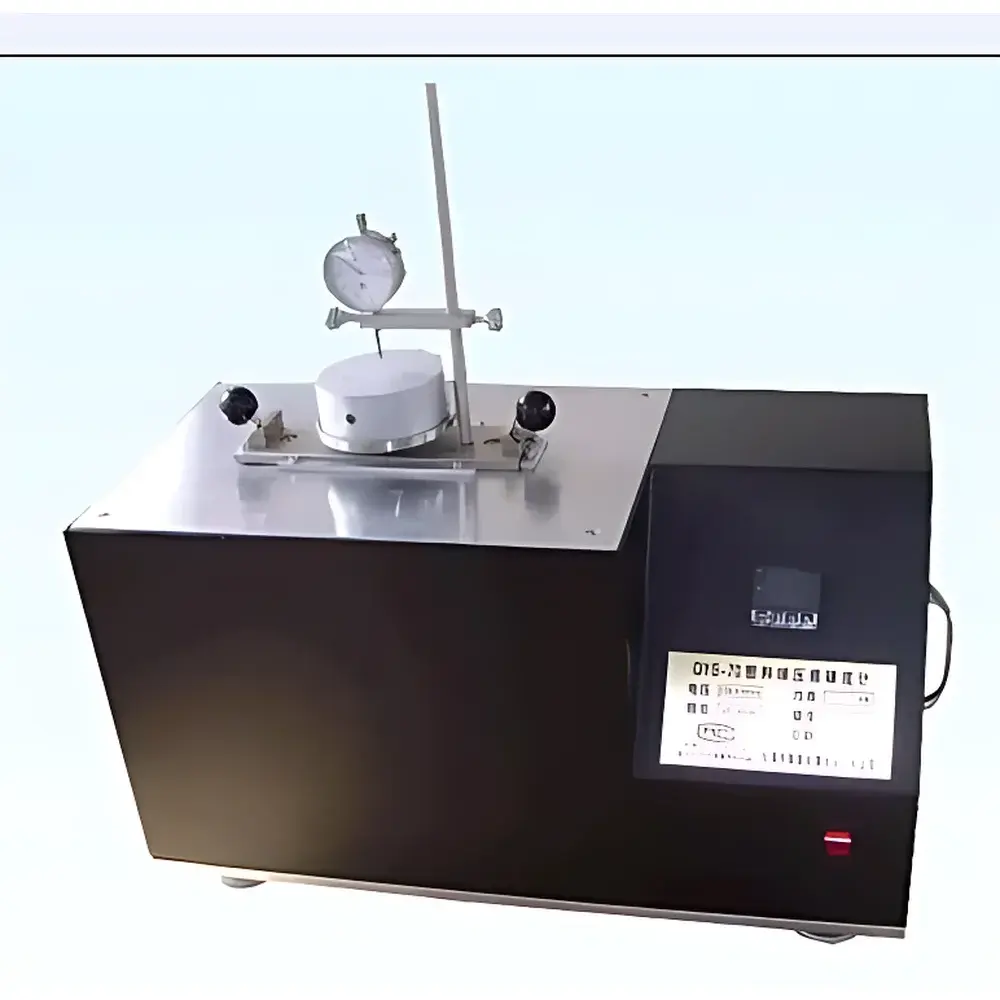
Water Bath Indentation Hardness Tester QYS-70
| Origin | Jilin, China |
|---|---|
| Manufacturer Type | Distributor |
| Origin Category | Domestic |
| Model | QYS-70 |
| Quotation | Upon Request |
| Water Bath Dimensions (L×W×H) | 300×180×200 mm |
| Temperature Range | Ambient to 90 °C |
| Temperature Display Accuracy | ±2 °C |
| Temperature Stability | ±2 °C |
| Applied Stress | 10 MPa |
| Heating Power | 1500 W |
| Supply Voltage | 220 V ±10% |
| Indenter Tip Diameter | 1.18 mm (Cross-sectional Area: 2.5 mm²) |
| Dial Indicator Resolution | 0.01 mm |
| Operating Environment | Ambient Temperature, Avoid Direct Sunlight |
Overview
The QYS-70 Water Bath Indentation Hardness Tester is a precision-engineered instrument designed specifically for the quantitative evaluation of indentation hardness in polyethylene-based pipeline coating systems—particularly extruded polyethylene (PE) anticorrosive layers used in oil and gas infrastructure. It operates on the principle of controlled static indentation under thermally stabilized conditions: a calibrated cylindrical indenter applies a defined normal stress (10 MPa) to the specimen surface while immersed in a temperature-regulated water bath. The resulting penetration depth is measured with high-resolution mechanical dial indication (0.01 mm resolution), enabling direct calculation of indentation hardness according to the methodology specified in SY/T 0413–2002, the Chinese petroleum industry standard for polyethylene anticorrosive coatings on steel pipelines. Unlike conventional Rockwell or Brinell hardness testers, this system integrates thermal conditioning as an intrinsic part of the test protocol—ensuring material response is evaluated at service-relevant temperatures (up to 90 °C), thereby reflecting real-world performance under elevated thermal exposure.
Key Features
- Integrated thermostatically controlled water bath with precise digital temperature regulation (ambient to 90 °C), ±2 °C display accuracy and ±2 °C stability over time—critical for replicating field operating conditions.
- Fixed-load indentation mechanism delivering a consistent 10 MPa nominal stress via a hardened steel indenter with precisely defined geometry (1.18 mm diameter, 2.5 mm² cross-sectional area).
- Mechanical dial indicator with 0.01 mm graduation, mounted on a rigid, vibration-damped support structure to ensure repeatable depth measurement independent of operator influence.
- Robust stainless-steel water bath tank (300 × 180 × 200 mm internal dimensions) with corrosion-resistant heating elements and insulated housing to minimize thermal loss and power consumption.
- Separate electrical control cabinet with over-temperature protection, current-limiting circuitry, and EMI-filtered AC input (220 V ±10%), compliant with IEC 61000-4 electromagnetic compatibility requirements.
- Modular mechanical architecture facilitating routine maintenance, calibration verification, and traceable load verification using NIST-traceable reference weights.
Sample Compatibility & Compliance
The QYS-70 is validated for use with flat, planar specimens of extruded polyethylene anticorrosive coatings—typically cut from pipe sections or prepared as standardized plaques per SY/T 0413–2002 Section 6.2. Specimen thickness must exceed 3 mm to prevent substrate interference. The instrument supports testing under ISO/IEC 17025-compliant laboratory environments when operated with documented calibration schedules, environmental monitoring logs, and technician competency records. While SY/T 0413–2002 is its primary normative reference, the underlying indentation methodology aligns conceptually with ASTM D1474 (Indentation Hardness of Organic Coatings) and ISO 2039-1 (Plastics — Determination of Indentation Hardness), though direct equivalency requires method validation per laboratory SOPs. No CE marking or FDA 510(k) clearance applies, as the device falls outside medical or EU Machinery Directive scope.
Software & Data Management
The QYS-70 is a manually operated, analog-readout instrument with no embedded microprocessor or digital interface. All measurements are recorded manually into laboratory notebooks or LIMS-compatible spreadsheets. For GLP/GMP-aligned workflows, users are advised to implement controlled documentation practices including: pre-test environmental logs (ambient temperature, humidity), instrument calibration status verification (indenter geometry, dial indicator linearity, temperature sensor traceability), and dual-operator verification of final readings. Optional third-party digital caliper adapters or USB-connected dial indicator transducers may be integrated for automated data capture—provided such modifications do not alter the mechanical loading path or introduce hysteresis. Raw data files generated externally must retain full audit trails per 21 CFR Part 11 requirements if used in regulated quality systems.
Applications
- Quality assurance of PE anticorrosive coatings during manufacturing and field application—verifying batch-to-batch consistency in thermal-mechanical resistance.
- Research into polymer aging effects: sequential hardness testing after thermal cycling or UV exposure to quantify embrittlement or softening trends.
- Comparative evaluation of alternative coating formulations (e.g., PE vs. 3LPE vs. fusion-bonded epoxy hybrids) under identical thermal loading protocols.
- Failure analysis of pipeline coating defects—correlating localized hardness deviations with blistering, delamination, or thermal degradation observed via FTIR or DSC.
- Validation of curing parameters in extrusion lines—linking die temperature profiles to final-layer indentation response.
FAQ
What standards does the QYS-70 directly support?
It is explicitly designed to meet the test procedure and equipment requirements of SY/T 0413–2002, the People’s Republic of China petroleum industry standard for polyethylene anticorrosive coatings.
Is the indenter geometry certified or traceably calibrated?
The 1.18 mm diameter cylindrical indenter is manufactured to dimensional tolerances per GB/T 230.2, and users must verify tip geometry annually using optical profilometry or certified gauge blocks.
Can the unit operate continuously at 90 °C?
Yes—the 1500 W heating system and insulated bath design permit sustained operation at maximum setpoint, provided ambient ventilation meets minimum 0.5 m/s airflow per IEC 60068-2-1.
Does the instrument require annual recalibration?
Per ISO/IEC 17025, the temperature sensor, dial indicator, and applied load must be verified at least annually against accredited reference standards; frequency may increase based on usage intensity and internal QA policy.
Is there a recommended maintenance schedule?
Daily: drain and dry bath after use; weekly: inspect heater terminals and indicator gear backlash; quarterly: replace bath water with deionized water and verify seal integrity of electrical feedthroughs.



