
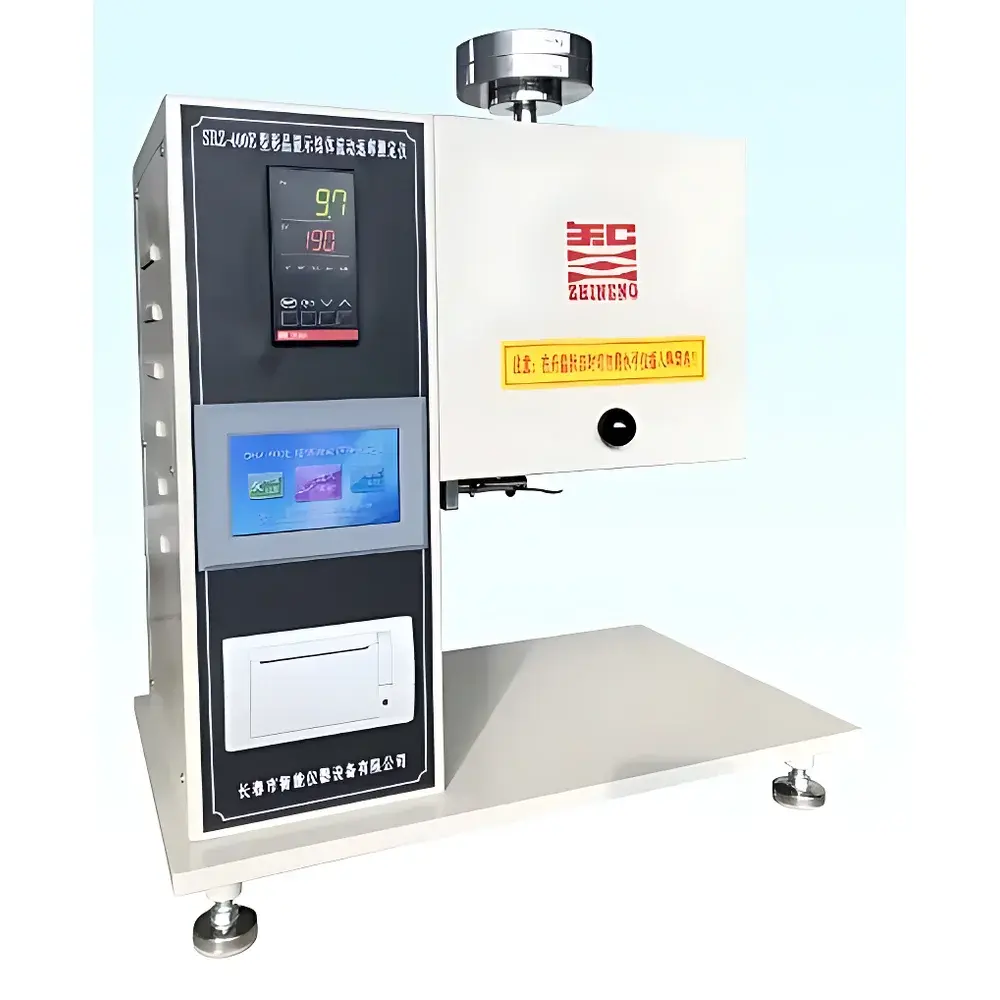
SRZ-400D Melt Flow Indexer (Melt Mass Flow Rate Tester)
| Origin | Jilin, China |
|---|---|
| Manufacturer Type | Authorized Distributor |
| Origin Category | Domestic (PRC) |
| Model | SRZ-400D |
| Pricing | Available Upon Request |
| Temperature Control Range | 80–400 °C |
| Temperature Accuracy | ±0.2 °C |
| Temperature Resolution | 0.1 °C |
| Barrel Bore Diameter | 9.550 mm ± 0.025 mm |
| Piston Head Diameter | 9.475 mm ± 0.015 mm |
| Piston Head Length | 6.35 mm ± 0.1 mm |
| Die Capillary Inner Diameter | 2.095 mm ± 0.005 mm |
| Distance Between Cut Positions | 30 mm |
| Power Supply | AC 220 V, ≤0.5 kW |
| Warm-up Recovery Time | ≤4 min |
| Net Weight | 50 kg |
| Dimensions (L×W×H) | 460 × 280 × 415 mm |
| Accuracy Class | Class 1 (per GB/T 3682 & ISO 1133) |
Overview
The SRZ-400D Melt Flow Indexer is a precision benchtop instrument engineered for the quantitative determination of melt mass flow rate (MFR) of thermoplastic polymers under standardized load and temperature conditions. It operates in strict compliance with ASTM D1238 (Procedure A), ISO 1133-1:2011, and GB/T 3682–2000 (Method A), delivering reproducible results essential for raw material qualification, process validation, and quality control in polymer compounding, extrusion, and injection molding facilities. The system employs a gravity-driven piston mechanism within a precisely dimensioned heated barrel, where molten polymer is extruded through a calibrated capillary die under defined mass loading. MFR is calculated as the mass of extrudate (in grams) collected over a fixed time interval (typically 10 minutes), expressed in g/10 min. Its robust thermal architecture—featuring dual-display Japanese temperature controllers, high-stability heating elements, and rapid thermal recovery (<4 min)—ensures minimal drift during sequential tests across wide thermal ranges (80–400 °C), critical for evaluating high-melting engineering resins such as polyetherimide (PEI), polyphenylene sulfide (PPS), and fluoropolymers.
Key Features
- Class 1 accuracy certified per GB/T 3682 and ISO 1133 metrological requirements, validated by traceable dimensional tolerances: barrel bore (Φ9.550 mm ±0.025 mm), piston head (Φ9.475 mm ±0.015 mm), and die orifice (Φ2.095 mm ±0.005 mm)
- Dual-channel Japanese digital temperature controller with 0.1 °C resolution and ±0.2 °C uniformity across the 300 mm active barrel zone
- Automated cutting mechanism capable of severing rigid, high-viscosity extrudates—including filled PEEK, carbon-fiber-reinforced nylon, and flame-retardant PC/ABS blends—without operator intervention
- Integrated microprocessor-based control system with color LCD touchscreen interface, multilingual prompt support (English/Chinese), and audible operational feedback
- Comprehensive standard weight set (five calibrated masses: 0.325 kg, 0.875 kg, 0.960 kg, 1.200 kg, 1.640 kg), all traceable to national mass standards
- Onboard thermal stability monitoring with real-time deviation logging and automatic hold-to-equilibrium verification prior to test initiation
Sample Compatibility & Compliance
The SRZ-400D supports routine MFR testing of homopolymers and copolymers including but not limited to polyethylene (HDPE, LDPE, LLDPE), polypropylene (PP-H, PP-R, impact-copolymer), polystyrene (GPPS, HIPS), ABS, polyamide (PA6, PA66, PA12), polyacetal (POM), polycarbonate (PC), poly(methyl methacrylate) (PMMA), polybutylene terephthalate (PBT), and specialty fluoropolymers (PTFE, FEP). All mechanical dimensions conform to ISO 1133 Annex A specifications, ensuring cross-laboratory comparability. The instrument satisfies mandatory calibration and verification requirements under ISO/IEC 17025:2017 for testing laboratories and supports audit-ready documentation for GMP environments operating under FDA 21 CFR Part 11 guidelines when paired with validated microcontrol software.
Software & Data Management
The included microcontroller software provides full test lifecycle management: parameter configuration (temperature, load, cut interval), real-time extrudate mass tracking, auto-calculated MFR and MVR (melt volume rate) values, statistical summary (mean, SD, CV%), and GLP-compliant electronic records. Data export is supported via USB to CSV or PDF formats; optional RS-232 or Ethernet connectivity enables integration into LIMS platforms. Audit trails capture user ID, timestamp, parameter changes, and result modifications—fully compliant with 21 CFR Part 11 electronic signature requirements when deployed with appropriate access controls and electronic signature modules.
Applications
- Raw material release testing against supplier MFR specifications (e.g., PE resin grade certification per ASTM D1238)
- In-process monitoring of polymer degradation during extrusion—detecting molecular weight shifts via MFR drift
- Quality assurance of recycled polymer streams where MFR serves as a proxy for chain scission extent
- R&D formulation screening for viscosity modifiers, fillers, and stabilizers
- Regulatory submission support for medical-grade polymer devices (ISO 10993-12, USP )
- Technical service labs performing third-party conformance verification for ISO 9001-certified manufacturers
FAQ
What international standards does the SRZ-400D comply with?
It fully conforms to ISO 1133-1:2011, ASTM D1238 (Procedure A), GB/T 3682–2000, and DIN 53735 for melt mass flow rate determination.
Can the instrument perform both MFR and MVR measurements?
Yes—MVR is derived from real-time piston displacement measurement using the integrated position sensor (30 mm travel range), enabling simultaneous calculation of melt volume flow rate per ISO 1133-1 Annex C.
Is calibration certification provided with the system?
Each unit ships with a factory calibration report covering thermal uniformity, dimensional verification of barrel/piston/die, and load cell traceability to NIM (National Institute of Metrology, China); on-site ISO/IEC 17025 calibration services are available upon request.
What maintenance is required for long-term accuracy?
Routine cleaning of the barrel, piston, and die using supplied stainless-steel tools and specified solvents (e.g., xylene for PE, chlorobenzene for PC) is recommended after every 10–15 tests; annual recalibration of temperature sensors and load verification are advised per ISO 17025 internal audit schedules.





