
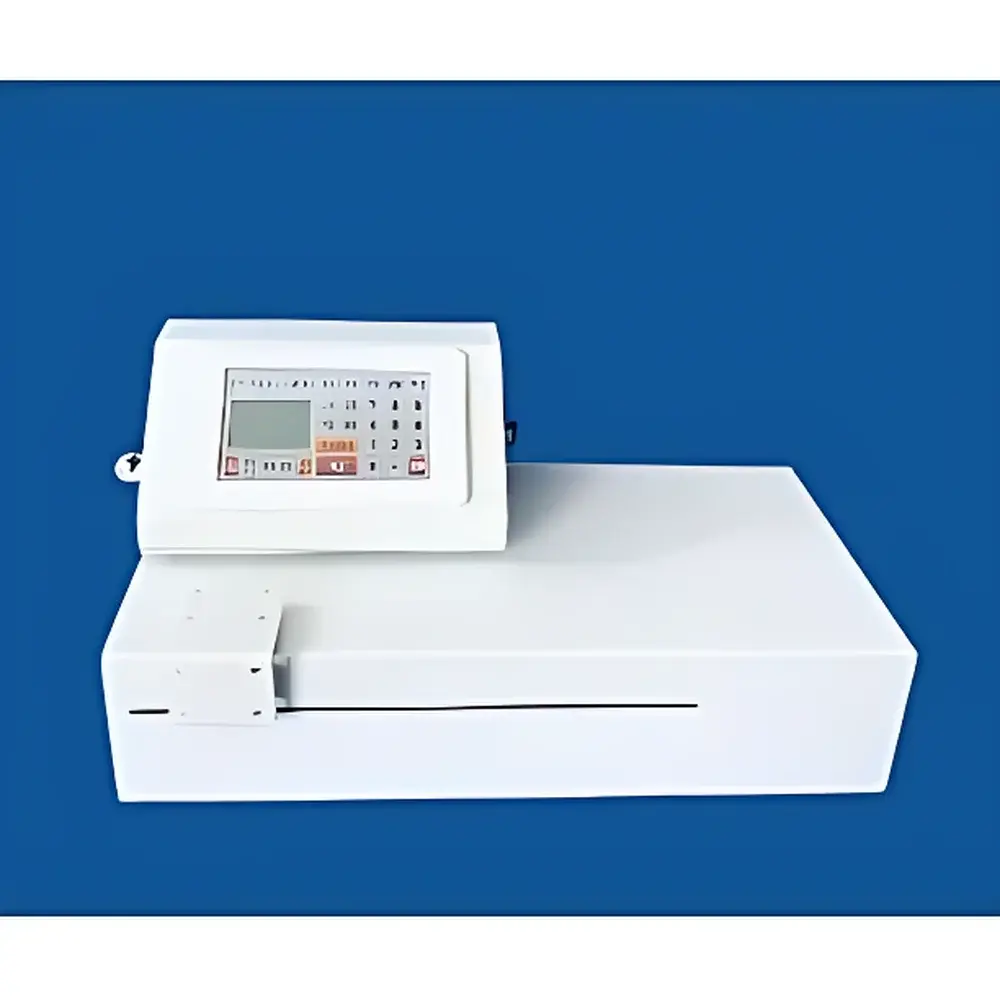
Truelab HT-1 Programmable Precision Motion Controller for Electrospinning
| Brand | Truelab |
|---|---|
| Origin | Shanghai, China |
| Manufacturer Type | Authorized Distributor |
| Country of Origin | China |
| Model | HT-1 |
| Pricing | Available Upon Request |
| Travel Range | 200 mm |
| Speed Range | 0–2000 mm/min (no load), 0–600 mm/min (3 kg load) |
| Positioning Accuracy | ±0.1 mm |
| Stage Dimensions | Horizontal 50 × 50 mm, Vertical 50 × 36 mm |
| Operating Environment | 4–50 °C, 0–90% RH (non-condensing) |
| Dimensions (L×D×H) | 523 × 200 × 93 mm |
| Weight | 7.1 kg |
| Display | 2.2-inch white LED touchscreen |
| Power Supply | 220 VAC, 50/60 Hz |
| Warranty | 12 months (parts and labor) |
Overview
The Truelab HT-1 Programmable Precision Motion Controller is an electromechanical positioning system engineered for reproducible, programmable linear motion in laboratory-scale advanced material synthesis and microfluidic automation. Based on a closed-loop stepper motor architecture with integrated microstepping drive electronics, the HT-1 delivers deterministic displacement control via user-defined motion profiles—including reciprocating, intermittent, variable-stroke, and multi-segment sequences. Its core function is to translate digital motion instructions into sub-millimeter mechanical actuation, enabling precise spatial modulation of electrospinning nozzles, syringe pump plunger carriers, or 3D micro-deposition heads. Unlike open-loop systems, the HT-1’s firmware incorporates real-time position feedback calibration, ensuring repeatable trajectory execution across thermal and load variations typical in ambient lab environments (4–50 °C, ≤90% RH non-condensing). The controller operates as a standalone unit—requiring no host PC for basic operation—and communicates via intuitive touchscreen interface, making it suitable for integration into ISO 17025-compliant QC workflows or GLP-aligned R&D protocols.
Key Features
- Programmable multi-segment motion profiles: Supports up to 16 independent motion segments per program, each configurable for direction, stroke length, dwell time, acceleration/deceleration ramp rate, and velocity setpoint.
- Load-adaptive speed control: Maintains specified positional accuracy (±0.1 mm) under static loads up to 3 kg, with dynamic speed range from 0 to 600 mm/min at full load and up to 2000 mm/min under no-load conditions.
- Modular mechanical interface: Standardized 50 × 50 mm horizontal mounting platform and 50 × 36 mm vertical support surface accommodate custom夹具 (e.g., L-brackets, nozzle clamps, syringe holders) using M3/M4 threaded inserts.
- Dual-mount flexibility: Designed for left-side or right-side benchtop installation without mechanical reconfiguration—enabling seamless integration into asymmetric experimental setups such as coaxial electrospinning rigs or dual-nozzle deposition stations.
- Embedded human-machine interface: 2.2-inch white LED touchscreen with tactile-responsive GUI provides immediate access to program editing, real-time position readout, manual jog controls, and error logging.
- Rugged industrial-grade construction: Aluminum alloy chassis, sealed stepper motor housing, and conformal-coated PCBs ensure long-term reliability in non-classified laboratory environments subject to particulate exposure and intermittent humidity shifts.
Sample Compatibility & Compliance
The HT-1 is not a sample-contacting analytical instrument but a motion actuation subsystem. As such, it imposes no intrinsic chemical or thermal constraints on samples; compatibility is determined solely by the attached fixture and payload. It supports standard electrospinning hardware (e.g., stainless-steel spinnerets, glass capillaries, polymer solution reservoirs) and microfluidic components rated for ambient pressure and temperatures between 4–50 °C. While the device itself carries no CE or UL certification, its power supply complies with IEC 61000-4 electromagnetic immunity standards, and its mechanical design aligns with ISO 12100:2010 principles for machinery safety. When deployed in regulated environments (e.g., pharmaceutical excipient development per USP , or nanofiber scaffold fabrication under ISO 13485), the HT-1 may be included in equipment qualification protocols (IQ/OQ/PQ) due to its deterministic repeatability and audit-ready parameter logging.
Software & Data Management
The HT-1 operates natively via its onboard firmware and requires no external software for routine use. All motion programs are stored in non-volatile flash memory and retain configuration after power cycling. A USB-C port enables optional firmware updates and backup/restore of program libraries—though no proprietary desktop application is provided. For traceability in GxP settings, users may manually record executed program IDs, timestamps, and environmental conditions in lab notebooks or LIMS entries. While the controller does not generate electronic records compliant with FDA 21 CFR Part 11 out-of-the-box, its deterministic behavior and stable positional output support retrospective validation when paired with external documentation practices meeting ALCOA+ principles (Attributable, Legible, Contemporaneous, Original, Accurate, Complete, Consistent, Enduring, Available).
Applications
- Electrospinning process optimization: Synchronized lateral oscillation of spinnerets to enhance fiber alignment uniformity and reduce bead formation in nanofiber mats.
- Precision liquid dispensing: Controlled translation of syringe-mounted tips for repeatable micro-dosing (e.g., 1–100 µL) in assay plate filling or gradient hydrogel fabrication.
- Non-planar additive manufacturing: Integration with open-source 3D printing toolheads to execute user-defined Z-axis lift-and-move trajectories for multi-layer scaffold printing.
- In situ characterization staging: Positioning of substrates beneath XRD, Raman, or optical microscopy probes with micron-level repeatability across thermal cycles.
- Automated tensile testing fixtures: Linear actuation of grips in small-scale mechanical testers for polymer film or hydrogel strip evaluation.
FAQ
Can the HT-1 be synchronized with external instruments such as high-voltage power supplies or syringe pumps?
Yes—via TTL-level trigger input/output ports (available on optional expansion module), enabling hardware-level coordination with third-party devices operating within 0–5 V logic levels.
Is firmware upgrade capability accessible to end users?
Firmware updates are distributed by Truelab and applied via USB-C connection using documented binary loading procedures; no developer SDK or API is provided.
What maintenance is required to sustain positioning accuracy over time?
No scheduled maintenance is specified; periodic visual inspection of belt tension and guide rail cleanliness is recommended. Re-calibration is unnecessary under normal operating conditions due to inherent stepper motor step-loss immunity.
Does the HT-1 support continuous rotation or only linear motion?
It is strictly a linear motion controller. Rotary motion requires separate rotary stages or belt-driven conversion kits, not supplied with the HT-1.
Can multiple HT-1 units be daisy-chained or networked?
No native networking capability exists. Coordination across multiple units must be managed externally via master controller or PLC-level sequencing.



