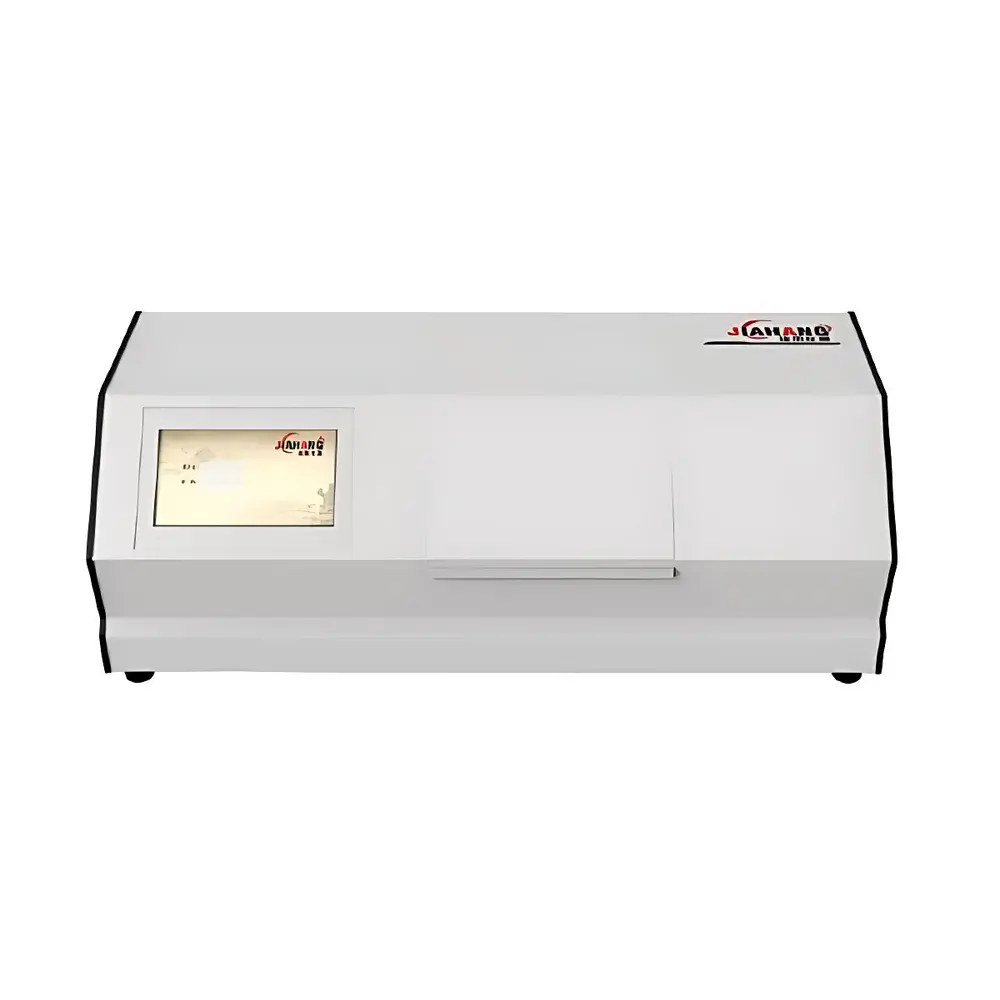
P300 Automated Polarimeter
| Origin | Shanghai, China |
|---|---|
| Manufacturer Type | Authorized Distributor |
| Origin Category | Domestic (PRC) |
| Model | P300 |
| Price Range | USD 1,400 – 7,200 |
| Product Type | Automatic Polarimeter |
| Temperature Control | Integrated Peltier |
| Digital Display | Yes |
| Light Source | High-Stability LED |
| Optical Rotation Range | ±89.99° |
| Sucrose Scale Range | ±259°Z |
| Measurement Accuracy | ±0.01° (within ±45°), ±0.02° (beyond ±45°) |
| Resolution | 0.001° |
| Repeatability (Std. Dev.) | ≤0.002° |
| Temp. Control Range | 15–35°C |
| Temp. Stability | ±0.2°C |
| Display | 5.6″ TFT True-Color Touchscreen |
| Sample Cells | 100 mm (standard & thermostatted), 200 mm (standard) |
| Minimum Transmittance | 1% |
| Calibration | Manual with Certified Quartz Controls |
| Interface | USB-B |
| Data Storage | 1,000 measurement records |
| Power | 220 V ±10%, 50 Hz ±1 Hz, 250 W |
| Net Weight | 24 kg |
Overview
The P300 Automated Polarimeter is a precision optical instrument engineered for the quantitative determination of optical rotation—defined as the angular deviation of plane-polarized light induced by chiral compounds in solution. Operating at the sodium D-line equivalent wavelength of 589.3 nm (achieved via high-stability LED source coupled with narrow-band interference filtering), the P300 complies with fundamental principles outlined in pharmacopoeial standards including USP , EP 2.2.7, and ChP IV. Its core measurement capability—optical rotation (α), specific rotation ([α]), concentration, and sucrose scale (°Z)—is grounded in the linear relationship between observed rotation, path length, solute concentration, and molecular asymmetry. Designed for routine QC/QA labs and R&D environments, the P300 delivers traceable, temperature-stabilized measurements critical for identity verification, enantiomeric purity assessment, and concentration quantification in APIs, excipients, natural extracts, and refined carbohydrates.
Key Features
- High-reliability 589.3 nm LED light source with >100,000-hour operational lifetime—eliminates warm-up delays, spectral drift, and filament degradation associated with sodium vapor or tungsten-halogen lamps.
- Integrated Peltier-based thermostatic cell holder enabling precise temperature control from 15 °C to 35 °C (±0.2 °C stability), ensuring compliance with temperature-sensitive pharmacopoeial methods requiring strict thermal regulation.
- True-color 5.6-inch capacitive touchscreen interface supporting intuitive navigation, multi-parameter configuration, and real-time display of α, [α], %w/v, and °Z values without external software dependency.
- Extended angular range of ±89.99° optical rotation and ±259°Z sucrose scale—accommodates highly optically active samples (e.g., epinephrine HCl, camphor derivatives, concentrated sucrose syrups) without manual range switching or signal saturation.
- Robust mechanical architecture with vibration-damped optical bench, dual-axis automatic polarization alignment, and optimized light-path geometry to minimize stray light and maximize signal-to-noise ratio.
Sample Compatibility & Compliance
The P300 supports standard 100 mm and 200 mm sample tubes (including thermostatted 100 mm variants), accommodating aqueous, alcoholic, and low-viscosity organic solutions with minimum transmittance ≥1%. It meets essential regulatory expectations for analytical instrumentation used in GMP environments: data integrity is preserved via timestamped local storage (1,000 records), non-volatile memory retention during power loss, and USB export for audit-ready reporting. While not inherently 21 CFR Part 11 compliant out-of-the-box, the system’s deterministic behavior, manual calibration traceability (using NIST-traceable quartz control plates), and absence of ambiguous software logic support qualification under GLP/GMP frameworks when deployed with documented SOPs and periodic performance verification per ASTM E289 or ISO 13805.
Software & Data Management
No proprietary PC software is required for basic operation; all functions—including method setup, measurement execution, unit conversion, and statistical review—are fully embedded within the instrument’s firmware. Measurement data (date/time stamp, sample ID, temperature, raw α-value, derived concentration/°Z, operator ID field) are stored locally and exportable via USB mass-storage mode to CSV files compatible with LIMS, Excel, or statistical packages (e.g., JMP, Minitab). The system supports manual zero-point calibration using certified quartz rotatory standards and includes built-in diagnostics for lamp intensity monitoring and detector linearity validation—enabling user-performed PQ checks aligned with ISO/IEC 17025 Clause 5.5.2.
Applications
- Pharmaceutical QC: Quantification of enantiomeric excess in chiral active pharmaceutical ingredients (e.g., levodopa, escitalopram); assay of optically active excipients (e.g., dextrose monohydrate, lactose).
- Sugar Industry: Direct °Z determination in cane/beet sugar solutions per ICUMSA Methods GS4/4-12 and national standards (GB/T 31437–2015).
- Food & Beverage: Verification of honey authenticity (adulteration detection via anomalous specific rotation), fruit juice concentration profiling.
- Academic Research: Kinetic studies of enzymatic racemization, chiral catalyst screening, and polymer helicity characterization in synthetic chemistry labs.
- Chemical Manufacturing: Release testing of optically active intermediates (e.g., menthol, limonene) per internal specifications aligned with ICH Q2(R2) guidance on analytical procedure validation.
FAQ
Does the P300 support automated calibration with digital reference standards?
No—the P300 requires manual calibration using physical quartz control plates traceable to national metrology institutes. No electronic or software-based auto-calibration is implemented.
Is temperature-controlled measurement mandatory for pharmacopoeial compliance?
Yes—USP and EP 2.2.7 explicitly require temperature control at 20 °C or 25 °C for official assays. The P300’s Peltier system satisfies this requirement across its full operating range.
Can the instrument measure samples with turbidity or particulate matter?
No—optical rotation measurement assumes optically clear, homogeneous solutions. Turbid or suspended samples must be filtered (e.g., 0.45 µm PVDF) prior to analysis to avoid scattering-induced error.
What is the maximum allowable absorbance for valid measurement?
The P300 specifies a minimum transmittance of 1%, corresponding to an absorbance limit of ~2.0 AU at 589.3 nm. Samples exceeding this threshold require dilution or use of shorter path-length cells.
Is USB data export compatible with FDA 21 CFR Part 11 requirements?
The native USB export function provides raw, uneditable CSV files. To meet Part 11, users must implement supplementary controls (e.g., secure network transfer, audit trail logging via LIMS, electronic signatures) outside the instrument’s firmware.