
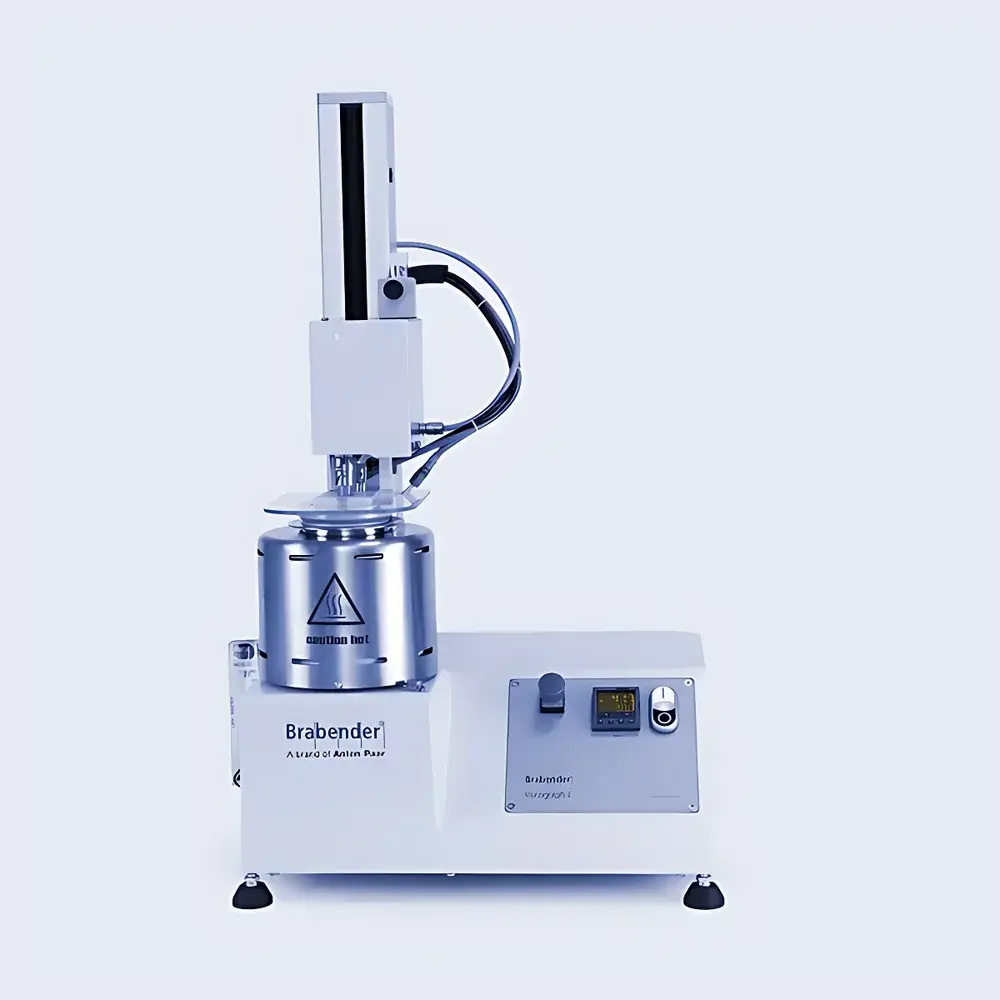
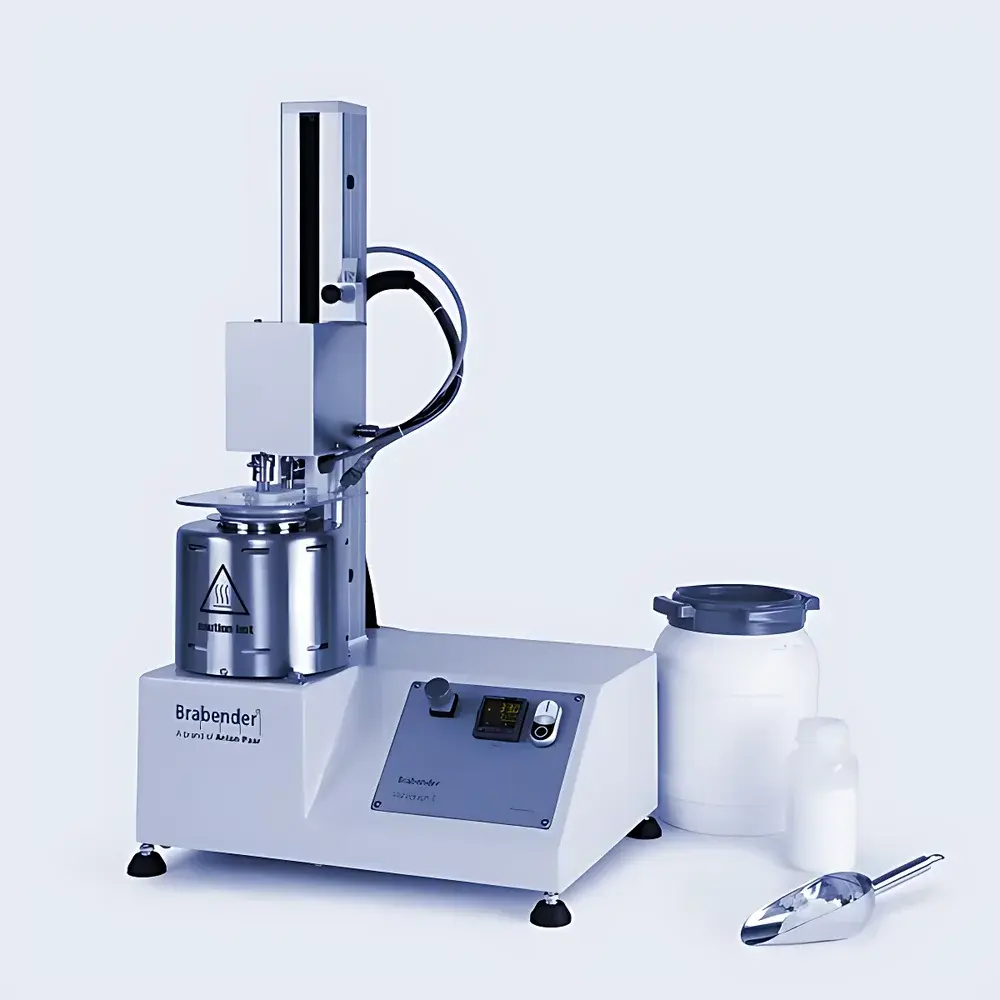
Brabender Viscograph-E Torque Viscometer
| Brand | Anton Paar |
|---|---|
| Origin | Germany |
| Manufacturer Type | Authorized Distributor |
| Origin Category | Imported |
| Model | Viscograph-E |
| Price | USD 135,000 (FOB Hamburg) |
Overview
The Brabender Viscograph-E is a precision torque-based viscometer engineered for standardized evaluation of starch gelatinization and pasting behavior under controlled thermal profiles. Operating on the principle of rotational torque measurement—where a rotating stirrer immersed in a starch slurry generates resistance proportional to apparent viscosity—the instrument delivers real-time rheological data across dynamically programmed temperature ramps. Designed specifically for food science laboratories, grain research centers, and industrial QC/QA departments, it complies with internationally recognized methodologies including ICC Standard No. 169 and AACCI Method 61-01.01. Its core function is to quantify five critical pasting parameters—onset temperature (A), peak viscosity (B), trough viscosity (C), final viscosity (D), breakdown (E), and setback (F)—enabling objective characterization of native, modified, and composite starch systems used in baking, extrusion, sauce formulation, and clean-label thickener development.
Key Features
- Stainless-steel sample vessel and impeller assembly engineered for long-term dimensional stability and wear resistance—eliminating consumable dependencies and ensuring measurement consistency over decades of operation.
- Direct-contact Pt100 temperature sensor embedded in the sample medium enables true bulk-phase temperature monitoring with ±0.1 °C accuracy, minimizing thermal lag and improving correlation with pilot-scale or production processing conditions.
- Programmable heating/cooling rates from 0.1 to 3.0 °C/min (up to 4.0 °C/min optional), supporting both standard protocols and custom thermal profiles for accelerated stability testing or low-temperature retrogradation studies.
- Fixed 40 g sample mass protocol (with total slurry volume of ~450 mL for starch, ~530 mL for flour) ensures reproducible hydration ratios and minimizes operator-induced variability in weighing and dispersion.
- Integrated calibration verification routine allows users to perform in-house functional checks without external service intervention—supporting GLP-compliant instrument qualification workflows.
Sample Compatibility & Compliance
The Viscograph-E accommodates a broad range of starch-containing matrices, including wheat, maize, rice, potato, tapioca, and waxy varieties—both unmodified and chemically or enzymatically modified forms. It also supports composite systems such as starch-protein blends, hydrocolloid-starch mixtures, and whole-grain flours. All measurements are traceable to ICC 169 (determination of pasting properties of cereal flours and starches) and AACCI 61-01.01 (standard method for rapid visco analyzer and Brabender viscoamylograph analysis). Data output conforms to ISO/IEC 17025 requirements for test method validation when operated within documented SOPs. The instrument’s mechanical architecture and software architecture support audit-ready documentation per FDA 21 CFR Part 11 when configured with MetaBridge’s electronic signature and audit trail modules.
Software & Data Management
MetaBridge software provides a unified interface for instrument control, real-time curve visualization, parameter extraction, and report generation. It supports concurrent connection to multiple Brabender instruments—including Amylograph, Farinograph, and Extensograph—enabling cross-platform dough and starch functionality analysis. Remote access via HTML5-compatible browsers allows off-site monitoring and troubleshooting. Raw torque vs. time/temperature datasets export in CSV and XML formats for integration into LIMS, ERP, or statistical process control platforms. All user actions—including method edits, calibration events, and result approvals—are logged with timestamps, operator IDs, and IP addresses to satisfy GMP/GLP audit requirements.
Applications
- Characterization of thermal stability and shear sensitivity during high-moisture cooking processes (e.g., extrusion, retorting, UHT processing).
- Evaluation of acid tolerance in acidic beverage formulations through controlled pH-adjusted pasting trials.
- Assessment of cold-set gel strength and retrogradation kinetics in chilled desserts and dairy alternatives.
- Batch-to-batch consistency verification of commercial starch suppliers against contractual specifications.
- Formulation screening of novel thickener blends for reduced-sugar or gluten-free applications.
- Supporting regulatory dossier submissions requiring physicochemical evidence of functional equivalence between native and modified starches.
FAQ
What is the Brabender Unit (BU), and how is it calibrated?
The Brabender Unit is a proprietary torque-derived viscosity unit defined as 1 BU = 10 cP × mm²/s at 20 °C, referenced to water and standardized using certified starch reference materials traceable to NIST SRM 1849a.
Can the Viscograph-E be used for non-starch polysaccharides like guar gum or xanthan?
Yes—though not covered by ICC/AACCI standards, its open protocol mode supports custom methods for hydrocolloids, provided appropriate impeller geometry and hydration protocols are validated internally.
Is third-party validation support available for IQ/OQ/PQ documentation?
Anton Paar-certified service engineers provide full installation qualification (IQ), operational qualification (OQ), and performance qualification (PQ) packages aligned with ISO 9001 and ASTM E2500 guidelines.
How often does the system require recalibration?
Torque sensor calibration is recommended annually or after 500 test cycles; temperature probe verification should be performed before each daily session using certified reference thermometers.
Does the instrument meet CE and UL safety standards?
Yes—certified to IEC 61010-1:2010 for laboratory equipment, with dual-voltage compatibility (115 V/230 V) and reinforced insulation for wet-environment operation.






