
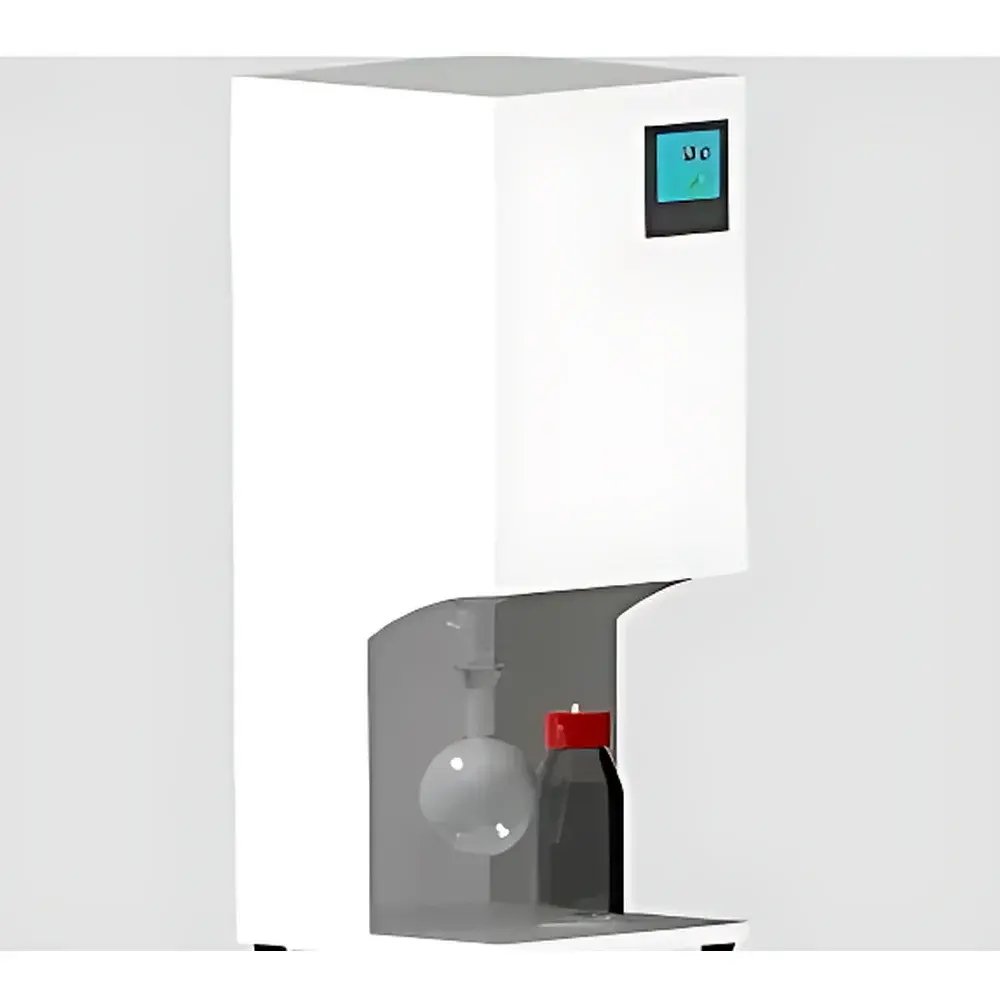
Truelab CHR-1 Laboratory Humidity Control & Solvent Recovery System
| Brand | Truelab |
|---|---|
| Origin | Shanghai, China |
| Model | CHR-1 |
| Humidity Control Range | 20–90 %RH (±3 %RH accuracy) |
| Humidity Display Resolution | 0.1 %RH |
| Humidity Stability | ±3 %RH |
| Dual-layer Condenser Tube | Ø150 mm × 200 mm effective length |
| Condensing Surface Area | ~0.23 m² |
| Solvent Recovery Flask | 1000 mL, standard taper joint (24/29) |
| Humidifier Water Reservoir | 0.6 L |
| Humidifier Heating Power | 250 W |
| Humidifier Temperature Range | Ambient to 90 °C |
| Humidifier Temp. Display Resolution | 0.1 °C |
| Humidifier Temp. Stability | ±1 °C |
| Gas Inlet/Outlet | 1 × 8 mm barbed fitting each |
| Chilled Fluid Inlet/Outlet | 1 × 8 mm barbed fitting each |
| Communication Interface | 1 × GX16-3 connector |
| Dimensions (W×D×H) | 300 × 320 × 745 mm |
| Weight | 22.5 kg |
| Warranty | 12 months labor and parts |
Overview
The Truelab CHR-1 Laboratory Humidity Control & Solvent Recovery System is an integrated environmental conditioning platform engineered for precise RH management and closed-loop solvent capture in controlled laboratory environments. It operates on a dual-function principle: first, active humidity regulation via PID-controlled humidification and refrigerated dehumidification; second, condensative solvent recovery through a high-efficiency dual-layer condenser cooled by an external low-temperature circulator. Unlike passive desiccant-based systems, the CHR-1 employs thermoelectric and resistive heating elements combined with a vapor-compression cooling interface—enabling dynamic equilibrium between moisture addition and removal within sealed test chambers or gloveboxes. Its design targets applications requiring reproducible hygroscopic conditioning (e.g., polymer hydration studies, battery electrode aging, pharmaceutical stability testing) while simultaneously recovering volatile organic solvents (e.g., acetone, ethanol, THF, NMP) from process exhaust streams—reducing emissions, lowering disposal costs, and supporting green lab compliance.
Key Features
- Intelligent dual-mode humidity control: Independent PID-regulated humidifier (ambient to 90 °C, ±1 °C stability) and refrigerated dehumidifier (20–90 %RH, ±3 %RH accuracy) enable rapid equilibration and tight setpoint maintenance.
- High-surface-area dual-layer condenser: Stainless steel construction with 0.23 m² effective condensing area and optimized coolant flow path ensures >92 % solvent recovery efficiency for common low-boiling-point organics under typical lab vacuum conditions (5–50 mbar).
- Modular integration architecture: Standardized 8 mm barbed gas and coolant ports support seamless connection to external vacuum pumps, cryogenic circulators, and custom test enclosures without proprietary adapters.
- Real-time environmental monitoring: Integrated digital sensors provide continuous logging of chamber-relative humidity (0.1 %RH resolution) and humidifier temperature (0.1 °C resolution), with onboard data hold and manual setpoint recall.
- GLP-ready mechanical design: All wetted components are chemically resistant (borosilicate glass flask, PTFE-sealed joints, stainless steel condenser), and the GX16-3 communication interface supports optional RS-485 or analog 4–20 mA output for integration into centralized lab monitoring systems.
Sample Compatibility & Compliance
The CHR-1 is compatible with inert and moderately aggressive solvents including alcohols, ketones, esters, and aprotic dipolar solvents—provided operating vacuum and temperature parameters remain within ASME B31.3 and ISO 10523-defined material compatibility limits for 316 stainless steel and borosilicate 3.3 glass. It meets CE marking requirements for electrical safety (EN 61000-6-3, EN 61000-6-4) and is designed to support adherence to ISO 17025 clause 5.4.2 (environmental condition monitoring) and USP guidelines for humidity-controlled stability studies. While not intrinsically rated for Class I Div 1 hazardous locations, it may be deployed in ventilated fume hoods per NFPA 45 when handling flammable solvents.
Software & Data Management
The CHR-1 operates as a standalone instrument with local setpoint control via front-panel keypad and OLED display. For traceable operation in regulated environments, the GX16-3 interface enables connection to third-party SCADA or LIMS platforms using Modbus RTU or 0–10 V analog signals. Optional firmware upgrade supports 21 CFR Part 11-compliant audit trails—including user login timestamps, parameter change logs, and humidity/temperature event history—with encrypted SD card storage (not included). All sensor calibrations are field-verifiable using NIST-traceable hygrometers and dry-well calibrators.
Applications
- Controlled-humidity aging of lithium-ion battery cathode materials (e.g., NMC, LFP) per ASTM D7002 protocols.
- Solvent recovery during rotary evaporation, thin-film deposition, or solvent-cast polymer processing.
- Stability testing of hygroscopic APIs under ICH Q1A(R3) intermediate and accelerated conditions.
- Moisture sorption isotherm determination (DVS-style) when coupled with microbalance-equipped environmental chambers.
- Humidity calibration verification for reference hygrometers and dew point analyzers in metrology labs.
FAQ
Can the CHR-1 operate without an external chiller?
No—the dual-layer condenser requires a circulating coolant supply at –10 °C to +10 °C to achieve efficient condensation; ambient air cooling is insufficient for reliable solvent recovery.
Is the 1000 mL recovery flask autoclavable?
The borosilicate glass flask is autoclavable at 121 °C for 20 minutes; however, the PTFE stopcock and silicone tubing must be removed prior to sterilization.
Does the system support programmable ramp-and-soak humidity profiles?
Not natively—the CHR-1 provides fixed-setpoint control only; multi-step profiles require external PLC or software integration via the GX16-3 interface.
What maintenance intervals are recommended for long-term reliability?
Condenser cleaning every 200 operational hours; humidifier reservoir descaling monthly with 5 % citric acid solution; annual verification of RH sensor drift against saturated salt standards (e.g., MgCl₂, NaCl, KNO₃).
Can the unit be mounted inside a glovebox?
Yes—its compact footprint (300 × 320 mm base) and rear-mounted service ports allow installation within ISO Class 5–7 gloveboxes; ensure adequate clearance for heat dissipation from the 250 W humidifier element.



