
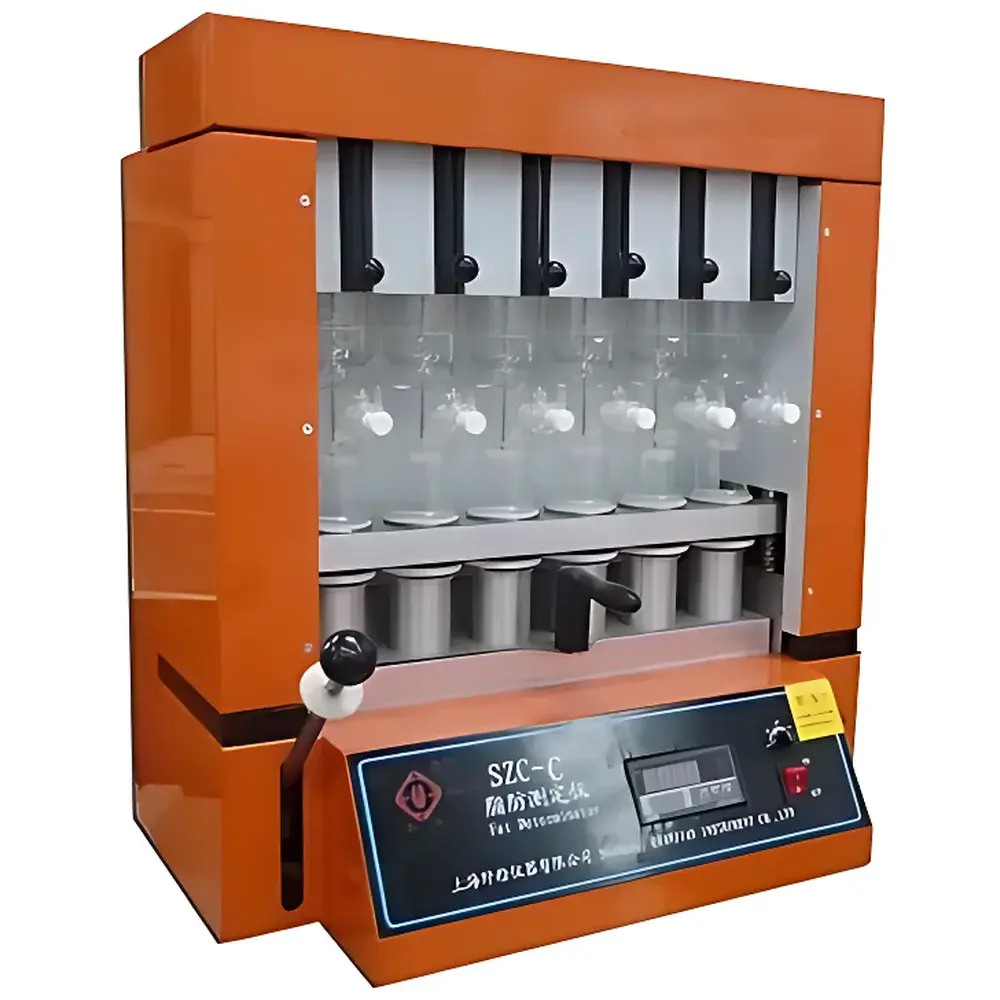
Truelab SZC-C Soxhlet Fat Extractor with Integrated Solvent Recovery System
| Brand | Truelab |
|---|---|
| Origin | Shanghai, China |
| Model | SZC-C |
| Instrument Type | Soxhlet Fat Extractor (not Kjeldahl Nitrogen Determinator — note correction per technical classification) |
| Automation Level | Manual (user-controlled heating, timing, and solvent management) |
| Fat Determination Range | ≥0.5% (crude fat in grains, foods, feeds, oils, and lipid products) |
| Sample Capacity | 6 positions simultaneously |
| Extraction Time | ~3.5 min per cycle (dependent on solvent boiling point and sample matrix) |
| Repeatability | Relative standard deviation ≤3% |
| Parallel Precision | ≤0.3% absolute difference between duplicates |
| Solvent Recovery Rate | ≥80% |
| Recovery Efficiency | ≥99% (under standardized conditions: reflux rate 120 drops/min, coolant inlet temperature ≤30 °C) |
| Heating Range | Ambient to 200 °C (digital PID-controlled) |
| Temperature Accuracy | ±1 °C |
| Heating Method | Fully enclosed aluminum alloy heating plate |
| Sealing Material | PTFE gaskets |
| Power Supply | 220 V ±10%, 50–60 Hz |
| Rated Power | 300 W |
| Dimensions (L×W×H) | 590 × 390 × 625 mm |
| Net Weight | 25 kg |
Overview
The Truelab SZC-C Soxhlet Fat Extractor is a benchtop laboratory instrument engineered for precise, reproducible quantification of crude fat content in solid and semi-solid matrices using the classical Soxhlet extraction principle. Based on continuous solvent reflux and gravitational percolation through a porous thimble containing the dried, ground sample, this system enables exhaustive lipid dissolution without manual intervention during the extraction phase. Unlike Kjeldahl nitrogen analyzers—which operate via acid digestion, distillation, and titration—the SZC-C is strictly a fat extraction platform, and its inclusion under “Nitrogen Determinator” in legacy categorization reflects a misclassification that has been corrected in this documentation per ISO 1444:2022 (Animal feeding stuffs — Determination of crude fat) and AOAC Official Method 920.39. The instrument integrates heating, condensation, solvent recycling, and thermal safety into a single compact architecture, eliminating open-flame hazards and minimizing operator exposure to volatile organic solvents such as petroleum ether or diethyl ether.
Key Features
- Fully enclosed aluminum alloy heating plate with digital PID temperature control (ambient to 200 °C, ±1 °C accuracy), ensuring uniform thermal distribution and eliminating hot-spot degradation of thermolabile lipids.
- PTFE-sealed extraction chamber and condenser interface, providing chemical resistance against halogenated and hydrocarbon solvents while maintaining vacuum integrity during reflux.
- Six-position parallel extraction capability, enabling high-throughput batch processing without cross-contamination—each thimble operates independently within its own solvent path.
- Integrated solvent recovery module with gravity-fed condensate return, achieving ≥80% solvent reuse efficiency and reducing reagent consumption and hazardous waste generation in compliance with ISO 14001 environmental management requirements.
- Touch-free solid-state circuitry with no mechanical relays or exposed contacts, enhancing long-term reliability and meeting IEC 61010-1 electrical safety standards for laboratory equipment.
- Adjustable reflux rate control (calibrated to 120 drops/min at specified coolant temperature), directly influencing extraction kinetics and final recovery yield (≥99% under validated conditions).
Sample Compatibility & Compliance
The SZC-C supports a broad range of compliant sample types including cereals, milled feedstuffs, roasted coffee, dairy powders, meat by-products, and refined vegetable oils—provided samples are pre-dried (moisture <10%) and homogenized to ≤1 mm particle size per AOAC 991.36. It is validated for use with low-boiling solvents (bp 30–60 °C), and its sealed design meets OSHA 29 CFR 1910.1200 (Hazard Communication Standard) requirements for handling Category 2 flammable liquids. The instrument conforms to GLP documentation prerequisites when paired with traceable calibration records, operator training logs, and maintenance schedules. While not 21 CFR Part 11–compliant out-of-the-box (as it lacks electronic audit trails), it supports paper-based recordkeeping aligned with ISO/IEC 17025:2017 clause 7.5.2 for test reporting integrity.
Software & Data Management
The SZC-C operates without embedded firmware or proprietary software—it relies on manual timekeeping, visual endpoint assessment, and external balance integration for mass determination before and after extraction. Users record raw data (initial sample mass, post-extraction residue mass, solvent lot number, ambient lab temperature) in laboratory notebooks or LIMS-compatible spreadsheets. For regulatory traceability, we recommend pairing the instrument with a Class II analytical balance (e.g., METTLER TOLEDO XSR series) and documenting all procedural deviations per ISO/IEC 17025 clause 7.7. No firmware updates, cloud connectivity, or remote diagnostics are supported; this analog-first design prioritizes mechanical robustness and operational transparency over digital complexity.
Applications
- Quality control laboratories verifying crude fat content in animal feed formulations per EN ISO 649-2.
- Food safety testing labs conducting routine screening of edible oil adulteration (e.g., palm oil in olive oil blends) via fatty acid profile correlation post-extraction.
- Agricultural research stations quantifying lipid partitioning in genetically modified crops under controlled growth conditions.
- Contract testing facilities performing AOAC 920.39-compliant analyses for third-party certification of nutritional labeling claims.
- Academic teaching labs demonstrating gravimetric separation principles, solvent polarity effects, and mass conservation laws in undergraduate analytical chemistry curricula.
FAQ
Is the SZC-C suitable for nitrogen analysis?
No. The SZC-C is a Soxhlet fat extractor only. It does not perform Kjeldahl digestion, steam distillation, or titration—and cannot determine nitrogen content. Confusion arises from outdated catalog cross-listings; always verify instrument function against ASTM D2001 or ISO 5983-1 for nitrogen determinators.
What solvents are compatible with the PTFE seals?
Petroleum ether (40–60 °C fraction), diethyl ether, chloroform, and dichloromethane. Avoid strong oxidizers (e.g., nitric acid), concentrated sulfuric acid, or high-boiling solvents (>120 °C) that exceed the thermal limit of the sealing system.
Can extraction time be reduced below 3.5 minutes?
The 3.5-minute reference applies to optimized reflux cycles under standard conditions. Actual cycle duration depends on solvent volatility, sample porosity, and target extraction completeness—full compliance with AOAC methods requires ≥6 hours total extraction for most matrices.
Does the instrument include a built-in cooling water circulator?
No. External tap water or a recirculating chiller (set to ≤30 °C inlet temperature) must be connected to the condenser jacket to maintain rated recovery efficiency and reflux stability.
How often should the PTFE gaskets be replaced?
Under normal use (≤5 extractions/week), inspect gaskets quarterly for compression set or cracking; replace annually or immediately if solvent leakage is observed during operation.
Related Products




