
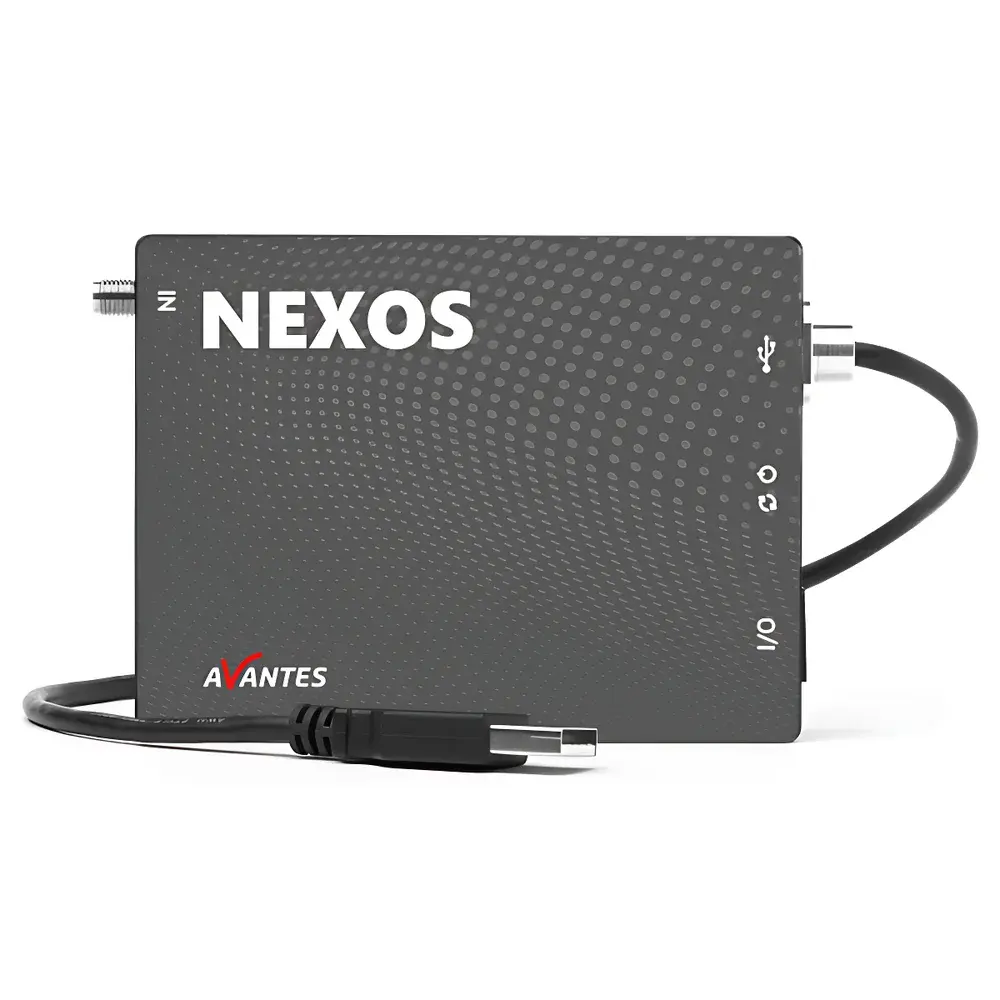
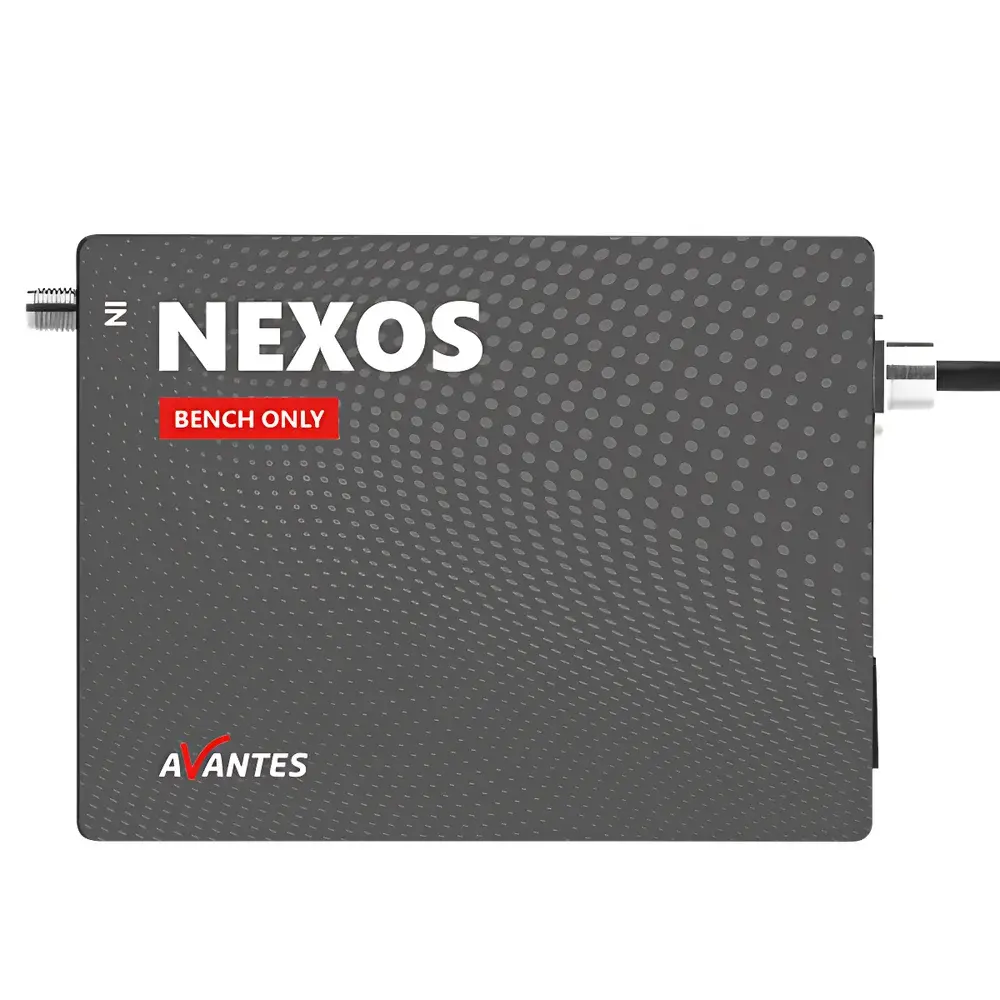
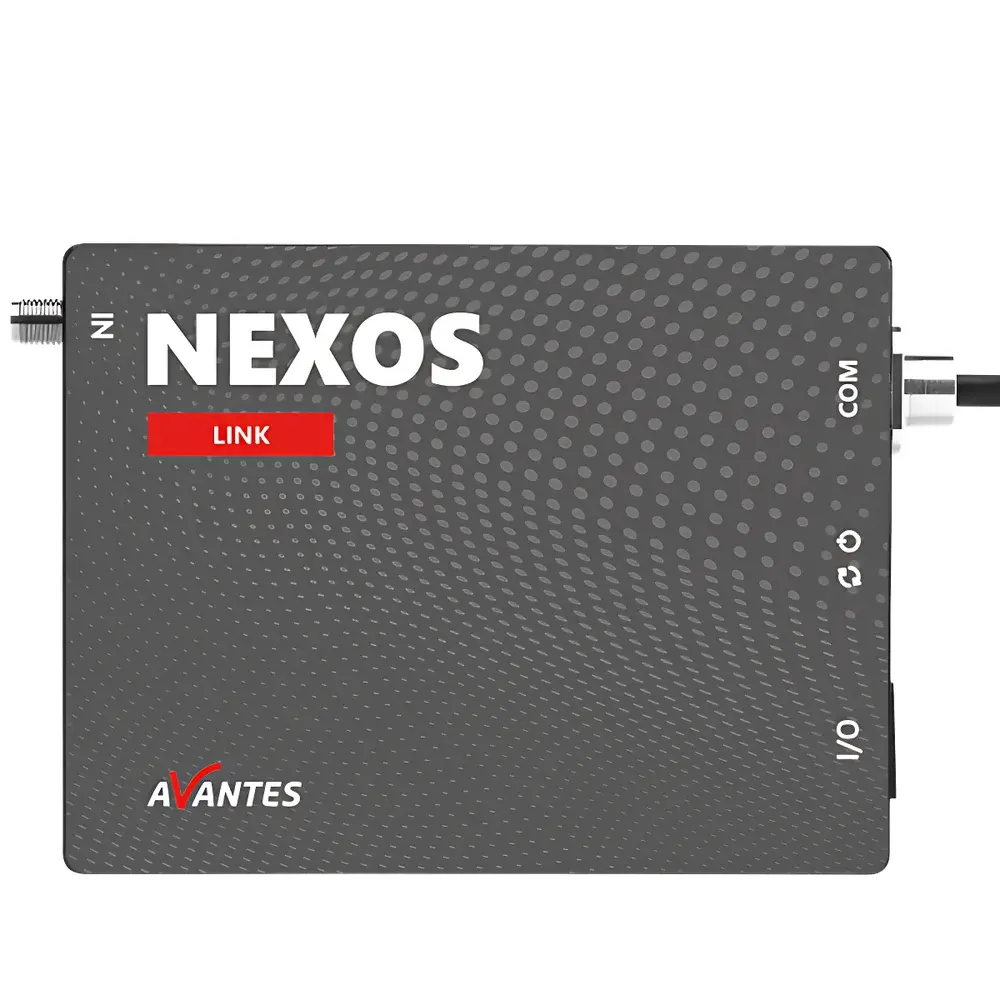
Avantes NEXOS™ Series Compact Fiber Optic Spectrometer
| Brand | Avantes |
|---|---|
| Origin | Netherlands |
| Model | NEXOS™ Series |
| Spectral Range | 190–1100 nm |
| Detector Type | CMOS |
| Signal-to-Noise Ratio | 375:1 (NEXOS™, 2K) / 365:1 (PNEXOS™, 4K) |
| Dynamic Range | 4500 |
| Stray Light | 0.1–1% |
| Communication Interfaces | USB (NEXOS™), RS232/SPI (NEXOS™ Link), Optical Bench Only (NEXOS™ Bench Only) |
| Optical Design | Symmetric Czerny-Turner |
| Pixel Options | 2048 or 4096 |
| Slit Options | Configurable slit widths |
Overview
The Avantes NEXOS™ Series is a family of compact, high-performance fiber optic spectrometers engineered for seamless integration into OEM instrumentation, process monitoring systems, and laboratory-grade analytical platforms. Based on the symmetric Czerny-Turner optical architecture, the NEXOS™ platform delivers consistent spectral fidelity across its full 190–1100 nm range—spanning deep UV through visible to near-infrared wavelengths. Unlike conventional benchtop spectrometers, the NEXOS™ series prioritizes modularity and system-level interoperability without compromising core metrological integrity. Its optical path is optimized to minimize aberrations and maintain resolution stability under thermal and mechanical stress, making it suitable for both controlled lab environments and rugged industrial deployments. The spectrometer’s fundamental measurement principle relies on wavelength-dispersive detection via diffraction grating, with photon collection mediated by SMA 905-compatible optical fibers. All variants share common firmware architecture and calibration traceability to NIST-traceable standards, ensuring cross-platform data comparability in multi-instrument configurations.
Key Features
- Three distinct form factors: NEXOS™ (USB interface), NEXOS™ Link (RS232/SPI interface), and NEXOS™ Bench Only (bare optical bench with detector only)
- CMOS linear array detectors offering 2048-pixel (standard) or 4096-pixel (PNEXOS™) configurations for flexible resolution/sensitivity trade-offs
- Configurable entrance slits (e.g., 5 µm, 10 µm, 25 µm, 50 µm) enabling user-defined optical resolution and throughput optimization
- High dynamic range of 4500:1 (typical, full-scale), supporting quantitative analysis across orders of magnitude in intensity
- Low stray light performance (0.1–1% depending on grating and wavelength region), critical for accurate absorbance and fluorescence measurements
- Robust mechanical housing with thermal stabilization design, minimizing wavelength drift during extended acquisition cycles
- Firmware-upgradable architecture with support for trigger synchronization, external shutter control, and real-time averaging
Sample Compatibility & Compliance
The NEXOS™ Series interfaces directly with Avantes’ portfolio of pulsed and continuous-wave light sources—including deuterium-halogen, LED, and laser-based options—as well as calibrated reflectance and transmission accessories (e.g., integrating spheres, cuvette holders, fiber probes). Its spectral response is validated per ISO/IEC 17025-accredited procedures at Avantes’ Netherlands facility. While not certified as standalone medical or safety-critical devices, the platform supports compliance workflows aligned with GLP and GMP environments when deployed within validated instrument systems. Data acquisition meets the audit trail requirements outlined in FDA 21 CFR Part 11 when used with AvaSoft software configured for electronic signature and version-controlled method storage. Spectral calibrations are performed using traceable mercury-argon and tungsten-halogen reference lamps, with certificate-of-calibration documentation available upon request.
Software & Data Management
The NEXOS™ Series is fully supported by AvaSoft 8, Avantes’ flagship spectroscopy software suite, which provides real-time spectral visualization, multichannel acquisition, kinetic time-series analysis, and chemometric preprocessing tools (e.g., baseline correction, smoothing, peak integration). SDKs are provided for C/C++, Python, LabVIEW, MATLAB, and .NET environments, enabling embedded integration into custom control systems. Raw spectral data is exported in ASCII (.txt), CSV, or binary formats compatible with third-party analytics platforms such as OriginLab, JMP, and Python-based SciPy/Pandas workflows. Firmware updates and configuration management are handled via the AvaSoft Device Manager, ensuring consistent parameter persistence across reboots and host OS changes. All communication protocols—USB HID, virtual COM port (RS232), or SPI register mapping—are documented in publicly accessible technical manuals compliant with IEC 61131-3 conventions for industrial automation contexts.
Applications
- UV-Vis-NIR absorbance and transmittance quantification in pharmaceutical dissolution testing and QC labs
- In-line colorimetric monitoring of chemical reactions and polymerization processes
- Fluorescence lifetime excitation profiling in life science instrumentation
- Plasma emission analysis in semiconductor etch chamber diagnostics
- LED and OLED spectral power distribution (SPD) characterization for lighting R&D
- Environmental water quality sensing via multi-wavelength absorbance (e.g., nitrate, COD, chlorophyll-a)
- OEM integration into handheld spectrometers, portable gas analyzers, and agricultural nutrient sensors
FAQ
What is the difference between NEXOS™, NEXOS™ Link, and NEXOS™ Bench Only?
NEXOS™ uses USB 2.0 for plug-and-play operation; NEXOS™ Link replaces USB with RS232 or SPI interfaces for embedded control; NEXOS™ Bench Only omits all electronics—only the optical bench and detector are supplied for full hardware-level customization.
Can I change the grating or slit after purchase?
Yes—both gratings and slits are field-replaceable with standard tools and alignment fixtures. Avantes provides detailed service manuals and offers recalibration services post-modification.
Is the NEXOS™ series compatible with third-party optical fibers?
Yes—any SMA 905-terminated fiber with core diameter matching the selected slit width is mechanically and optically compatible. Core diameter mismatch may reduce throughput or resolution.
How is wavelength calibration maintained over temperature fluctuations?
The symmetric Czerny-Turner design inherently reduces thermal focal shift. Additionally, optional onboard thermistor feedback enables software-based wavelength correction using temperature-compensated calibration polynomials.
Does Avantes provide application-specific firmware or OEM branding options?
Yes—custom firmware builds, bootloader modifications, and white-label GUI skins are available under NDA for qualified OEM partners with volume commitments.






