
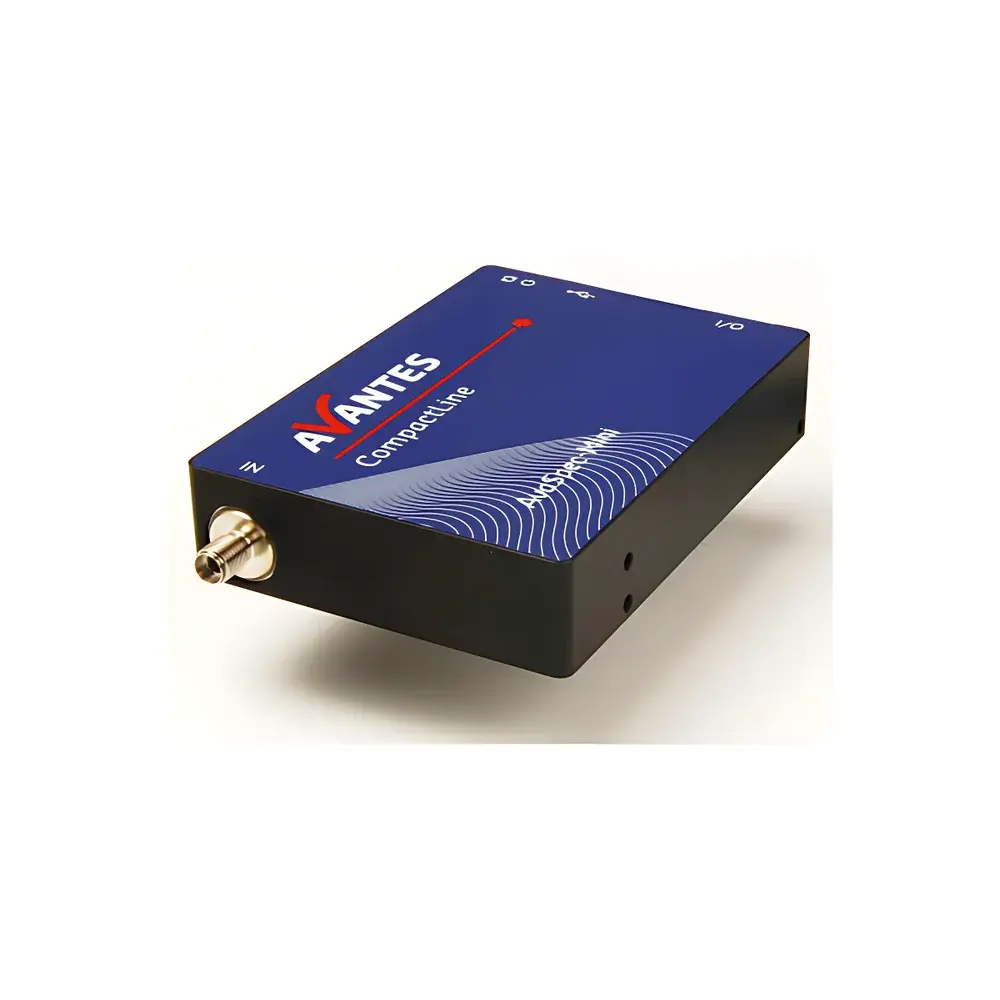
Avantes AvaSpec-Mini MK-II Compact Fiber Optic Spectrometer
| Brand | Avantes |
|---|---|
| Origin | Netherlands |
| Model | AvaSpec-Mini MK-II |
| Spectral Range | 200–1100 nm |
| Detector | Hamamatsu CMOS (2048 or 4096 pixels) |
| Optical Design | Symmetric Czerny-Turner, 75 mm focal length |
| Resolution (FWHM) | down to 0.09 nm (with 1800 l/mm grating & 10 µm slit) |
| Stray Light | <0.2% |
| Sensitivity | up to 375,000 counts/nJ (2048CL) |
| Signal-to-Noise Ratio | 330:1 (2048CL), 300:1 (4096CL) |
| Dynamic Range | 3300:1 |
| A/D Converter | 16-bit, 6 MHz |
| Integration Time | 30 µs – 50 s |
| Data Transfer Speed | 4.6 ms/scan (2048CL), 8.9 ms/scan (4096CL) |
| Interface | USB 2.0 |
| Digital I/O | 5 programmable bidirectional I/O lines, 1 analog output, 1 analog input |
| Dimensions & Weight | 95 × 68 × 20 mm, 174 g |
| Power Supply | USB-powered (500 mA) |
| Operating Temperature | 0–55 °C |
Overview
The Avantes AvaSpec-Mini MK-II is a compact, OEM-optimized fiber optic spectrometer engineered for integration into portable, handheld, and embedded spectroscopic systems. Based on the symmetric Czerny-Turner optical architecture with a 75 mm focal length, it delivers high optical throughput and excellent wavelength fidelity across an extended spectral range of 200–1100 nm. Its core measurement principle relies on dispersive spectroscopy: incident light is collimated, diffracted by a ruled or holographic grating, and focused onto a linear CMOS detector array—enabling precise intensity-vs-wavelength quantification. The instrument’s miniature footprint (95 × 68 × 20 mm, 174 g) and USB 2.0 interface make it ideal for space-constrained applications where low power consumption, rapid data acquisition, and robust mechanical design are critical. Unlike benchtop spectrometers, the AvaSpec-Mini MK-II prioritizes deterministic timing, minimal thermal drift, and reproducible spectral response—attributes essential for industrial process monitoring, field-deployable sensors, and battery-powered analytical devices.
Key Features
- Ultra-compact form factor (credit-card–sized) with full spectral coverage from deep UV to NIR
- Two detector options: 2048-pixel or 4096-pixel Hamamatsu CMOS arrays—optimized for speed, sensitivity, and linearity
- High-resolution capability: FWHM down to 0.09 nm achievable with 1800 l/mm grating and 10 µm entrance slit
- Low stray light (<0.2%) ensures accurate quantification in multi-peak or broadband measurements, particularly critical for fluorescence, Raman excitation monitoring, and LED spectral characterization
- Fast acquisition: minimum integration time of 30 µs; full-spectrum readout in as little as 4.6 ms (2048CL configuration)
- Wide dynamic range (3300:1) enables simultaneous detection of weak and strong spectral features without hardware gain switching
- Onboard digital I/O (5 programmable bidirectional lines, 1 analog input/output) supports synchronized triggering, external shutter control, and real-time feedback loops in closed-loop systems
- USB-powered operation eliminates need for external power supplies—simplifying integration into portable platforms and reducing system BOM cost
Sample Compatibility & Compliance
The AvaSpec-Mini MK-II interfaces seamlessly with standard SMA-905 fiber optic cables (e.g., 200 µm, 400 µm, or 600 µm core diameters), enabling flexible sampling configurations—including reflection probes, transmission cuvette holders, immersion probes, and integrating spheres. It supports both free-space and fiber-coupled illumination sources (e.g., deuterium-halogen lamps, LEDs, laser diodes). While the spectrometer itself is not certified as a medical device or safety-critical instrument, its performance characteristics align with key requirements for method validation under ISO/IEC 17025 and ASTM E308 (for colorimetry), ASTM E131 (for terminology in molecular spectroscopy), and USP (for UV-Vis spectrophotometer verification). Its stable thermal behavior (0–55 °C operating range) and low drift support GLP-compliant routine QC checks when paired with appropriate calibration standards (NIST-traceable tungsten halogen and mercury-argon lamps).
Software & Data Management
Avantes provides the cross-platform AvaSoft software suite (Windows, Linux, macOS) with full API support (C/C++, .NET, Python, LabVIEW, MATLAB). The SDK includes low-level register access, asynchronous scan control, and hardware-triggered acquisition modes—essential for deterministic timing in OEM applications. Raw spectra are exported in ASCII or binary formats compatible with third-party analysis tools (e.g., OriginLab, JMP, Python SciPy stack). For regulated environments, optional firmware extensions enable audit-trail logging and user-access controls compliant with FDA 21 CFR Part 11 requirements when deployed within validated instrument control systems. All firmware updates are delivered via signed binaries with SHA-256 checksum verification to ensure integrity and traceability.
Applications
- Handheld and portable analyzers for food quality screening (e.g., moisture, fat, sugar content via NIR reflectance)
- OEM integration into UV-Vis absorption monitors for water treatment, pharmaceutical dissolution testing, and bioreactor OD tracking
- LED and laser diode spectral characterization in manufacturing QA/QC labs
- Fluorescence lifetime excitation profiling and emission peak tracking in point-of-care diagnostics
- Plasma monitoring in semiconductor etch and deposition tools
- Educational lab modules requiring rugged, low-cost, yet metrologically sound spectroscopic instrumentation
FAQ
What is the minimum integration time supported by the AvaSpec-Mini MK-II?
The shortest configurable integration time is 30 microseconds, enabling high-speed transient event capture.
Can the spectrometer operate without external power beyond USB?
Yes—it draws nominal current (≤500 mA at 5 V) directly from the USB 2.0 host port, eliminating the need for auxiliary power supplies.
Is NIST-traceable calibration available for this model?
Avantes offers factory calibration with NIST-traceable standards (deuterium, tungsten-halogen, mercury-argon) and optional recalibration services per ISO/IEC 17025-accredited procedures.
How does resolution vary with slit width and grating selection?
Resolution (FWHM) is a function of optical design and component configuration—detailed in the published resolution matrix covering slit widths (10–500 µm) and gratings (300–1800 l/mm); typical values range from 0.09 nm to >22 nm depending on setup.
Does the device support synchronization with external equipment?
Yes—via TTL-compatible trigger input/output signals and programmable digital I/O lines, supporting master-slave timing architectures in multi-instrument systems.




