
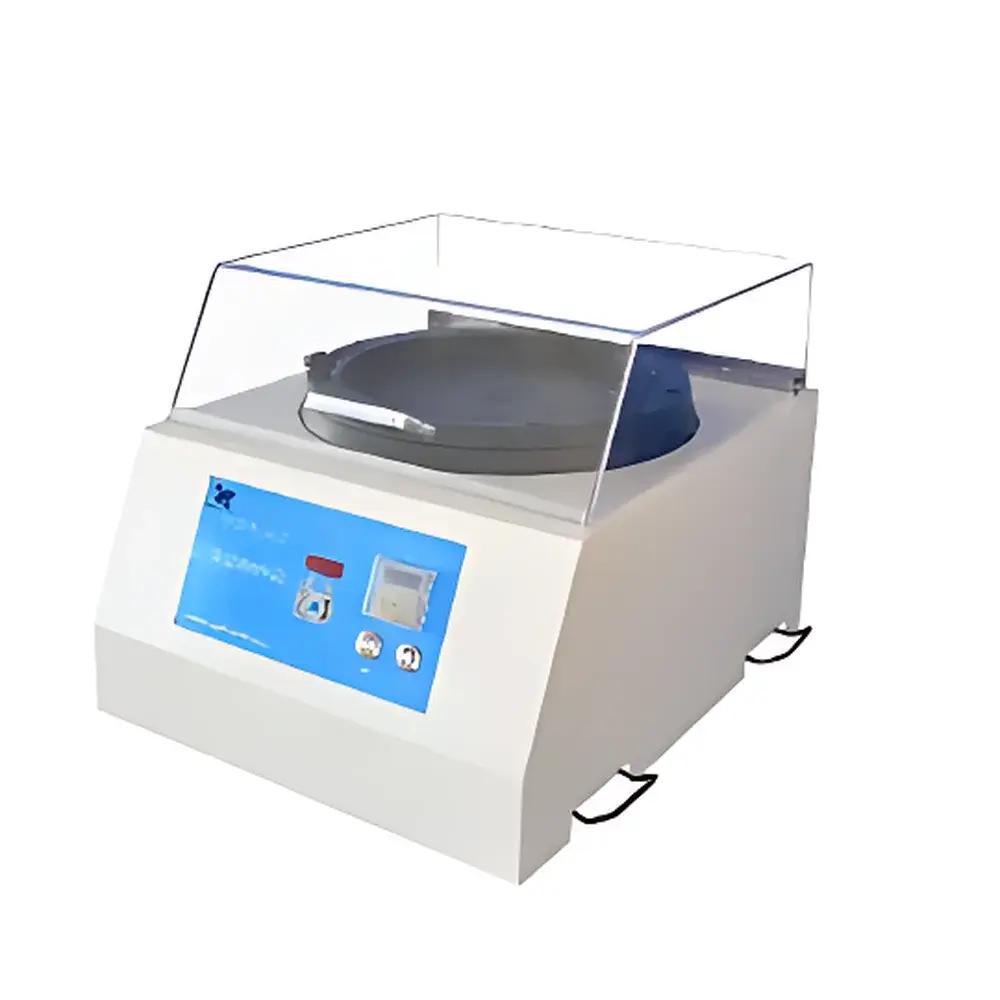
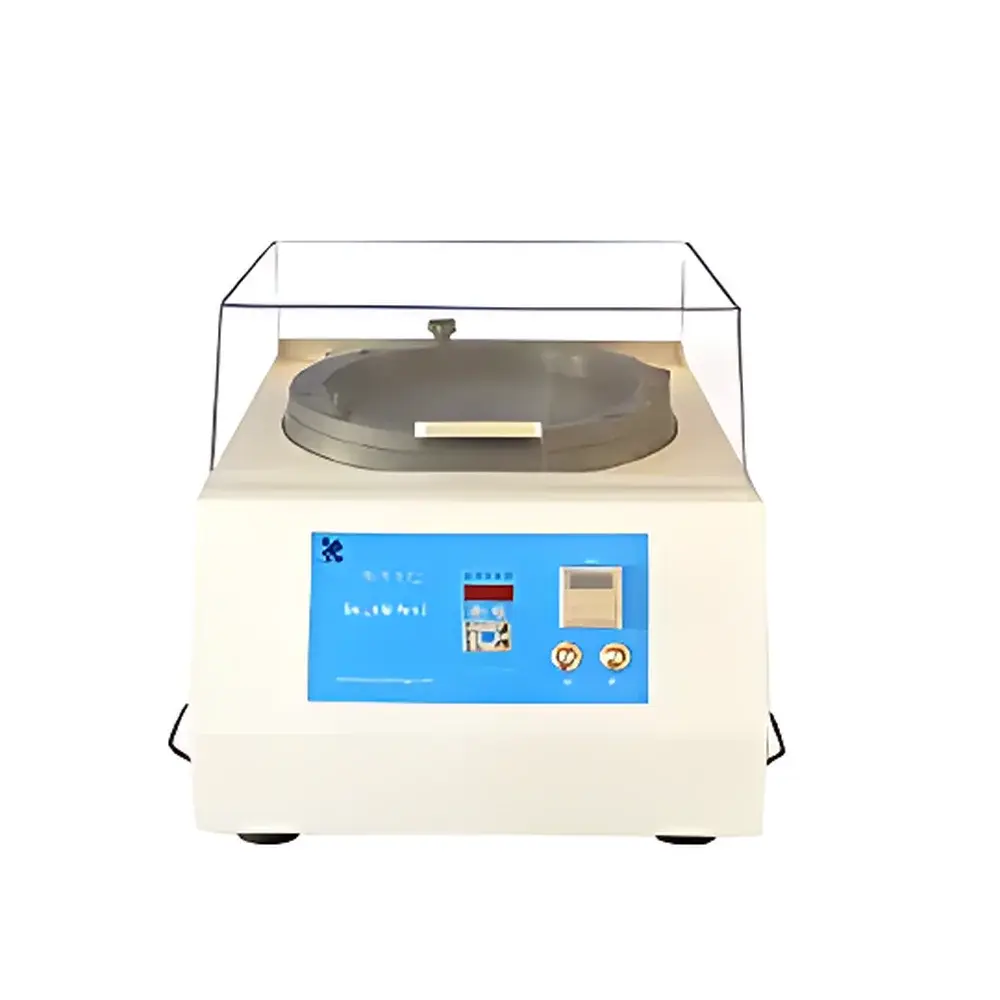
UNIPOL-900Z Vibratory Polishing Machine by KJ Group
| Brand | KJ Group |
|---|---|
| Origin | Liaoning, China |
| Model | UNIPOL-900Z |
| Dimensions (L×W×D) | 530 × 530 × 430 mm |
| Platen Count | 1 |
| Platen Diameter | 228.6 mm |
| Frequency Range | 0–240 Hz |
| Max Timer Setting | 9999 min |
| Input Voltage | AC 110/220 V, 50/60 Hz |
| Power Consumption | 350 W |
| Weight | 82 kg |
| Sample Holder Options | 1", 1.25", 1.5", 2", 32 mm, 50 mm (customizable) |
| Compliance | Designed for ASTM E3, ISO 14487, and GLP-compliant sample prep workflows |
Overview
The UNIPOL-900Z Vibratory Polishing Machine is an advanced, microstructure-preserving surface finishing instrument engineered specifically for the preparation of electron backscatter diffraction (EBSD)-ready specimens and other high-fidelity materials science samples. Unlike conventional rotary or planar polishing systems that induce mechanical deformation, subsurface damage, or preferential grain removal, the UNIPOL-900Z employs controlled vibratory motion—rather than rotational shear—to achieve ultra-low-stress, isotropic material removal. This principle relies on harmonic oscillation of the sample carrier relative to a stationary polishing surface, enabling uniform abrasion without directional bias. The result is a stress-relieved, artifact-free surface ideal for subsequent SEM-EBSD analysis, TEM lamella inspection, or X-ray diffraction studies where crystallographic integrity must be preserved. Its design targets laboratories engaged in metallurgy, geoscience (rock/mineral thin-section preparation), semiconductor packaging analysis, and advanced ceramics R&D—where traditional polishing methods risk introducing dislocation arrays or phase-specific etching artifacts.
Key Features
- Digitally controlled variable-frequency drive (0–240 Hz) with real-time LCD display of operating parameters including frequency, elapsed time, and remaining cycle duration.
- Full automation capability: programmable timer up to 9999 minutes supports unattended operation, minimizing operator intervention and ensuring inter-sample reproducibility.
- Robust fiberglass-reinforced polymer housing with chemical-resistant finish and integrated transparent polycarbonate dust shield—maintains platen cleanliness while enabling visual process monitoring.
- Modular sample holder system accommodating standard diameters (1″, 1.25″, 1.5″, 2″, 32 mm, 50 mm); custom fixtures available for non-standard geometries or oversized specimens (e.g., wafer fragments, geological core segments).
- Optimized for compatibility with low-damage polishing consumables—including synthetic leather, microfiber pads, polyurethane matrices—and colloidal silica (50 nm) and alumina (80 nm) suspensions calibrated for EBSD-grade finish.
- Thermally stable base platform with vibration-dampening feet ensures consistent amplitude delivery across extended cycles, critical for achieving sub-micron surface roughness (Ra < 5 nm after final polish).
Sample Compatibility & Compliance
The UNIPOL-900Z accommodates both mounted (epoxy/resin-embedded) and unmounted specimens, including brittle ceramics, single-crystal semiconductors, multiphase alloys, and heterogeneous geological aggregates. Its low-shear mechanism prevents pull-out of hard second-phase particles and avoids smearing of soft metallic phases—key requirements outlined in ASTM E3 “Standard Guide for Preparation of Metallographic Specimens” and ISO 14487 “Metallographic specimen preparation for microstructural analysis.” The machine’s operational envelope (ambient temperature: 10–40 °C; humidity: 45–65% RH; altitude ≤1000 m) aligns with GLP facility environmental specifications. All electrical components comply with IEC 61000-6-3 (EMC emission standards) and IEC 61000-6-2 (immunity), supporting integration into regulated QA/QC environments subject to FDA 21 CFR Part 11 audit readiness when paired with validated LIMS data capture protocols.
Software & Data Management
While the UNIPOL-900Z operates via embedded firmware without external PC dependency, its digital interface logs timestamped cycle metadata—including start/stop times, selected frequency, and total runtime—stored in non-volatile memory for traceability. Optional RS-232 or USB-to-serial adapter enables export of operational logs to laboratory information management systems (LIMS) or electronic lab notebooks (ELN). When used within GMP/GLP workflows, this logging functionality supports audit trails required under Annex 11 and USP Analytical Instrument Qualification guidelines. No proprietary software installation is required; exported CSV files are compatible with common statistical process control (SPC) platforms for trend analysis of polishing consistency across batches.
Applications
- Preparation of EBSD-compatible surfaces for orientation mapping in nickel-based superalloys, titanium alloys, and additively manufactured Inconel 718.
- Stress-free polishing of quartz, feldspar, and olivine grains in petrographic thin sections for quantitative texture analysis.
- Final-stage finishing of silicon carbide (SiC) power device substrates prior to cross-sectional SEM imaging.
- Surface conditioning of zirconia-toughened alumina (ZTA) biomedical implants to assess grain boundary cohesion without thermal or mechanical perturbation.
- Routine quality control polishing of solder joint cross-sections in automotive electronics assemblies per IPC-TM-650 2.1.1.
FAQ
What types of samples are unsuitable for vibratory polishing on the UNIPOL-900Z?
Extremely soft polymers (e.g., PTFE, LDPE) or highly porous foams may experience excessive edge rounding or surface pitting due to prolonged low-force abrasion; such materials require alternative electrochemical or ion-beam polishing methods.
Can the UNIPOL-900Z be integrated into automated sample prep lines?
Yes—its dry-operation design, compact footprint (530 × 530 mm), and programmable timer support integration with robotic sample loaders and conveyor-based staging systems compliant with SEMI S2/S8 safety standards.
Is calibration certification available for metrological traceability?
KJ Group provides optional factory calibration documentation (NIST-traceable frequency and timer verification) upon request, aligned with ISO/IEC 17025 requirements for accredited calibration laboratories.
How does vibratory polishing compare to electrolytic polishing for stainless steel?
Vibratory polishing removes material mechanically without altering surface chemistry or inducing electropolishing-induced recrystallization; it is preferred when maintaining native oxide layer integrity is essential for subsequent ToF-SIMS or XPS analysis.
What maintenance intervals are recommended for long-term reliability?
Biannual inspection of suspension springs, annual replacement of polishing pad mounting gaskets, and quarterly verification of frequency output accuracy using a handheld tachometer—documented in the included Maintenance Log Template (per ISO 55001 asset management principles).



