
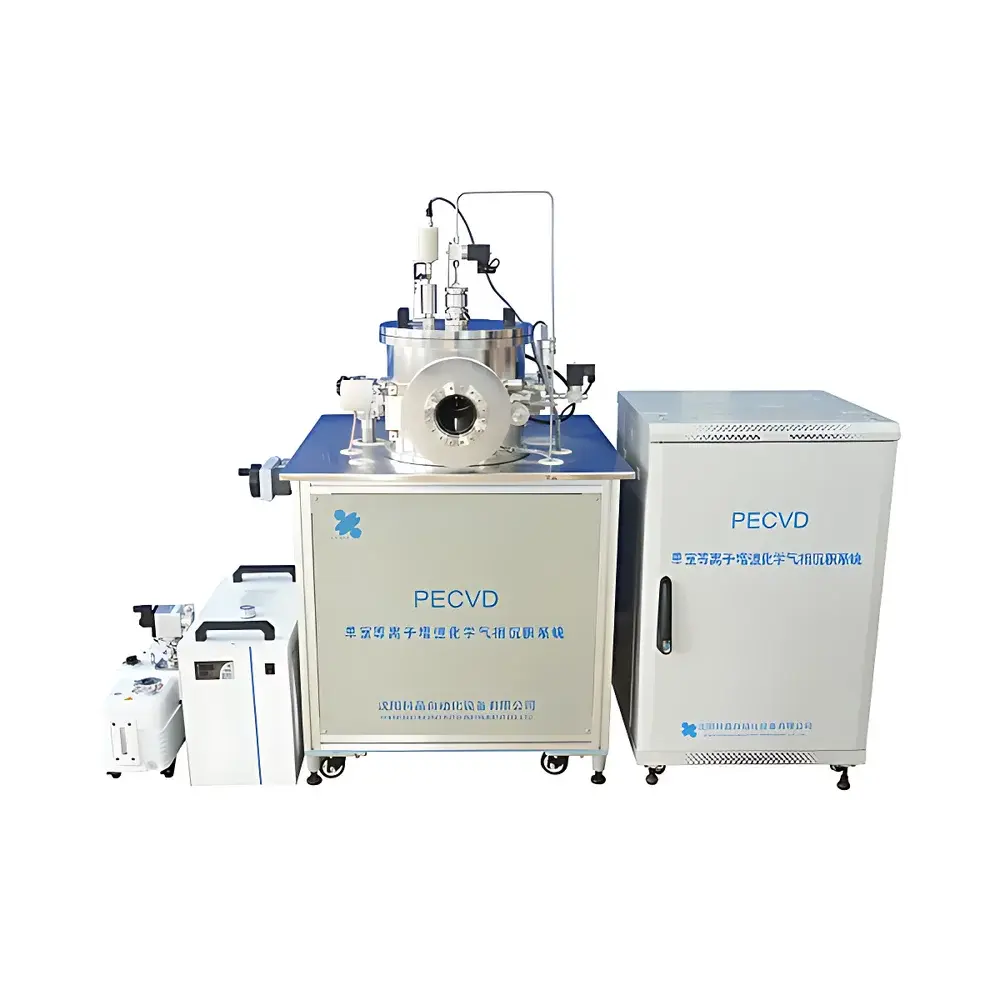
KJ GROUP PECVD-300 Capacitively Coupled Parallel-Plate Plasma Enhanced Chemical Vapor Deposition System
| Brand | KJ GROUP |
|---|---|
| Origin | Liaoning, China |
| Manufacturer Type | Authorized Distributor |
| Country of Origin | China |
| Model | PECVD-300 |
| Vacuum Chamber Dimensions | Φ300 mm × 300 mm |
| Base Pressure (after bake-out) | ≤8.0×10⁻⁵ Pa |
| Ultimate Leak Rate | ≤5.0×10⁻⁷ Pa·L/s |
| Process Pressure Range | 13.3–133 Pa |
| RF Power Supply | 13.56 MHz, 0–300 W, auto-matching |
| Electrode Gap Adjustment | 15–50 mm (graduated scale) |
| Substrate Heating | up to 500 °C, ±1 °C stability |
| Showerhead Diameter | Φ90 mm |
| Gas Inlets | 2 standard MFC channels (100 sccm each) |
| Cooling Water Requirements | 0.2–0.4 MPa pressure, 15–25 °C inlet temperature |
| Total Power Consumption | <4 kW |
Overview
The KJ GROUP PECVD-300 is a laboratory-scale, single-chamber capacitively coupled plasma enhanced chemical vapor deposition system engineered for controlled thin-film synthesis and nanomaterial growth under low-temperature plasma conditions. It operates on the principle of radiofrequency (13.56 MHz) capacitive coupling between parallel electrodes — a configuration that generates uniform, low-energy plasma with high dissociation efficiency for precursor gases while minimizing ion bombardment damage to thermally sensitive substrates. Unlike thermal CVD, PECVD enables film deposition at substrate temperatures as low as room temperature up to 500 °C, making it suitable for integrating dielectric, semiconductor, and carbon-based layers (e.g., SiNx, SiOx, a-Si:H, DLC, and graphene-related films) onto glass, silicon, flexible polymers, or pre-patterned wafers. The system is designed for process development, material screening, and small-batch prototyping in academic research labs, R&D centers, and pilot production environments where reproducibility, vacuum integrity, and parameter traceability are critical.
Key Features
- Robust stainless-steel (AISI 304) vacuum chamber with argon arc welding, electropolished and glass-bead blasted surface finish for ultra-low outgassing and corrosion resistance.
- Manual front-loading cylindrical chamber (Φ300 mm × 300 mm) with quartz viewport and integrated shutter for real-time plasma observation without breaking vacuum.
- High-vacuum architecture featuring a 600 L/s turbomolecular pump backed by a 4 L/s dry scroll pump; achieves base pressure ≤8.0×10⁻⁵ Pa after bake-out and maintains ≤20 Pa after 12-hour pump-down hold.
- Capacitive electrode configuration: stationary top showerhead electrode (Φ90 mm) and bottom rotating heated stage, enabling uniform gas distribution and enhanced film homogeneity across 4-inch substrates.
- Precision substrate heating system with PID-controlled resistive heating, stable ±1 °C regulation from ambient to 500 °C, and programmable ramp/soak profiles.
- Adjustable inter-electrode gap (15–50 mm) with calibrated mechanical scale, allowing empirical optimization of plasma density, ion energy, and radical flux for specific film stoichiometry and stress control.
- Integrated 13.56 MHz RF generator (0–300 W) with automatic impedance matching network to sustain stable plasma ignition and minimize reflected power during process transients.
Sample Compatibility & Compliance
The PECVD-300 accommodates rigid and semi-rigid substrates up to 100 mm in diameter, including silicon wafers, fused silica, ITO-coated glass, metal foils, and polymer films (e.g., PET, PI). Its modular gas delivery supports up to two independently controlled mass flow controllers (standard 100 sccm range), compatible with common precursors such as NH3, SiH4, CH4, N2, Ar, O2, and forming gas mixtures. All wetted components comply with ASTM F519 for stress-corrosion resistance, and vacuum seals meet ISO 2859-1 sampling standards. While the system itself does not carry CE or UL certification, its electrical design conforms to IEC 61000-6-3 (EMC emission limits) and IEC 61000-6-2 (immunity requirements), and vacuum performance aligns with ISO 27893 for residual gas analysis readiness. Users implementing GLP or GMP workflows may integrate external audit-trail-capable data loggers for temperature, pressure, RF forward/reflected power, and MFC setpoints.
Software & Data Management
The system operates via a dedicated industrial HMI panel with local touchscreen interface, supporting manual mode operation and basic recipe storage (up to 20 user-defined protocols). All critical process parameters — chamber pressure (capacitance manometer), substrate temperature, RF forward/reflected power, MFC flow rates, and electrode gap position — are continuously monitored and logged at 1 Hz resolution to internal non-volatile memory. Raw time-series data export is supported via USB 2.0 in CSV format for post-processing in MATLAB, Python (Pandas), or OriginLab. Optional RS-485/Modbus RTU interface enables integration into centralized SCADA or MES platforms for lab-wide equipment monitoring and electronic batch record (EBR) generation, compliant with FDA 21 CFR Part 11 when paired with validated third-party software.
Applications
- Growth of hydrogenated amorphous silicon (a-Si:H) and microcrystalline silicon (μc-Si) for thin-film photovoltaic device development.
- Deposition of silicon nitride (SiNx) and silicon oxynitride (SiOxNy) passivation layers in CMOS and MEMS fabrication.
- Synthesis of diamond-like carbon (DLC) coatings for tribological testing and biomedical surface functionalization.
- Plasma-assisted synthesis of vertical ZnO or GaN nanowires on seeded substrates under sub-atmospheric pressure conditions.
- Surface modification of polymeric membranes for enhanced hydrophilicity, anti-fouling, or gas separation selectivity.
- Fundamental studies of plasma-surface interaction kinetics, including VUV photon flux effects and ion-assisted reaction pathways.
FAQ
What vacuum pumping configuration is required for optimal base pressure performance?
A 600 L/s turbomolecular pump backed by a 4 L/s dry scroll pump is factory-integrated and necessary to achieve ≤8.0×10⁻⁵ Pa after bake-out. Use of alternative pumps may compromise ultimate vacuum and process repeatability.
Can the system be upgraded to support additional gas lines or higher RF power?
Yes — the gas manifold accepts up to four MFC channels (additional modules available separately), and the RF subsystem can be replaced with a 500 W or 1 kW generator (requires chamber grounding verification and impedance recalibration).
Is remote operation or Ethernet connectivity supported?
Standard configuration includes only local HMI control. Remote operation requires optional Modbus TCP gateway or third-party OPC UA server integration, which must be validated per site-specific cybersecurity policies.
What maintenance intervals are recommended for long-term vacuum integrity?
O-rings should be inspected quarterly and replaced annually; turbomolecular pump oil (if applicable) requires servicing every 12 months or 8,000 operating hours; chamber cleaning with acetone/isopropanol is advised after every 50 deposition cycles involving silicon-containing precursors.
Does the system include exhaust abatement or toxic gas handling provisions?
No — end-of-line scrubbers, catalytic destruct units, or acid gas neutralizers must be supplied and installed by the user in accordance with local environmental regulations (e.g., EPA 40 CFR Part 63, EU Directive 2010/75/EU).



