
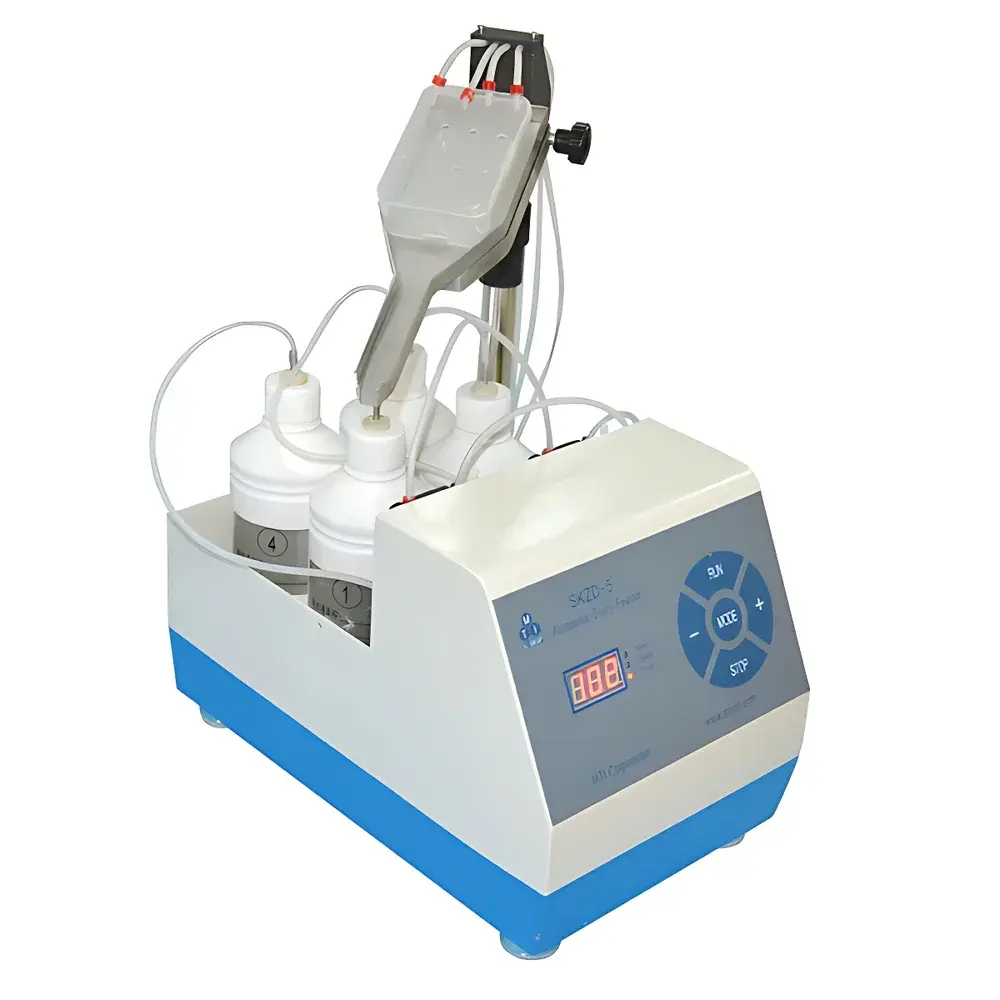
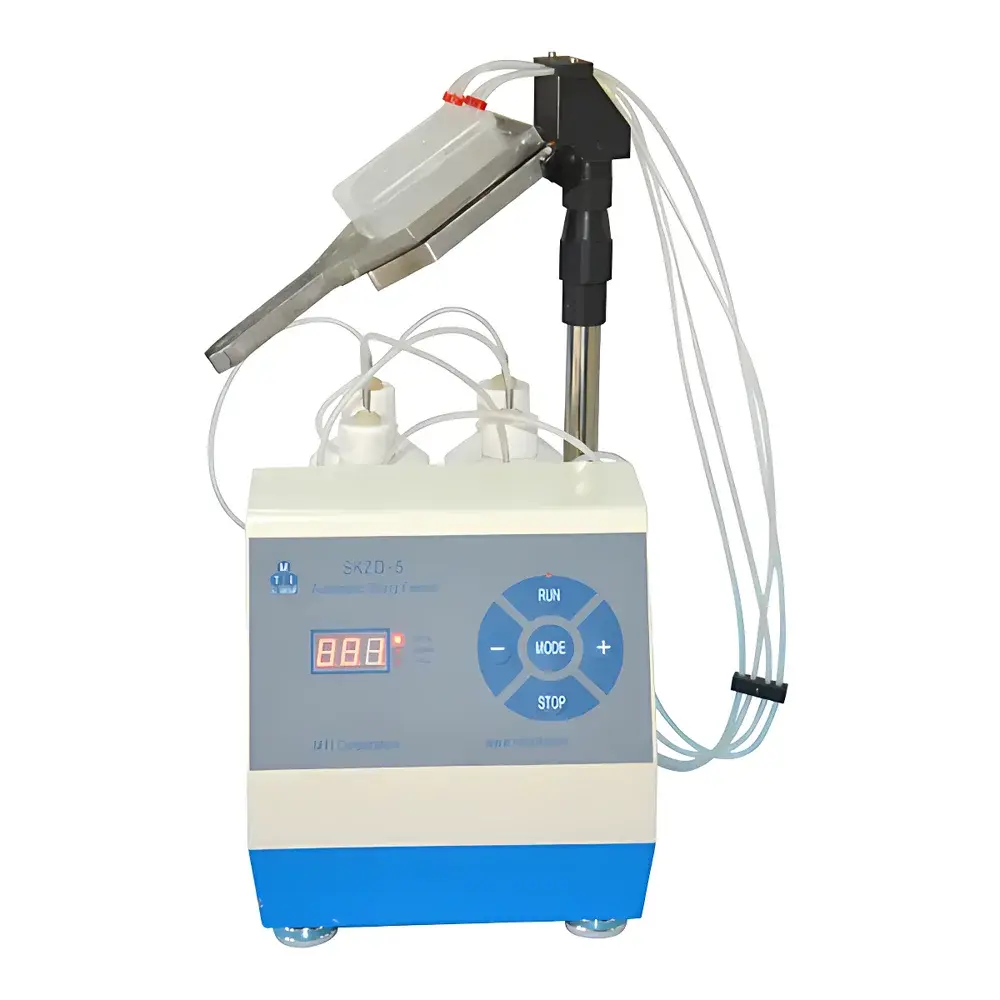
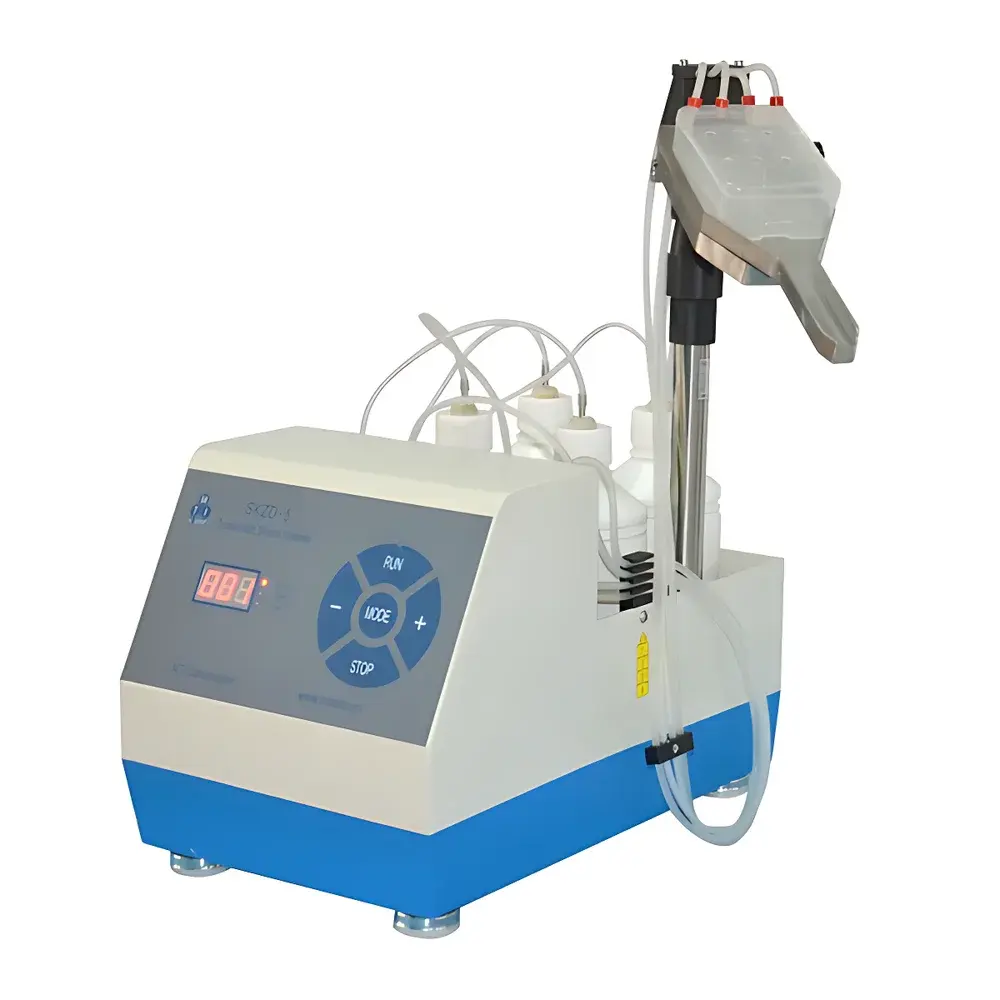
KJ GROUP SKZD-5 Automatic Dispensing System for Precision Lapping and Polishing
| Brand | KJ GROUP |
|---|---|
| Origin | Liaoning, China |
| Manufacturer Type | Authorized Distributor |
| Country of Origin | China |
| Model | SKZD-5 |
| Pricing | Upon Request |
| Power Input | AC 100–240 V, 50/60 Hz |
| Suspension Liquid Flow Rate | 0.1–10 mL/min (tubing ID 2 mm, OD 4 mm) |
| Dry Abrasive Slurry Flow Rate | 0.16–7.5 mL/min (tubing ID 2 mm, OD 4 mm) |
| Number of Peristaltic Pumps | 4 |
| Reagent Bottle Capacity | 4 × 500 mL |
| Dry Abrasive Reservoir Dimensions | 90 × 60 × 27 mm |
| Timer Range | 1–999 min |
| Operating Environment | ≤1000 m altitude, 10–40 °C, 45–65 %RH |
| Footprint | 230 × 370 × 450 mm (W×D×H) |
| Weight | 11 kg |
Overview
The KJ GROUP SKZD-5 Automatic Dispensing System is an engineered solution for precise, repeatable, and hands-free delivery of both liquid suspension slurries and dry abrasive powders during lapping, fine grinding, and polishing processes—particularly when integrated with planar precision lapping machines. Unlike conventional spray-based or gravity-fed dispensers, the SKZD-5 employs a dual-mode peristaltic pumping architecture to deliver controlled volumetric flow without atomization, ensuring consistent slurry formulation at the interface between workpiece and lap plate. Its core operational principle relies on positive displacement via four independent, calibrated peristaltic pumps—each driving either aqueous suspension media or liquid-assisted dry abrasive transport through chemically resistant silicone tubing (ID 2 mm, OD 4 mm). This design eliminates cross-contamination, supports multi-chemistry workflows, and enables reproducible material removal rates critical for semiconductor wafer conditioning, optical lens fabrication, and advanced ceramic substrate processing.
Key Features
- Four independently controllable peristaltic pumps enable simultaneous or sequential dispensing of up to four different slurries or abrasive carriers—eliminating manual bottle changes and minimizing process interruption.
- Dual dispensing capability: supports both liquid suspension delivery (0.1–10 mL/min) and liquid-assisted dry abrasive metering (0.16–7.5 mL/min), where carrier fluid flow rate directly modulates dry abrasive output via hydraulic entrainment in the reservoir chamber.
- Microprocessor-based control system with intuitive LED interface and programmable timer (1–999 minutes) ensures autonomous operation; automatic pump shutdown upon timer expiry guarantees precise reagent dosing and prevents over-application.
- No-spray, non-aerosol delivery mechanism maintains workplace air quality compliance and avoids surface overspray, particle drift, or uneven film formation—critical for cleanroom-compatible lapping environments.
- Modular dry abrasive reservoir (90 × 60 × 27 mm) features sealed geometry and optimized fluid-path geometry to ensure uniform powder mobilization and stable flow kinetics across varying viscosity profiles.
- Compact footprint (230 × 370 × 450 mm) and low mass (11 kg) allow flexible integration onto standard lapping station workbenches (min. 400 × 500 mm surface); ventilation requirement accommodates solvent-evaporation management in enclosed setups.
Sample Compatibility & Compliance
The SKZD-5 is compatible with a broad range of lapping and polishing media—including colloidal silica, cerium oxide, aluminum oxide, diamond suspensions, and proprietary dry abrasives formulated for silicon, sapphire, glass, and tungsten carbide substrates. Its tubing and reservoir materials meet USP Class VI biocompatibility standards for non-leaching contact surfaces. While not certified to ISO 13485 or FDA 21 CFR Part 11 out-of-the-box, the system’s deterministic timer logic, non-volatile parameter storage, and discrete pump actuation support GLP/GMP-aligned documentation protocols when paired with external audit-log software. It operates within ambient environmental limits specified by IEC 61000-6-2 (immunity) and IEC 61000-6-4 (emission), and complies with CE marking requirements for laboratory equipment under Directive 2014/30/EU (EMC) and 2014/35/EU (LVD).
Software & Data Management
The SKZD-5 operates via embedded firmware with no external PC dependency. All parameters—including individual pump activation states, flow duration, and timer settings—are retained in non-volatile memory after power cycling. Though it lacks USB or Ethernet connectivity, its deterministic behavior and fixed-resolution timer (1-minute granularity) permit full traceability in batch records. For regulated environments, users may integrate the device into broader MES or LIMS platforms via discrete digital I/O signals (optional relay module available upon request), enabling start/stop synchronization and event logging aligned with ASTM E2500-13 (verification of automated systems) and ISO/IEC 17025:2017 Clause 7.7 (data integrity).
Applications
- Semiconductor backgrinding and wafer bevel conditioning requiring sub-micron thickness uniformity.
- Optical component manufacturing—including plano-convex lenses, laser crystals, and EUV mask substrates—where slurry consistency directly impacts surface roughness (Ra) and subsurface damage depth.
- Advanced ceramic and metal matrix composite polishing, where dry abrasive modulation enables rapid transition between coarse and fine grit stages without hardware reconfiguration.
- R&D laboratories performing DOE-driven abrasive optimization studies, leveraging the four-channel architecture to compare slurry formulations side-by-side under identical mechanical conditions.
- Quality control labs conducting inter-laboratory round-robin testing of lapping efficiency, where reproducible reagent delivery minimizes inter-operator variability.
FAQ
Does the SKZD-5 support remote monitoring or data export?
No—the unit operates as a standalone instrument with local control only. Data logging requires external recording of timer events and manual entry into lab notebooks or LIMS.
Can the tubing be replaced with fluoropolymer alternatives for aggressive solvents?
Yes—while standard configuration uses platinum-cured silicone (compatible with pH 2–12 aqueous media), users may substitute with FEP or PTFE-reinforced peristaltic tubing (sold separately) for organic solvent compatibility.
Is calibration traceable to NIST or other national standards?
Flow calibration is performed using gravimetric measurement against certified analytical balances; however, the device does not include built-in calibration certificates. Users are advised to perform periodic verification per ISO/IEC 17025 Section 6.6.
What maintenance intervals are recommended for the peristaltic pumps?
Tubing replacement is recommended every 500 hours of cumulative operation or after 12 months—whichever occurs first—to maintain flow accuracy within ±3% of setpoint.
Does the dry abrasive reservoir require periodic cleaning between material changes?
Yes—residue accumulation alters flow dynamics. Cleaning with isopropyl alcohol and compressed air is required before switching abrasive types to prevent cross-contamination and ensure repeatable delivery kinetics.



