
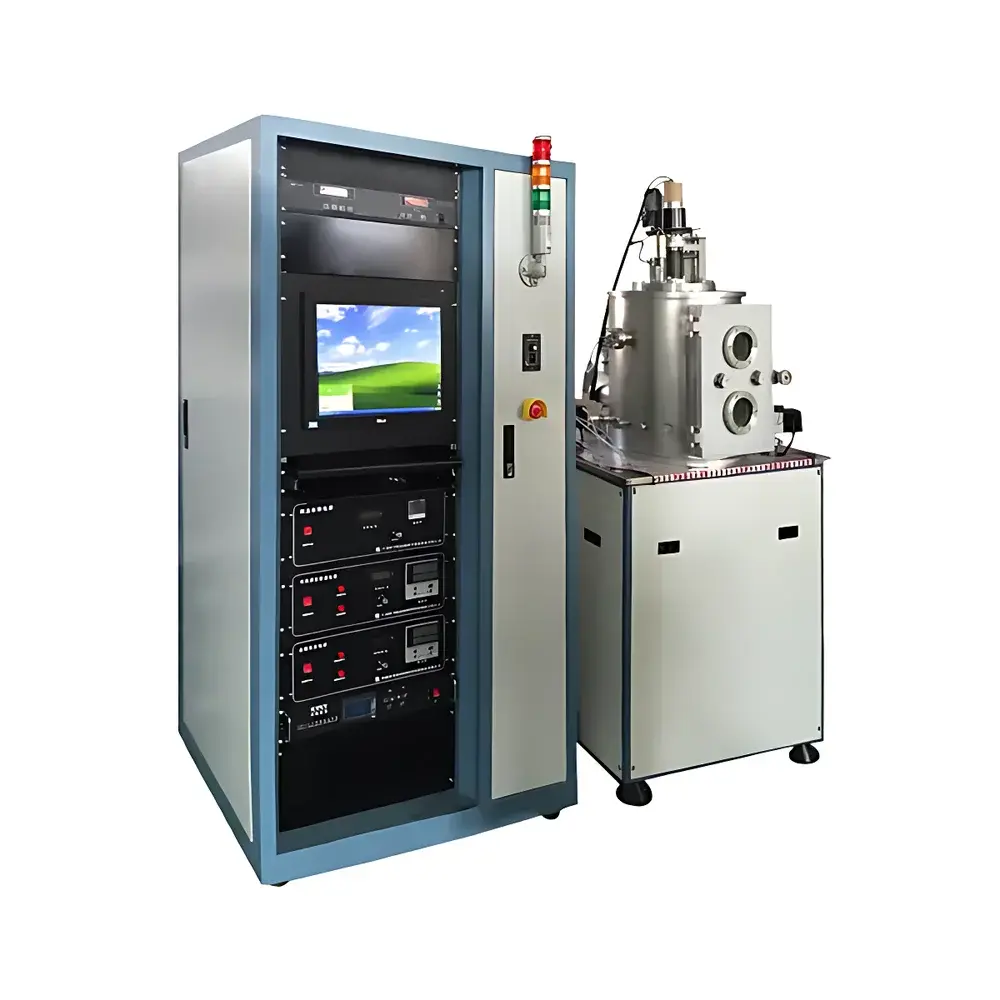
KJ GROUP KJ-Perovskite Organic-Inorganic Hybrid Thermal Evaporation Coating System
| Brand | KJ GROUP |
|---|---|
| Origin | Liaoning, China |
| Manufacturer Type | Authorized Distributor |
| Country of Origin | China |
| Model | KJ-Perovskite |
| Price Range | USD $42,000 – $70,000 |
| Chamber Material | 304 Stainless Steel |
| Chamber Dimensions (W×D×H) | 600 mm × 450 mm × 450 mm |
| Vacuum System | Turbo-molecular Pump + Rotary Vane Mechanical Pump |
| Base Pressure | ≤6 × 10⁻⁴ Pa |
| System Leak Rate | ≤1 × 10⁻⁷ Pa·L/s |
| Organic Sources | 4 × 5 mL crucibles, dual 0.5 kW temperature-controlled e-beam/ resistive sources (max 400 °C, with thermocouple feedback) |
| Inorganic Sources | 4 × 5 mL crucibles, dual high-current resistive sources (300 A, 3.2 kW) |
| Source Shutter | Pneumatically actuated magnetic latching shutter |
| Substrate Holder | Top-mounted, accommodates Ø120 mm wafers or standard microscope slides |
| Substrate Rotation | 0–30 rpm, motorized and programmable |
| Substrate Heating | RT–180 °C, PID-controlled with integrated thermocouple |
| Thickness Monitoring | Dual-channel quartz crystal microbalance (QCM), resolution 0.1 Å, range 0–999,999 Å |
| Safety Interlocks | Coolant flow monitoring, power loss detection, emergency stop circuitry, misoperation prevention logic |
Overview
The KJ GROUP KJ-Perovskite Organic-Inorganic Hybrid Thermal Evaporation Coating System is a vertically oriented, high-vacuum thermal evaporation platform engineered for the reproducible fabrication of multilayer thin films in perovskite photovoltaics (PV), organic light-emitting diodes (OLEDs), and hybrid optoelectronic devices. Its core architecture follows a bottom-up evaporation configuration—where four organic and four inorganic evaporation sources are mounted on the chamber floor, while substrates are secured on a temperature-controlled, rotating stage mounted on the top lid. This geometry minimizes particulate contamination, enables precise shadow-mask alignment, and supports sequential co-evaporation of volatile organic precursors (e.g., spiro-OMeTAD, PTAA) alongside metal halides (e.g., PbI₂, MAI, FAI) or metallic electrodes (Ag, Au, Al). The system operates under ultra-low base pressure (≤6 × 10⁻⁴ Pa), ensuring minimal residual gas incorporation during deposition—a critical requirement for achieving stoichiometric control and low-defect nucleation in solution-incompatible, air-sensitive perovskite phases.
Key Features
- Vertical source-to-substrate orientation with top-mounted substrate holder and bottom-mounted evaporation sources—optimized for uniform film coverage and reduced thermal cross-talk.
- Dual independent evaporation zones: Four 5 mL organic-compatible crucibles (resistive heating, 400 °C max, 0.5 kW) and four inorganic crucibles (high-current resistive, 300 A, 3.2 kW) enable simultaneous or staggered deposition of molecular and metallic species.
- Automated magnetic-latching shutters for each source—precisely timed via TTL-triggered sequencing to ensure sub-second layer definition and interfacial sharpness.
- Programmable substrate rotation (0–30 rpm) and integrated PID-controlled heating (RT–180 °C) support in-situ annealing, crystallinity tuning, and solvent-free phase transformation during deposition.
- Real-time thickness monitoring using a dual-channel quartz crystal microbalance (QCM) with 0.1 Å resolution and full-scale range up to 999,999 Å—calibrated for common perovskite constituents (PbI₂: d = 6.15 g/cm³; CH₃NH₃PbI₃: d ≈ 4.1 g/cm³).
- Comprehensive safety architecture including coolant flow interlock, mains power loss detection, hardware-enforced emergency stop, and software-level misoperation guardrails compliant with IEC 61000-6-2/6-4 EMC standards.
Sample Compatibility & Compliance
The KJ-Perovskite system accommodates standard 120 mm diameter substrates—including silicon wafers, glass slides, ITO/PEDOT:PSS-coated PET, and flexible metal foils—without requiring custom fixtures. Its stainless-steel vacuum chamber (304 grade, electropolished interior) meets ASTM F86 for surface passivation and resists halide-induced corrosion during extended PbI₂ or SnI₂ evaporation cycles. All electrical subsystems conform to CE marking requirements (2014/30/EU EMC Directive, 2014/35/EU LVD Directive). Data acquisition from the QCM and temperature controllers supports audit-ready timestamped logging, aligning with GLP-compliant lab practices. While not FDA 21 CFR Part 11 certified out-of-the-box, the system’s deterministic control architecture and non-volatile event logging provide foundational traceability for GMP-aligned R&D environments.
Software & Data Management
Control is executed via KJ-Soft v3.2—a Windows-based, multi-threaded application supporting recipe-driven automation, real-time parameter visualization (pressure, source current/voltage, substrate temperature, QCM frequency shift), and synchronized shutter sequencing. All operational parameters—including ramp rates, dwell times, shutter open/close delays, and thickness setpoints—are stored in encrypted XML files with SHA-256 integrity checksums. Export formats include CSV (for MATLAB/Python post-processing) and PDF reports containing metadata (operator ID, timestamp, chamber history, calibration logs). Optional OPC UA server integration enables connection to enterprise MES/LIMS platforms for centralized batch record management.
Applications
- Sequential and co-evaporated deposition of mixed-cation, mixed-halide perovskites (e.g., Cs₀.₀₅(FA₀.₈₃MA₀.₁₇)₀.₉₅Pb(I₀.₈₃Br₀.₁₇)₃) for high-efficiency solar cells (>25% PCE in research cells).
- Thermally stable hole-transport layers (e.g., NiOₓ, MoOₓ, CuSCN) and electron-transport layers (e.g., C₆₀, BCP, TiOₓ) compatible with roll-to-roll pre-patterning workflows.
- Fabrication of tandem device stacks—e.g., perovskite/silicon or perovskite/CIGS—requiring sub-nanometer interlayer control and thermal budget management.
- Model studies of interfacial diffusion kinetics via controlled bilayer evaporation (e.g., evaporated Spiro-OMeTAD onto vapor-deposited MAPbI₃) monitored by in-situ QCM mass change analysis.
- Process transfer validation between lab-scale R&D and pilot-line vacuum coating tools, leveraging identical source geometry, pressure regimes, and thermal profiles.
FAQ
What vacuum level is required for high-quality perovskite film deposition?
A base pressure ≤6 × 10⁻⁴ Pa is recommended to limit H₂O and O₂ partial pressures below 10⁻⁷ mbar—critical for suppressing decomposition of methylammonium and formamidinium cations during thermal evaporation.
Can the system deposit both organic and inorganic layers in a single vacuum cycle?
Yes. The independent control of eight evaporation sources (four organic, four inorganic), combined with programmable shutter timing and substrate rotation, enables fully automated multilayer sequences without venting.
Is the QCM calibrated for perovskite materials?
The included dual-channel QCM supports user-defined density inputs. Factory-provided calibration curves cover PbI₂, MAPbI₃, FAPbI₃, and common HTL/ETL materials; additional densities can be entered manually based on XRD-determined crystallographic density.
Does the system support remote monitoring or integration with lab networks?
Standard Ethernet (TCP/IP) connectivity enables remote status viewing and basic recipe upload/download. Optional KJ-Link add-on provides secure TLS-encrypted API access for Python- or LabVIEW-based automation frameworks.
What maintenance intervals are recommended for the vacuum system?
Molecular pump oil replacement every 6,000 hours; mechanical pump oil every 500 hours; chamber cleaning (including anti-contamination baffle) after every 50 deposition runs involving halide precursors to prevent residue buildup on viewports and sensors.



