
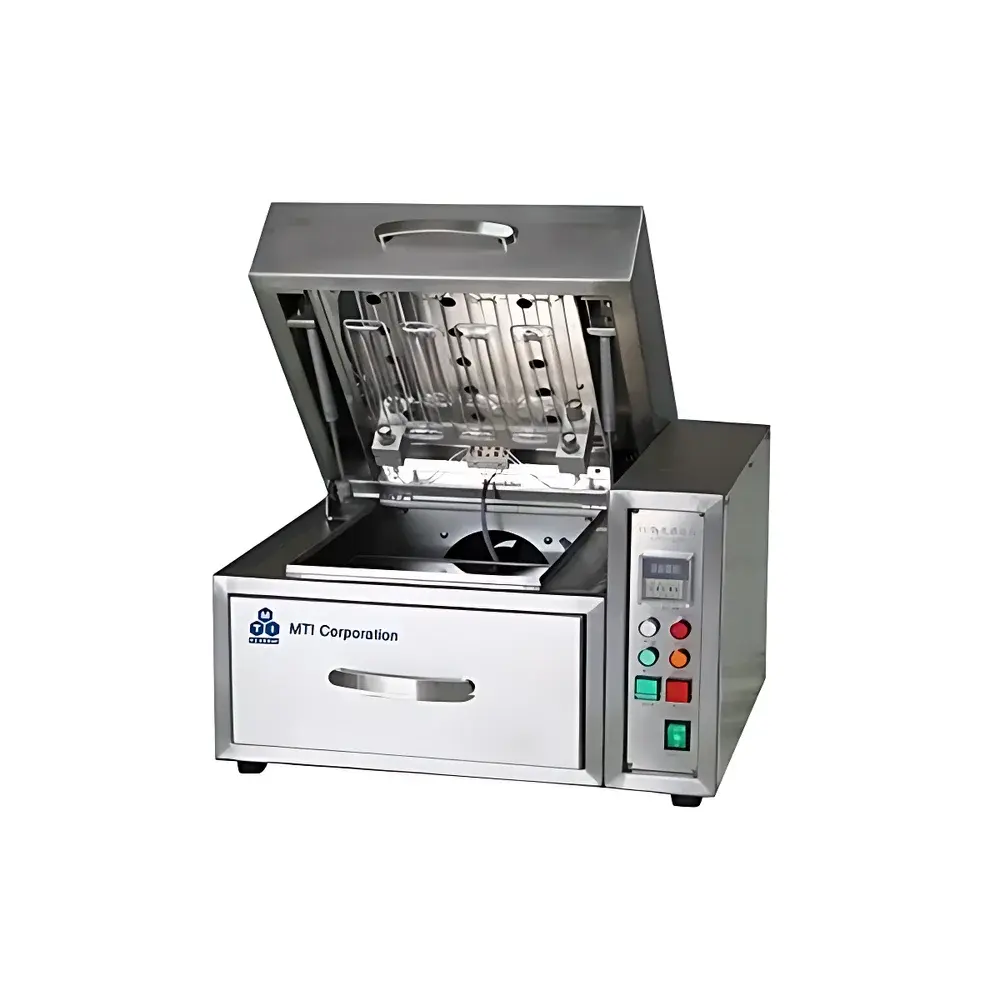
PCE-22-LD UV/Ozone Cleaner
| Origin | USA |
|---|---|
| Manufacturer Type | Authorized Distributor |
| Origin Category | Imported |
| Model | PCE-22-LD |
| Price | Upon Request |
| Power Rating | ≤350 W |
| Input Voltage | AC 208–240 V, Single-Phase, 50/60 Hz |
| Chamber Dimensions (W×H×D) | 510 × 350 × 400 mm |
| Net Weight | 28 kg |
| Sample Stage Area | 310 × 320 mm |
| Adjustable Lamp-to-Stage Distance | 20–40 mm |
| Max. Heating Temperature | 150 °C |
| Temperature Control | 20-Step Programmable Ramp/Soak, ±1 °C Accuracy |
| UV Lamp | Dual-Wavelength Hg Lamp (185 nm & 254 nm), 55 W, 200 × 200 mm Irradiation Area, 2500 h Lifetime |
| Ozone Exhaust Port | Ø80 mm (rear-mounted) |
| Ambient Ozone Emission | <45 ppb |
| Operating Environment | Altitude ≤5500 ft |
Overview
The PCE-22-LD UV/Ozone Cleaner is an engineered benchtop system designed for atomic-level surface cleaning and modification of substrates in semiconductor fabrication, nanomaterial research, electron microscopy sample preparation, and thin-film deposition workflows. It operates on the principle of photochemical oxidation: ultraviolet radiation at 185 nm photolyzes ambient molecular oxygen (O₂) to generate ozone (O₃), while simultaneous irradiation at 254 nm directly cleaves C–C, C–H, and C–O bonds in organic contaminants—including photoresist residues, hydrocarbons, siloxanes, and adventitious carbon layers. The synergistic action of UV photons and reactive oxygen species enables dry, acid-free, non-abrasive removal of sub-monolayer organic contamination without substrate etching or thermal damage. Unlike plasma-based systems, this method imposes no electrical bias, eliminates ion bombardment effects, and avoids metal sputtering—making it especially suitable for delicate surfaces such as Au-coated TEM grids, PDMS microstructures, and oxide-passivated III–V wafers (e.g., GaAs, InP). The integrated heating stage extends functionality to thermally assisted decomposition of stubborn organics and controlled surface functionalization.
Key Features
- Programmable heated sample stage (up to 150 °C) with ±1 °C temperature stability and 20-segment ramp/soak capability for process reproducibility
- Dual-wavelength mercury vapor lamp (185 nm + 254 nm) delivering uniform irradiance across a 200 × 200 mm area; lamp life rated at 2500 hours
- Stainless-steel chamber with drawer-style sample access, minimizing exposure time and ensuring operator safety
- Adjustable lamp-to-sample distance (20–40 mm) to optimize photon flux density and ozone concentration at the surface
- Dedicated rear-mounted Ø80 mm ozone exhaust port compatible with standard laboratory ducting (external tubing required)
- Compliance with UL/CSA Class I, Division 2 safety standards; ambient ozone emission maintained below 45 ppb during operation
- Compact footprint (510 × 350 × 400 mm) and low power draw (≤350 W) for integration into ISO Class 5–7 cleanrooms or shared lab spaces
Sample Compatibility & Compliance
The PCE-22-LD accommodates substrates up to 12 inches in diameter and 35 mm in thickness—including silicon, germanium, gallium arsenide, quartz, fused silica, sapphire, and various metal oxides (e.g., SiO₂, Al₂O₃, TiO₂). Its non-contact, solvent-free mechanism preserves stoichiometry and interfacial integrity critical for XPS, AFM, and ellipsometry validation. The system meets key regulatory expectations for pre-deposition surface conditioning under ASTM F2089-21 (Standard Practice for Cleaning Semiconductor Wafers Using UV/Ozone) and supports GLP-compliant documentation when paired with external logging systems. While not intrinsically certified for GMP manufacturing environments, its design adheres to IEC 61000-6-3 (EMC emissions) and IEC 61000-6-2 (immunity), facilitating audit readiness in regulated R&D labs.
Software & Data Management
The PCE-22-LD operates via front-panel digital interface with real-time display of elapsed time, setpoint temperature, and lamp status. Though it lacks embedded data logging or remote control capabilities, all timing and thermal parameters are manually programmable with resolution down to 0.01 seconds and 0.1 °C. For traceability in QA/QC applications, users may integrate external USB data loggers or PLC controllers via dry-contact relay outputs (optional accessory). Process parameters—including exposure duration, heating profile, and lamp activation sequence—can be documented per batch in accordance with internal SOPs aligned with FDA 21 CFR Part 11 principles (when combined with validated electronic record systems).
Applications
- Pre-lithography wafer cleaning to eliminate residual photoresist and improve resist adhesion
- Surface activation of polymers (e.g., PDMS, PET, PI) for enhanced hydrophilicity prior to bonding or metallization
- Cleaning of SEM/TEM specimen holders and grid substrates to reduce charging and carbon buildup
- Oxidative removal of organic monolayers from biosensor surfaces without degrading immobilized antibodies or DNA probes
- UV-assisted curing of sol-gel precursors and photocatalytic oxidation of surface-bound VOCs
- MEMS device cleaning where mechanical scrubbing or solvent immersion risks stiction or structural fatigue
- Surface functionalization of graphene and TMDs (MoS₂, WS₂) for controlled oxygen incorporation
FAQ
Is the PCE-22-LD suitable for use in a nitrogen-purged glovebox?
No—the system relies on ambient air as the ozone precursor; operation under inert atmosphere will suppress O₃ generation and significantly reduce cleaning efficacy.
Can the UV lamp be replaced by the end user?
Yes—the lamp is field-replaceable using standard tools; replacement requires recalibration of lamp alignment to maintain irradiance uniformity across the sample area.
What safety precautions are required for ozone exhaust?
Ozone must be vented outdoors via rigid or reinforced rubber tubing; local exhaust ventilation should comply with OSHA PEL (0.1 ppm, 8-hr TWA) and NIOSH REL (0.05 ppm, 15-min ceiling).
Does the heater affect UV output intensity?
No—lamp operation and thermal control are electrically isolated; stage heating does not alter UV spectral distribution or photon flux.
How often should the chamber interior be cleaned?
Stainless-steel walls require wiping with IPA every 50 operational hours to prevent ozone-induced oxidation film accumulation that may attenuate UV transmission.



