
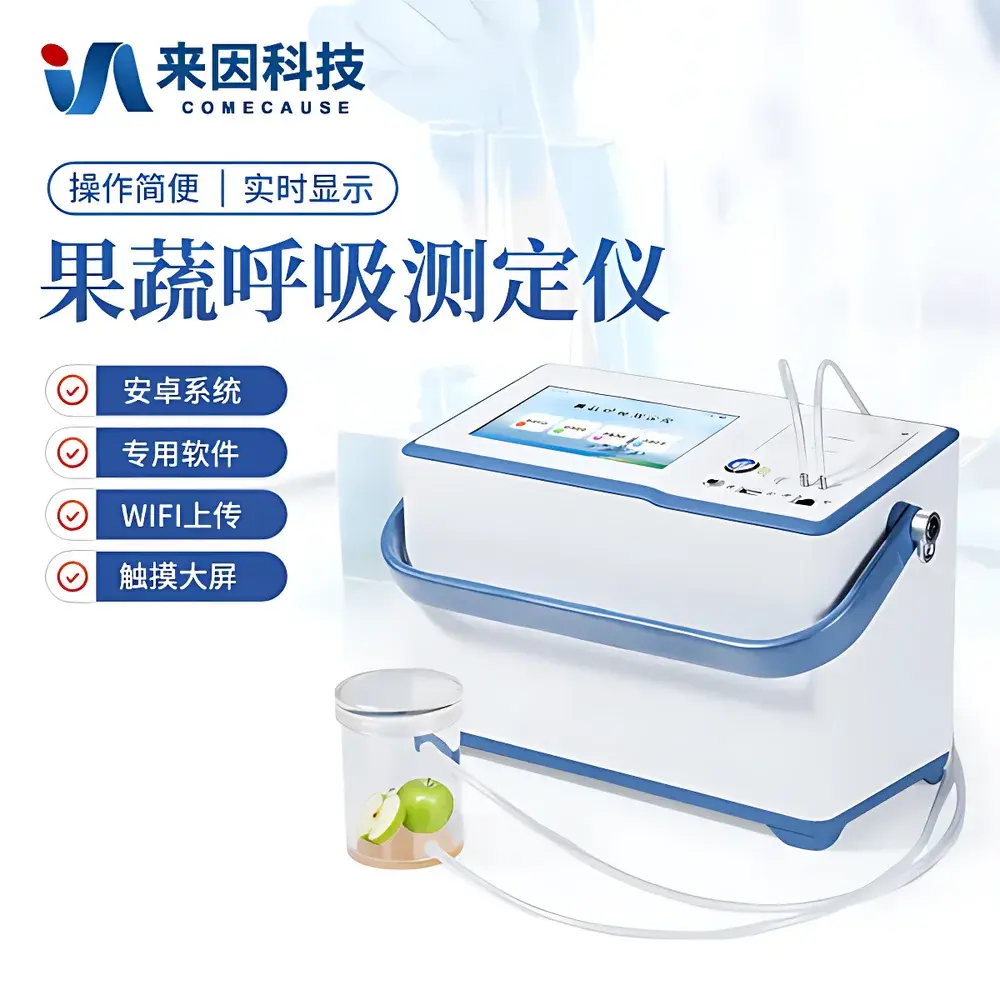
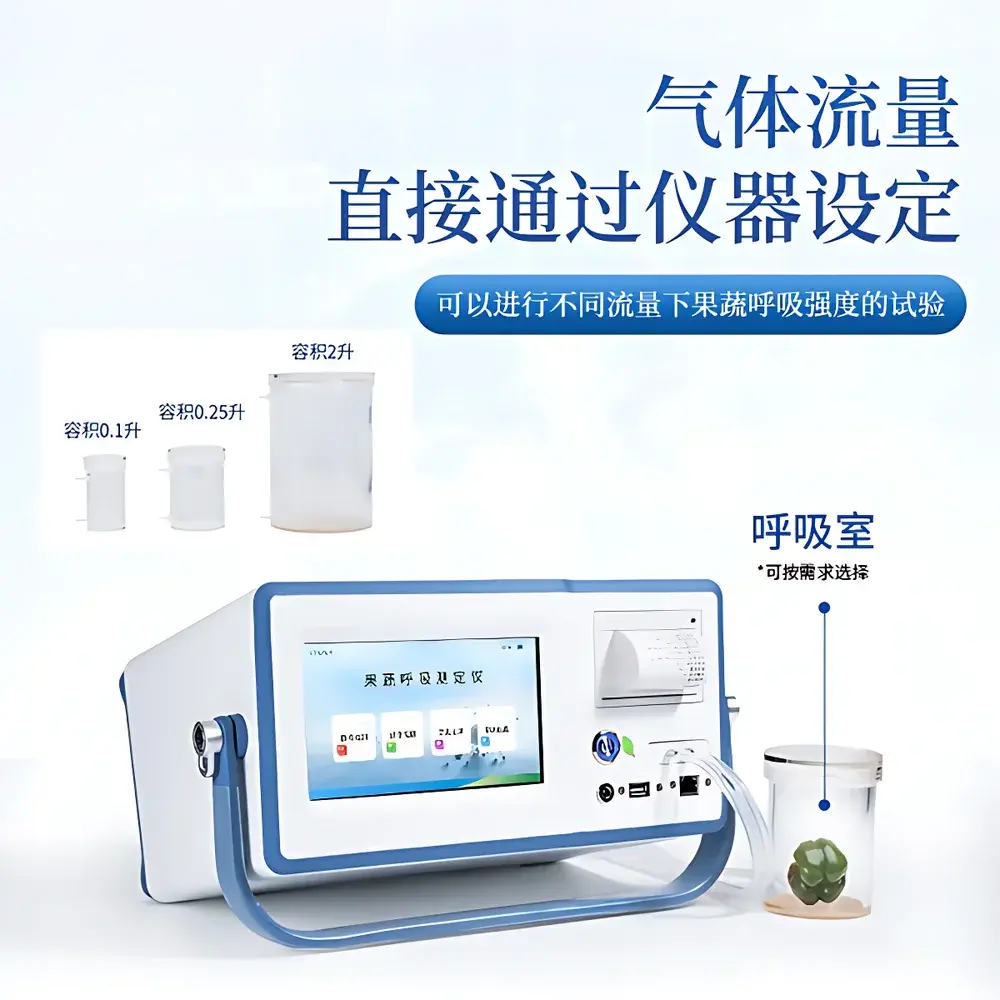
COMECAUSE IN-GX20 Portable Postharvest Respiration Rate Analyzer for Fruits and Vegetables
| Brand | COMECAUSE |
|---|---|
| Origin | Shandong, China |
| Manufacturer Type | OEM/ODM Manufacturer |
| Country of Origin | China |
| Model | IN-GX20 |
| Price | USD 3,650 (FOB) |
| CO₂ Detection Principle | Non-Dispersive Infrared (NDIR) |
| CO₂ Range | 0–5000 ppm |
| CO₂ Resolution | 0.1 ppm |
| CO₂ Accuracy | ±3 ppm |
| O₂ Detection Principle | Electrochemical |
| O₂ Range | 0–100% vol |
| O₂ Linearity | ≤±2% F.S. |
| O₂ Repeatability | ≤±1% |
| O₂ Response Time | ≤30 s |
| Temperature Range | −20 to +95 °C |
| Temp. Accuracy | ±0.2 °C |
| Humidity Range | 0–100% RH |
| RH Accuracy | ±0.2% F.S. |
| Power Supply | 12 V DC, 3 A adapter |
| Internal Storage | 16 GB (≥100,000 records) |
| Connectivity | Wi-Fi, 4G LTE, USB 2.0, GPS module |
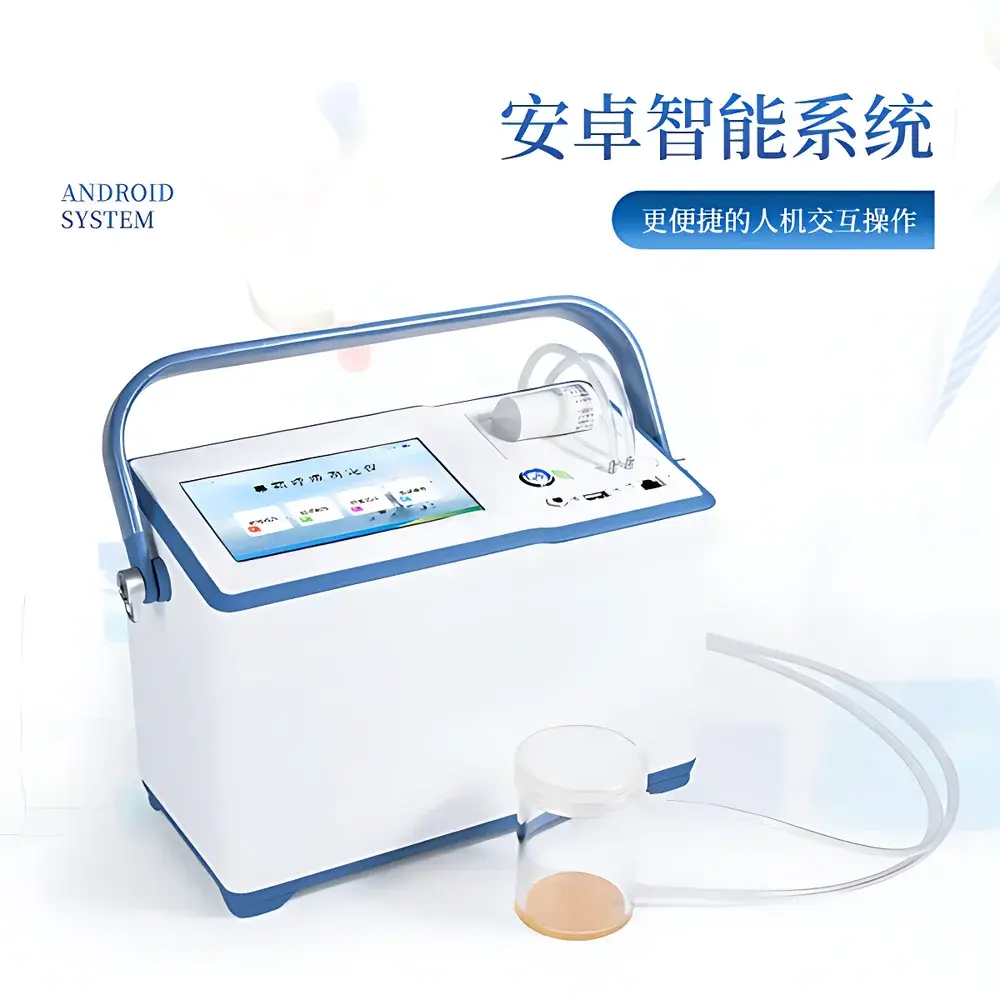
| Display | 7-inch capacitive touchscreen (Android OS) |
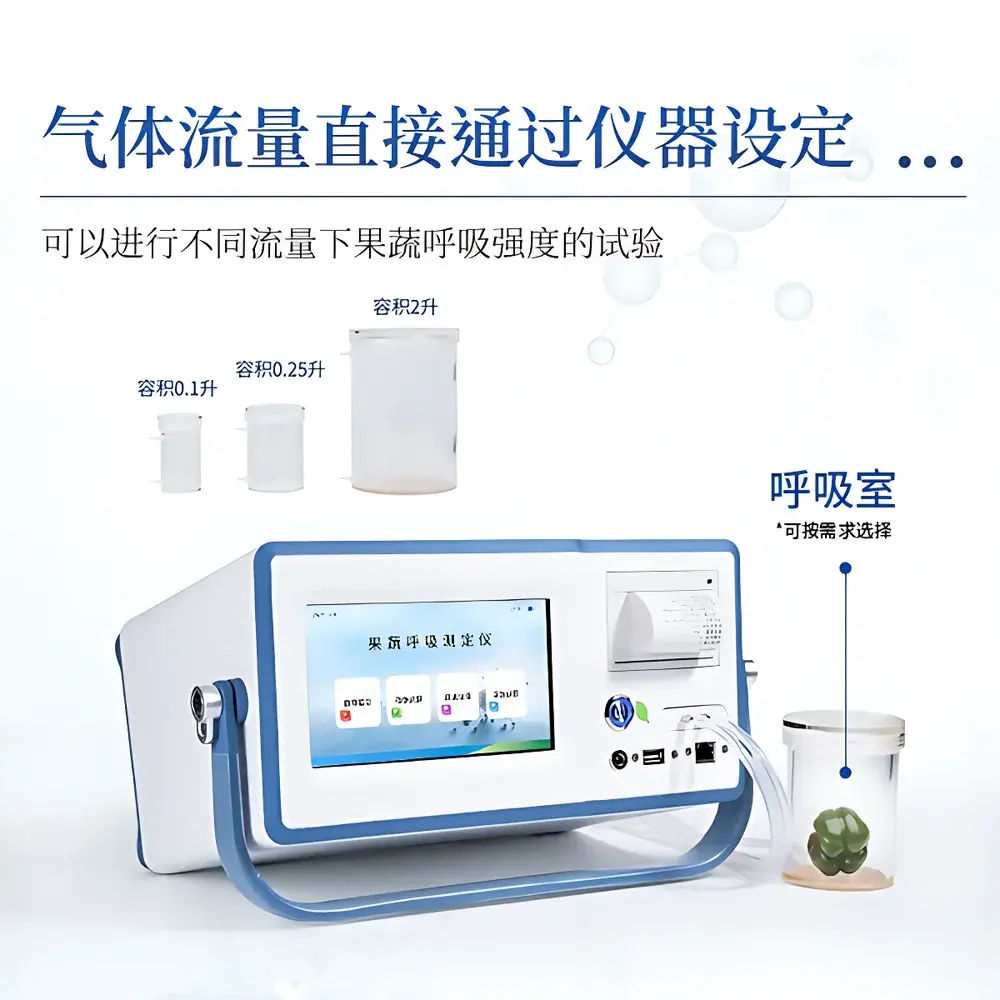
| Respiration Chambers | Three interchangeable volumes (0.1 L, 0.25 L, 2.0 L) |
Overview
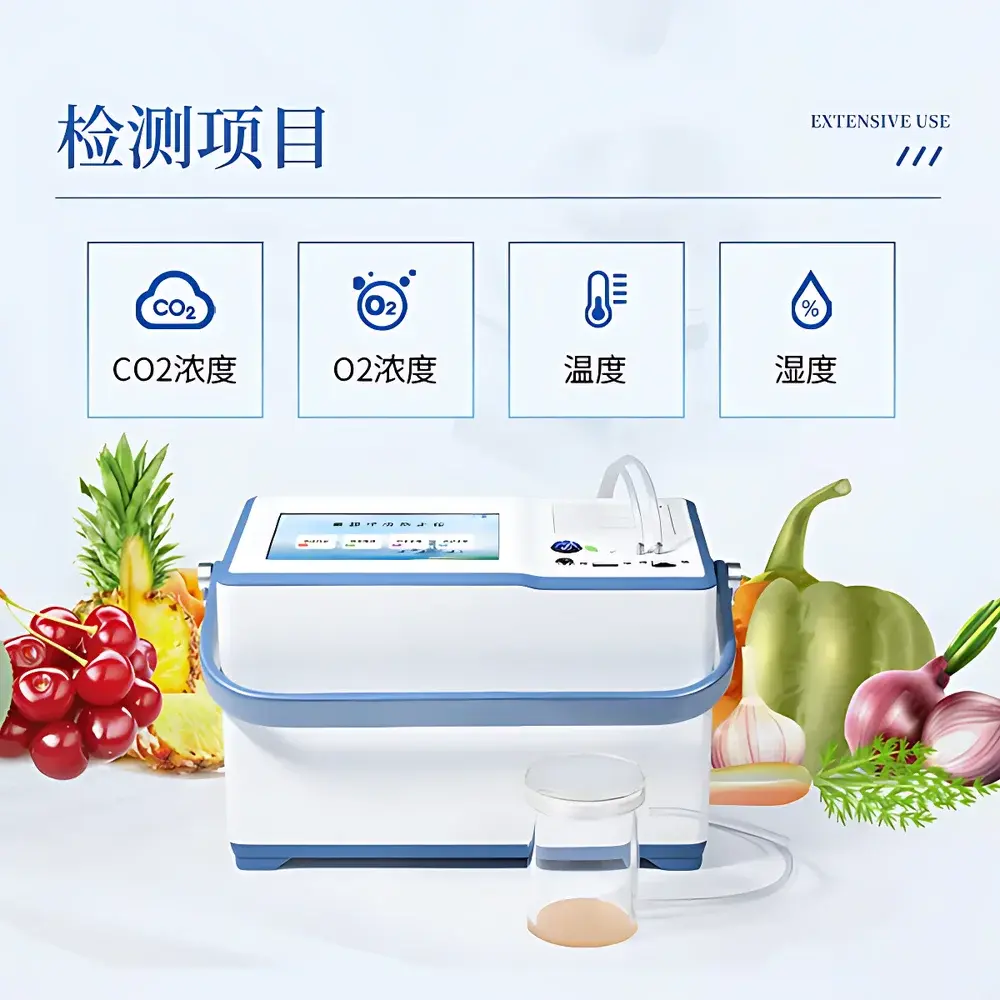
The COMECAUSE IN-GX20 Portable Postharvest Respiration Rate Analyzer is a field-deployable, non-destructive gas exchange measurement system engineered for quantitative assessment of postharvest respiration physiology in fruits and vegetables. It operates on the fundamental principle of closed-system gas accumulation kinetics: a harvested sample is sealed within a temperature- and humidity-controlled chamber, and real-time changes in CO₂ concentration (via NDIR detection) and O₂ concentration (via electrochemical sensing) are monitored over time. These differential gas fluxes—normalized to sample mass, chamber volume, and environmental conditions—are converted into standard respiration rates (e.g., µmol CO₂ kg⁻¹ s⁻¹ or nmol O₂ g⁻¹ h⁻¹) using built-in thermobarometric compensation algorithms compliant with ISO 8602:2017 (Respiratory activity of horticultural products — Determination of carbon dioxide production). Designed for use across ambient storage, cold rooms, controlled-atmosphere (CA) warehouses, retail refrigerated display units, and transport containers, the IN-GX20 supports dynamic experimental protocols under variable O₂/CO₂ partial pressures and temperatures—enabling mechanistic studies of respiratory climacteric behavior, stress-induced ethylene modulation, and metabolic suppression during preservation.
Key Features
- Integrated dual-gas sensing architecture: High-stability NDIR CO₂ sensor (response <1 s, resolution 0.1 ppm) paired with calibrated electrochemical O₂ sensor (T90 <30 s, linearity ≤±2% F.S.)
- Modular, optically transparent respiration chambers (0.1 L, 0.25 L, 2.0 L) fabricated from borosilicate glass and fluoropolymer seals to ensure inertness, UV stability, and leak integrity (<1 mL h⁻¹ at 1 kPa differential)
- On-device Android 11 operating system with 7-inch HD capacitive touchscreen, enabling fully autonomous operation without external PCs
- Real-time visualization of CO₂, O₂, temperature, and relative humidity trends—including first-order derivative plots for respiration rate calculation
- Configurable flow control (0–2 L min⁻¹) for open- or semi-open-loop protocols, supporting both static accumulation and dynamic purge modes
- Built-in GPS geotagging and timestamping for traceable field trials; data encryption (AES-256) for secure cloud upload via Wi-Fi or 4G LTE
- Comprehensive metadata capture: species, cultivar, harvest date, weight, origin, treatment history, and storage condition annotations per assay
- Direct thermal printing capability (via integrated mini-printer) with GLP-compliant report formatting (including instrument ID, calibration dates, operator ID)
Sample Compatibility & Compliance
The IN-GX20 accommodates intact, minimally processed produce—from small berries (e.g., strawberries, grapes) to large root vegetables (e.g., potatoes, beets) and whole melons—without tissue disruption. Chamber volume selection ensures optimal signal-to-noise ratio: low-volume chambers minimize dilution effects for high-respiration samples (e.g., sweet corn, broccoli), while the 2.0 L chamber enables stable measurements of low-metabolism commodities (e.g., onions, garlic) over extended durations (up to 72 h). All sensors undergo factory calibration traceable to NIST-certified gas standards. The system complies with ASTM D6186-22 (Standard Practice for Measuring Respiration Rate of Horticultural Crops) and supports audit-ready data logs required under ISO/IEC 17025:2017 and FDA 21 CFR Part 11 for electronic records and signatures. Chamber materials meet USP Class VI biocompatibility requirements and exhibit no measurable VOC outgassing under storage-relevant conditions.
Software & Data Management
The embedded Android application provides full experimental lifecycle management: protocol definition (duration, sampling interval, gas thresholds), real-time curve overlay, automatic baseline correction, and slope-based respiration rate derivation using linear regression (R² ≥ 0.995 threshold). Raw sensor data (10 Hz sampling) and processed metrics are stored locally in SQLite databases with SHA-256 hash integrity verification. Cloud synchronization employs MQTT protocol with TLS 1.3 encryption; uploaded datasets are structured as FAIR-compliant JSON-LD objects, including ontological tags from the Crop Ontology (CO) and Plant Trait Ontology (TO). USB export generates CSV files compatible with R, Python (Pandas), and MATLAB for advanced statistical modeling (e.g., Arrhenius activation energy estimation, Q₁₀ analysis). Audit trails record all user actions, parameter modifications, and calibration events with immutable timestamps.
Applications
- Optimization of controlled-atmosphere (CA) storage parameters by quantifying O₂/CO₂ interaction effects on respiration suppression
- Evaluation of pre-storage treatments (e.g., hot water dips, 1-MCP, edible coatings) on respiratory quiescence and shelf-life extension
- Genotype × environment interaction studies linking respiration phenotypes to QTLs associated with postharvest longevity
- Validation of predictive models for quality decay (firmness loss, sugar degradation, off-flavor development) using respiration-derived metabolic indices
- Logistics monitoring: correlation of in-transit respiration spikes with temperature abuse events recorded by integrated dataloggers
- Regulatory compliance testing for organic certification bodies requiring documented physiological baselines
FAQ
What is the minimum detectable respiration rate for a 100 g apple sample in the 0.25 L chamber?
Under standard conditions (20 °C, 21% O₂), the system reliably resolves rates ≥0.08 µmol CO₂ kg⁻¹ s⁻¹ (CV <4.2%, n=6) based on NDIR noise floor and chamber sealing integrity.
Does the instrument support simultaneous CO₂ and O₂ measurement in kinetic mode?
Yes—both sensors operate synchronously at 10 Hz, with hardware-triggered timestamp alignment to eliminate phase lag between gas signals.
How often must the O₂ sensor be replaced, and is recalibration required after replacement?
Electrochemical O₂ sensors have a typical service life of 24 months under continuous operation; factory recalibration is mandatory post-replacement and documented in the device’s calibration log.
Can the IN-GX20 be used for soil or microbial respiration assays?
While not validated for soil matrix applications, the 2.0 L chamber and humidity control enable adaptation for solid-substrate microbial respiration when paired with appropriate filtration (0.2 µm PTFE) and CO₂ scrubbing controls.
Is the Android OS upgradable, and what security patches are maintained?
The device receives quarterly OTA security updates aligned with Google’s Android Security Bulletin schedule; root access is disabled by default to preserve FDA Part 11 compliance.






