
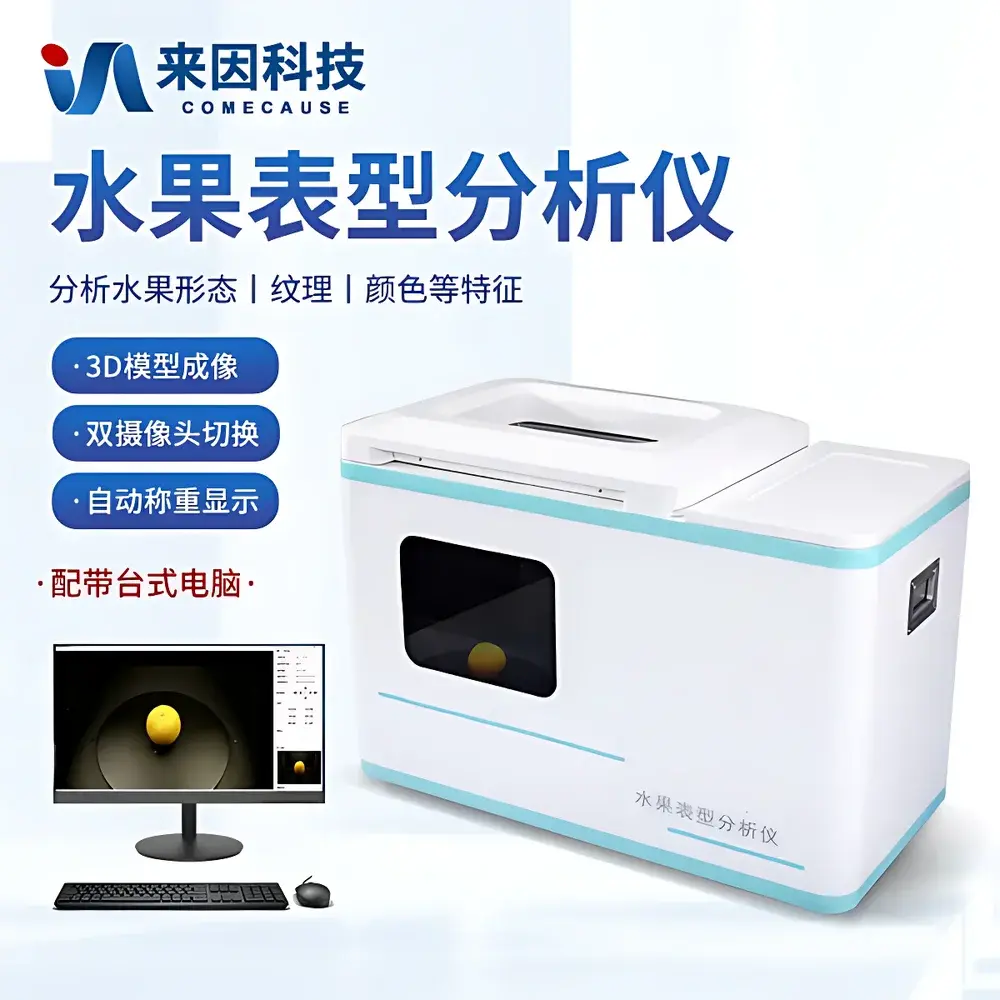
COMECAUSE IN-VistaFruit Fruit Phenotyping System
| Brand | COMECAUSE |
|---|---|
| Origin | Shandong, China |
| Manufacturer Type | Direct Manufacturer |
| Model | IN-VistaFruit |
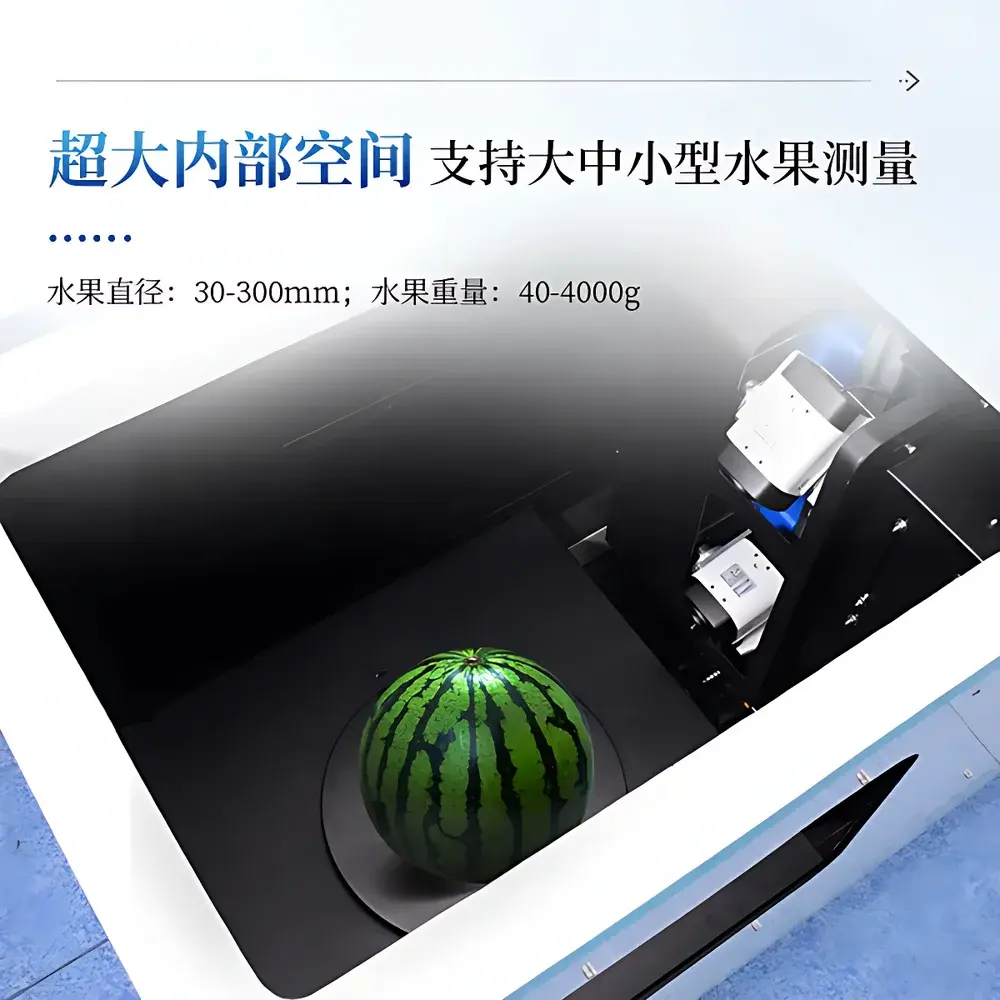
| Weight Capacity | 40–4000 g |
| Fruit Diameter Range | 30–300 mm |
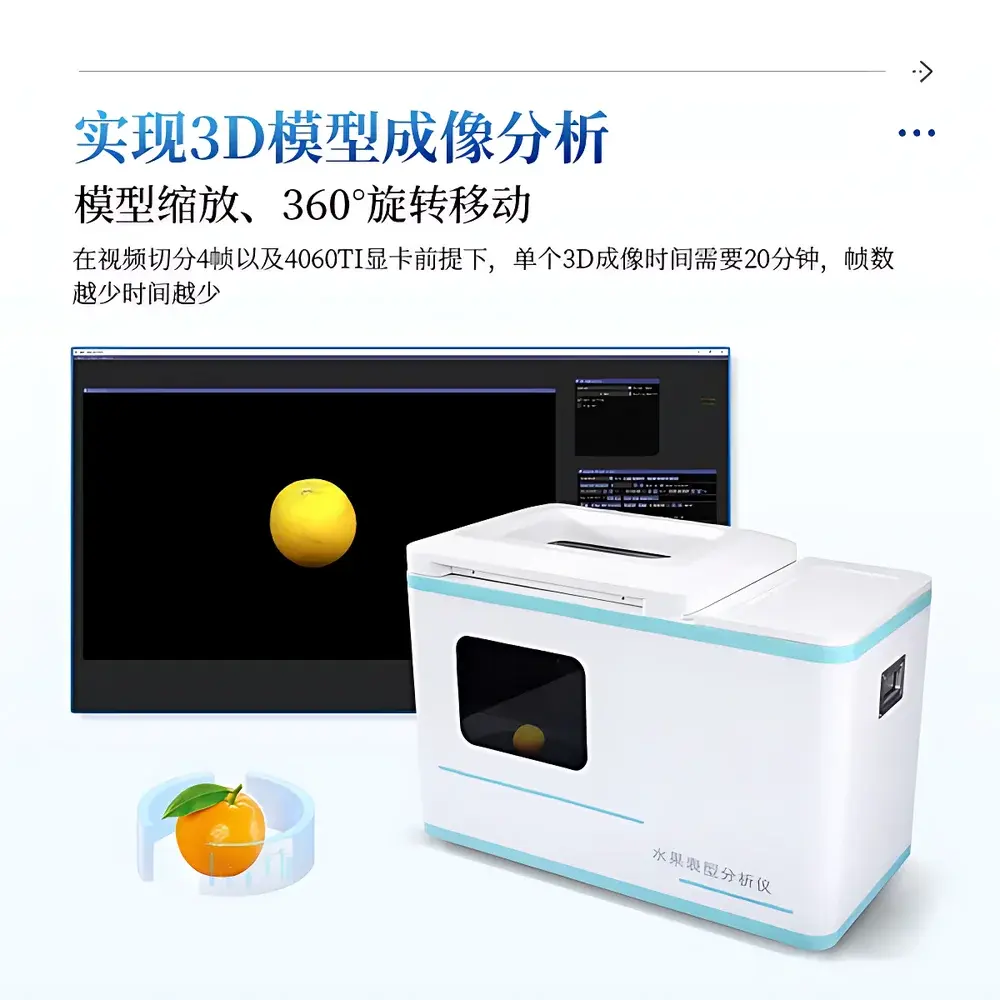
| 3D Reconstruction Time (typ.) | ~20 min per fruit (dependent on GPU performance, e.g., RTX 4060 Ti) |
| Integrated Scale | Yes |
| Software Language | English & Chinese (toggleable) |
| Dimensions (W×D×H) | 1006 × 506 × 718 mm |
| Net Weight | 62 kg |
| System Configuration | Intel Core i5-14400F, 16 GB RAM, 1 TB SSD, NVIDIA RTX 4060 Ti 8 GB, 27″ 2K Monitor |
Overview
The COMECAUSE IN-VistaFruit Fruit Phenotyping System is a benchtop, AI-powered 3D phenotypic imaging platform engineered for quantitative morphological, chromatic, and textural characterization of intact fruits. It integrates multi-view structured light capture with real-time image processing pipelines grounded in computer vision principles—including Gaussian Splatting-based surface reconstruction—and leverages deep learning-assisted segmentation to generate high-fidelity, geometrically accurate 3D point clouds. Unlike conventional 2D image analysis systems, the IN-VistaFruit captures spatial continuity across curvature, occlusion-prone regions, and heterogeneous surface reflectance—enabling reproducible quantification of shape descriptors (e.g., sphericity, form index), colorimetric metrics (CIELAB L*a*b*, HSV, grayscale), and texture statistics derived from Gray-Level Co-occurrence Matrix (GLCM) and Structural Similarity Index (SSIM) analyses. Designed for plant physiology labs, breeding programs, postharvest quality control units, and academic horticultural research, it supports non-destructive, operator-independent assessment aligned with FAO and ISHS standards for fruit quality evaluation.
Key Features
- Integrated dual-camera imaging station with motorized stage and software-controlled pan/tilt/zoom, enabling synchronized multi-angle acquisition without manual repositioning.
- Embedded high-precision load cell (40–4000 g range) delivering real-time mass data directly into the phenotyping workflow—no external scale calibration or manual entry required.
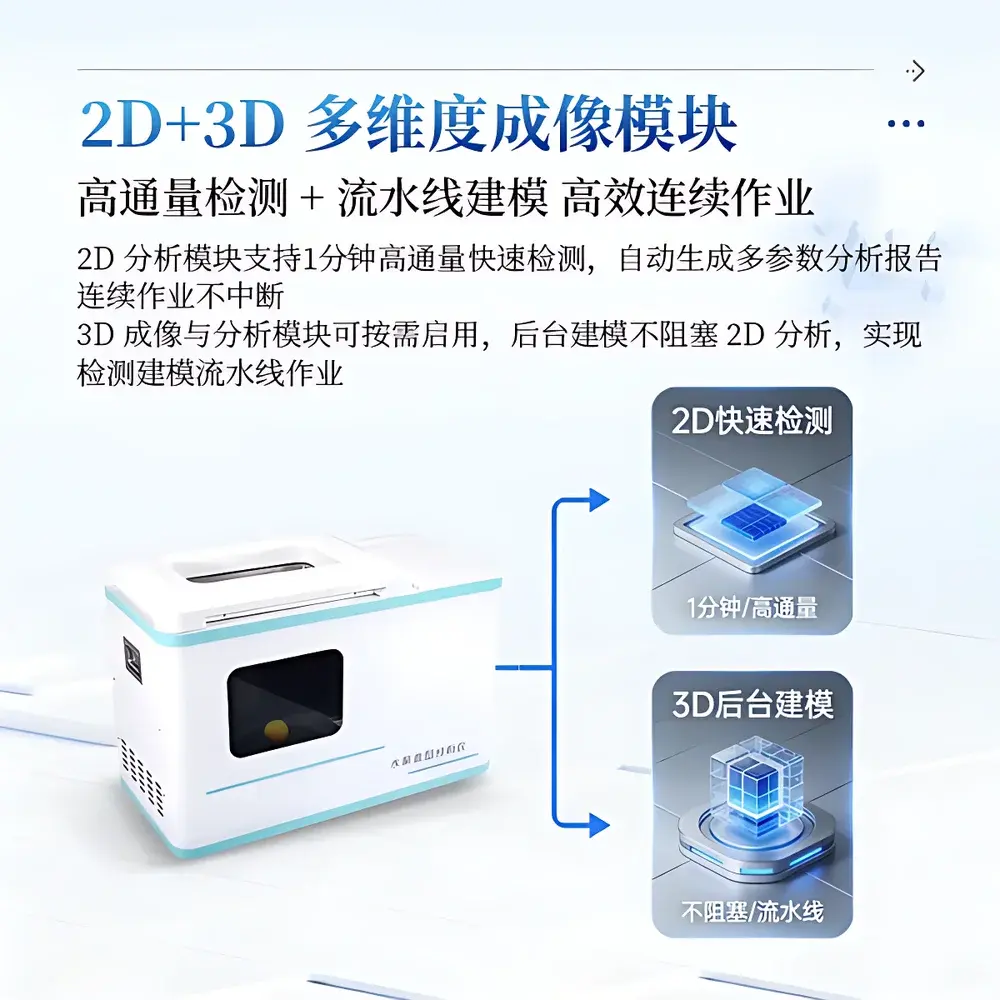
- Dual-mode operation: High-throughput 2D analysis module (<60 s/sample) for rapid screening; on-demand 3D modeling module with background queueing—ensuring uninterrupted 2D throughput while 3D reconstructions process asynchronously.
- GPU-accelerated 3D reconstruction engine optimized for consumer-grade NVIDIA GPUs (e.g., RTX 4060 Ti), scaling linearly with compute resources—reconstruction time ranges from <10 min (4-frame input, high-end GPU) to ~20 min (standard configuration).
- Full software localization with one-click English/Chinese UI toggle and adaptive resolution binding—preserving native display fidelity across monitor configurations up to 2K resolution.
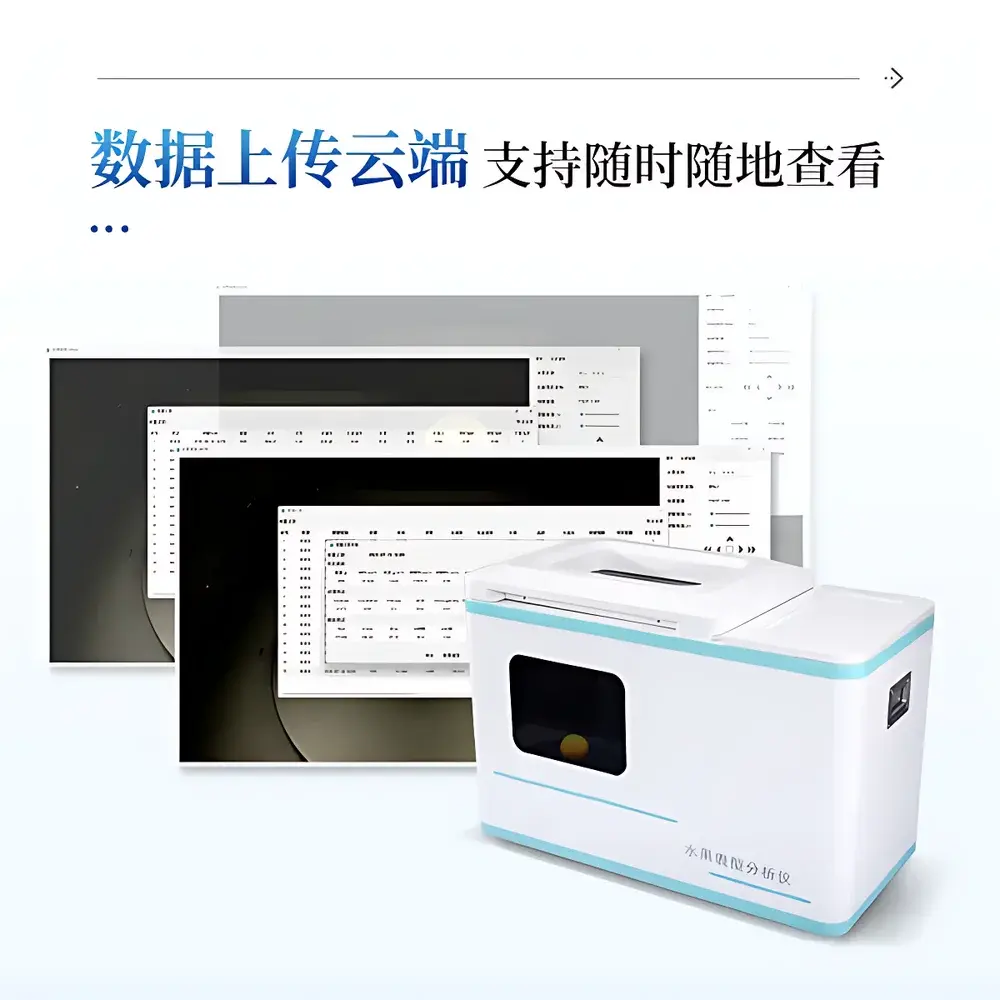
- Cloud synchronization via device-unique ID: All measurement metadata, raw images, point clouds, and parameter exports are timestamped, versioned, and encrypted during upload to secure cloud storage—accessible via web portal with role-based access controls.
Sample Compatibility & Compliance
The IN-VistaFruit is validated for intact, uncut specimens of commercially relevant fleshy fruits including but not limited to apple (Malus domestica), citrus (Citrus spp.), pear (Pyrus communis), watermelon (Citrullus lanatus), lychee (Litchi chinensis), peach (Prunus persica), pomelo (Citrus grandis), and Hami melon (Cucumis melo var. saccharinus). Specimen size constraints (30–300 mm diameter) accommodate >95% of mature market-grade fruit across major cultivars. The system complies with ISO 11737-1 for instrument environmental classification (indoor laboratory use), meets IEC 61000-6-3 electromagnetic compatibility requirements, and adheres to GLP-relevant data integrity principles—supporting audit trails, user authentication logs, and immutable export timestamps essential for regulatory submissions under OECD Test Guidelines and national agricultural R&D frameworks.
Software & Data Management
The proprietary VistaFruit Analysis Suite (v3.2+) provides a unified interface for acquisition, visualization, and statistical export. Its modular architecture separates acquisition control (camera focus, lighting intensity, stage positioning), real-time preview (dual-camera feed switching), and post-processing (2D ROI annotation, 3D mesh refinement, GLCM parameter selection). All measurements are stored in an SQLite-backed local database with optional cloud mirroring. Export formats include CSV (for morphometric/color/texture tables), OBJ/PLY (for 3D geometry), and PDF reports compliant with ISO/IEC 17025 documentation templates. Audit trail functionality records every parameter change, user login/logout event, and data modification—meeting foundational requirements for FDA 21 CFR Part 11 compliance when deployed in GxP-aligned environments.
Applications
- Quantitative trait locus (QTL) mapping studies requiring high-resolution phenotypic anchors for genome-wide association in fruit breeding programs.
- Postharvest quality monitoring: tracking changes in surface roughness (via entropy/homogeneity), color uniformity (ΔE*ab), and deformation-induced shape asymmetry over storage duration.
- Non-destructive grading automation: training ML classifiers using IN-VistaFruit-derived feature vectors (e.g., sphericity + SSIM + a*-value) to replace subjective human scoring in packinghouse QA workflows.
- Eco-physiological response assays: correlating drought/stress-induced surface microcracking (detected via contrast/dissimilarity shifts) with stomatal conductance or chlorophyll fluorescence data.
- Consumer sensory correlation: linking objective texture metrics (e.g., variance in gray-level distribution) to hedonic panel scores for texture perception in new cultivar release trials.
FAQ
What fruit types and sizes does the IN-VistaFruit support?
It accommodates fruits with diameters between 30 mm and 300 mm—including apple, orange, pear, watermelon, lychee, peach, pomelo, and Hami melon—provided they fit within the imaging chamber and remain stable on the weighing platform.
Is external weighing equipment required?
No. The system includes a built-in precision load cell (40–4000 g range) that automatically synchronizes mass data with imaging sessions.
Can 2D and 3D analyses run concurrently?
Yes. The 2D module operates continuously in foreground mode, while 3D reconstructions are queued and processed in the background—enabling true pipeline-style throughput without workflow interruption.
How is data security and traceability ensured?
All operations generate immutable audit logs; cloud uploads are TLS 1.3 encrypted; local databases enforce user-level permissions; exported files contain embedded metadata (operator ID, timestamp, instrument SN) for full chain-of-custody compliance.
What computing hardware is required beyond the supplied workstation?
None—the bundled GeekPro-17 workstation (i5-14400F, 16 GB RAM, RTX 4060 Ti 8 GB, 27″ 2K monitor) is fully optimized and validated for all core functions, including real-time rendering and Gaussian Splatting computation.



