
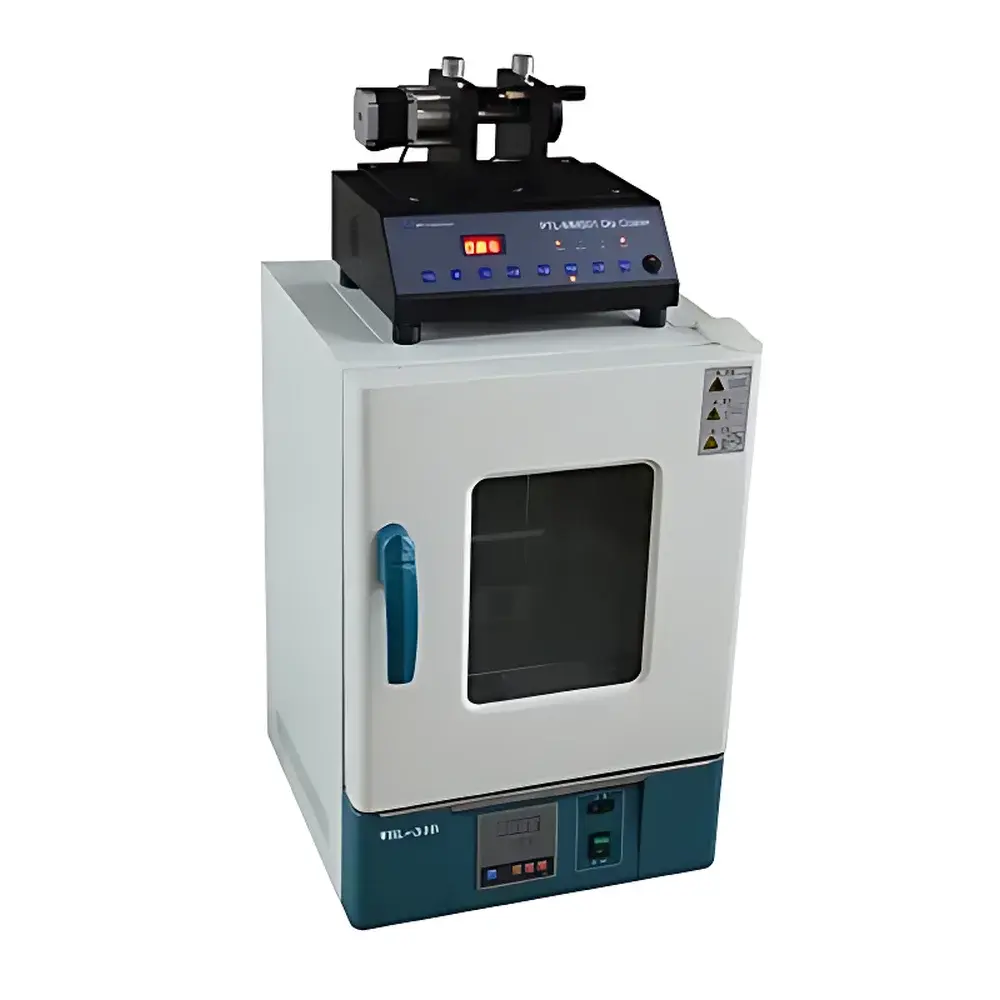
KJ GROUP PTL-MMB01 Constant-Temperature Dip Coater
| Brand | KJ GROUP |
|---|---|
| Origin | Liaoning, China |
| Manufacturer Type | Authorized Distributor |
| Country of Origin | China |
| Model | PTL-MMB01 |
| Pricing | Upon Request |
| Power Supply | AC 220 V, 50 Hz, 850 W |
| Lifting Speed Range | 1–200 mm/min |
| Temperature Control Range | RT + 5 °C to 100 °C |
| Temperature Stability | ±1.5 °C |
| Effective Immersion Length | 60 mm |
| Immersion & Drying Time Setting | 1–999 s |
| Programmable Dip Cycles | 1–20 |
| Sample Dimensions Supported | 75 mm × 25 mm × 2.5 mm |
| Footprint | 450 mm × 500 mm × 970 mm |
| Dry Box External Dimensions | 460 mm × 510 mm × 695 mm |
| Working Table Requirement | ≥800 mm × 600 mm × 700 mm, Load Capacity ≥200 kg |
| Environmental Operating Conditions | Altitude ≤1000 m, Ambient Temperature 25 °C ±15 °C, Relative Humidity 55 %RH ±10 %RH |
| Motor Type | High-Precision Stepper Motor with Suspended Mounting for Vibration Damping |
Overview
The KJ GROUP PTL-MMB01 Constant-Temperature Dip Coater is an engineered solution for controlled, reproducible thin-film deposition via vertical dip-coating — a technique widely used in sol-gel processing, liquid-phase epitaxy (LPE), and functional coating development. It operates on the principle of precise vertical translation of substrates through a precursor solution, followed by controlled withdrawal at defined speeds under thermally stabilized conditions. Unlike ambient dip coaters, the PTL-MMB01 integrates a fully enclosed, temperature-regulated drying chamber (RT + 5 °C to 100 °C) that envelops both immersion and withdrawal stages, ensuring uniform solvent evaporation kinetics and minimizing thermal gradients across the film interface. This architecture supports consistent nucleation, growth, and early-stage condensation of metal oxides, perovskites, polymers, and hybrid nanocomposites. Its compact footprint (450 × 500 × 970 mm) and modular design meet ISO/IEC 17025-aligned laboratory space constraints while maintaining mechanical rigidity essential for sub-millimeter positional repeatability.
Key Features
- Integrated constant-temperature environment: Full-process immersion, withdrawal, and initial drying occur inside a CE-certified, insulated chamber with ±1.5 °C thermal stability over the 25–100 °C range.
- Precision motion control: High-torque, closed-loop stepper motor with suspended mounting isolates mechanical vibration from the coating stage, enabling smooth, jitter-free lifting at speeds from 1 to 200 mm/min (adjustable in 0.1 mm/min increments).
- Flexible operational modes: Supports manual immersion + automatic withdrawal, automatic immersion + manual withdrawal, or fully automated multi-cycle sequences (1–20 dips per run).
- Programmable temporal parameters: Independent setting of immersion duration (1–999 s), dwell time at bottom position, withdrawal duration, and post-withdrawal drying interval (1–999 s).
- Standardized substrate handling: Accommodates rigid planar samples up to 75 × 25 × 2.5 mm using precision-machined clamps; 60 mm effective immersion length ensures full coverage without overflow.
- Robust electrical and mechanical architecture: Compliant with IEC 61000-6-3 (EMC) and IEC 61000-6-2 (immunity); grounded 220 V / 850 W supply; no compressed air or water connections required.
Sample Compatibility & Compliance
The PTL-MMB01 is compatible with glass slides, silicon wafers, ITO-coated substrates, ceramic plates, and metal foils — provided dimensional and flatness tolerances align with the 75 × 25 × 2.5 mm specification. Its sealed chamber design prevents solvent vapor dispersion, supporting safe handling of ethanol-, toluene-, and DMF-based precursors under standard fume hood–free operation (ventilation not required per manufacturer specifications). The system complies with EU Machinery Directive 2006/42/EC and carries CE marking for safety, electromagnetic compatibility, and low-voltage operation. While not inherently GLP/GMP validated, its programmable parameters, repeatable motion profile, and thermal traceability support audit-ready documentation when integrated into SOP-driven workflows aligned with ISO 9001 or ASTM D1308 (coating adhesion testing preparation).
Software & Data Management
The PTL-MMB01 utilizes embedded microcontroller firmware (no PC dependency) with non-volatile memory for storing up to 10 user-defined protocols. Each protocol retains lift speed, immersion/dwell/dry timing, cycle count, and temperature setpoint. All parameter changes are logged with timestamp and operator ID (via front-panel keypad entry), satisfying basic data integrity requirements for academic and industrial R&D. Though lacking native USB/Ethernet connectivity or FDA 21 CFR Part 11-compliant electronic signatures, the device supports external documentation via printed logs (when paired with optional serial-to-printer interface) and manual protocol archiving — making it suitable for pre-validation research phases and method development prior to scale-up.
Applications
- Sol-gel synthesis of TiO₂, SiO₂, ZnO, and SnO₂ antireflective or photocatalytic films.
- Perovskite precursor layer deposition for optoelectronic device prototyping (e.g., solar cells, LEDs).
- Preparation of hydrophobic/hydrophilic gradient coatings for microfluidic channel functionalization.
- Controlled fabrication of polymer multilayers (e.g., PAH/PSS) via layer-by-layer (LbL) assembly.
- R&D-scale production of corrosion-inhibiting silane films on aluminum and steel substrates.
- Teaching laboratories: Demonstrating colloidal stability, capillary rise, Marangoni effects, and evaporation-driven self-assembly.
FAQ
What is the maximum allowable sample thickness for reliable clamping?
The standard fixture accommodates substrates up to 2.5 mm thick; thicker samples require custom jig adaptation.
Can the temperature chamber be operated independently of the dip mechanism?
No — the heating chamber is mechanically coupled to the lifting frame and only activates during programmed cycles.
Is calibration traceable to national standards?
Temperature sensor calibration is factory-performed against NIST-traceable references; users may perform field verification using calibrated PT100 probes.
Does the system support dynamic speed ramping during withdrawal?
No — speed remains constant throughout each withdrawal phase; multi-step profiles require sequential manual intervention or external scripting via optional TTL triggers.
What maintenance is required for long-term accuracy?
Biannual inspection of stepper motor coupling alignment, cleaning of immersion cup threads, and verification of thermal insulation integrity around the chamber door seal.



