
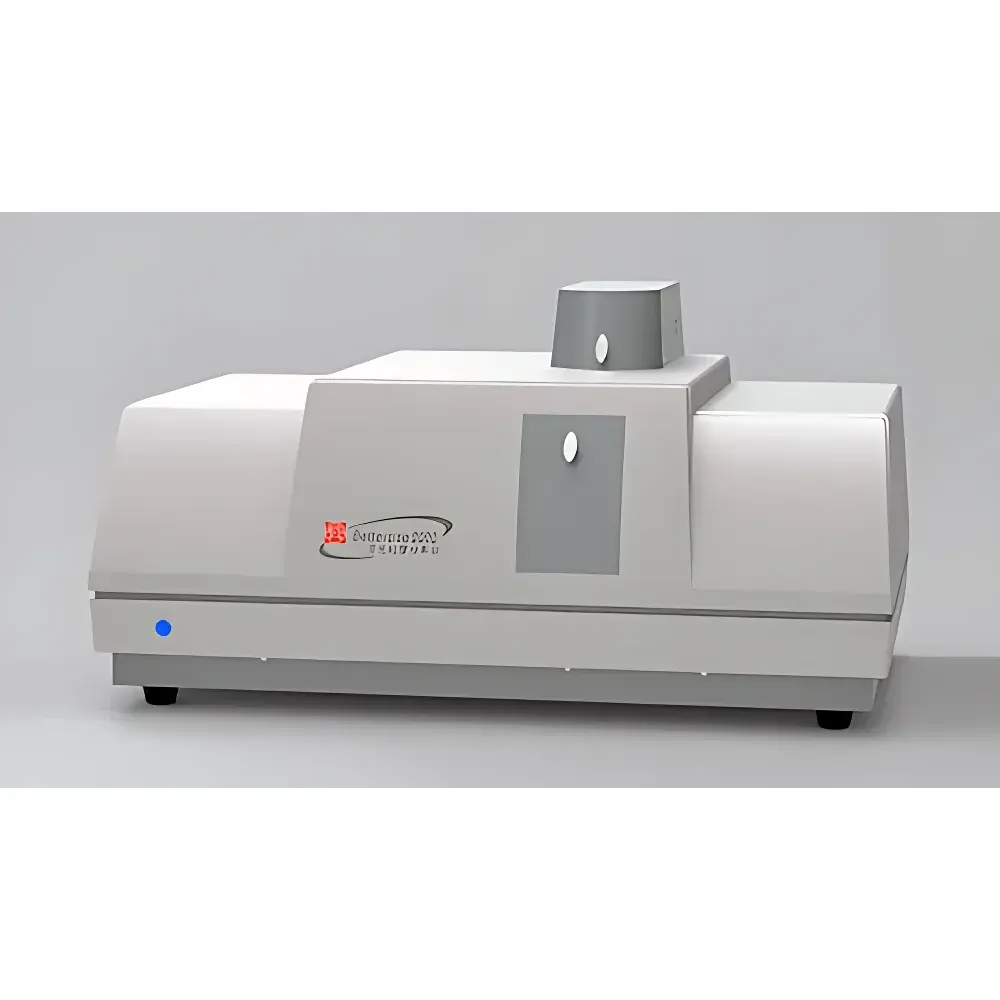
Bettersize BT-2000 Laser Diffraction Particle Size Analyzer
| Brand | BETTERSIZE |
|---|---|
| Model | BT-2000 |
| Measurement Principle | Mie Scattering Theory |
| Test Range | 0.02–2000 µm |
| Repeatability Error | ≤0.5% (D50 of ISO Standard Reference Materials) |
| Accuracy Error | ≤0.5% (D50 of ISO Standard Reference Materials) |
| Sampling Rate | 3500 Hz |
| Detector Channels | 90 |
| Laser Source | Imported Fiber-Coupled Semiconductor Laser (Lifespan >25,000 h) |
| Optical System | Dual-Lens Configuration with Auto-Alignment |
| Dispersion System | Integrated Circulation + Ultrasonic (50 W) + Stirring + Auto-Fill/Drain/Clean |
| Flow Rate | 3000–8000 mL/min |
| Sample Cell Volume | 600 mL |
| Operating System Compatibility | Windows XP/7/8/10 |
| Interface | USB 2.0/3.0 |
| Power Supply | AC 220 V, 50/60 Hz |
| Dimensions (W×D×H) | 800 × 500 × 410 mm |
| Weight | 45 kg |
Overview
The Bettersize BT-2000 Laser Diffraction Particle Size Analyzer is a high-precision, fully automated instrument engineered for reliable and traceable particle size distribution (PSD) analysis across research, quality control, and production environments. It operates on the fundamental principles of Mie scattering theory—mathematically modeling light interaction with spherical particles in suspension—to deliver quantitative PSD data from 0.02 µm to 2000 µm in a single measurement. Its dual-lens optical architecture—comprising a collimated laser beam and two complementary focusing lenses—maximizes angular detection coverage while minimizing optical aberration. This design ensures high-fidelity capture of weak, wide-angle scattered light signals, critical for resolving fine submicron features and broad multimodal distributions. The system integrates a fiber-coupled semiconductor laser with >25,000-hour operational lifetime, eliminating thermal drift concerns and supporting long-term calibration stability. All optical components—including precision Japanese-made lens assemblies—are factory-aligned and maintained via real-time auto-centering, ensuring consistent beam positioning independent of mechanical vibration or thermal expansion.
Key Features
- Fully automated SOP-driven operation: Auto-alignment, auto-fill, auto-drain, auto-degassing, auto-cleaning, and ultrasonic dispersion initiation—all programmable and repeatable.
- Dual-lens optical configuration with optimized focal geometry, enabling high-resolution detection across forward, side, and backward scattering angles.
- 90-channel photodiode array detector with 3500 Hz sampling frequency—capturing transient signal fluctuations and suppressing outlier influence through statistical averaging.
- Integrated dispersion module featuring adjustable 50 W ultrasonication, variable-speed stirring, and programmable flow control (3000–8000 mL/min) for robust de-agglomeration of cohesive powders.
- Real-time monitoring of dew point temperature during sample preparation—critical for hygroscopic materials and humidity-sensitive formulations.
- Compliance-ready architecture: Supports audit trails, user-level access control, and electronic signature protocols aligned with FDA 21 CFR Part 11 and GLP/GMP documentation requirements when paired with validated software configurations.
Sample Compatibility & Compliance
The BT-2000 accommodates a broad spectrum of dry and wet-dispersed particulate systems—including inorganic oxides (SiO₂, ZrO₂, MgO), carbon-based materials (graphite, activated carbon), metallic powders (Al, Cu, Mo, rare-earth alloys), battery cathode/anode active materials (NMC, LFP, SiOx), pharmaceutical excipients, catalysts, pigments, and natural sediments. Its 600 mL recirculating cell supports both aqueous and organic dispersions (e.g., isopropanol, ethanol), with chemical compatibility verified for common surfactants and dispersants. Instrument performance is verified against ISO 13320-recommended reference standards (e.g., NIST SRM 1963, ERM-FD102), demonstrating ≤0.5% D50 deviation under routine laboratory conditions. Calibration traceability follows ISO/IEC 17025 guidelines, with documented uncertainty budgets available upon request.
Software & Data Management
The BT-2000 runs on proprietary Windows-based analysis software compliant with ASTM E2917 and ISO 9276-2 reporting conventions. It provides real-time scatter pattern visualization, multi-modal peak deconvolution, and customizable report templates (PDF/Excel). Raw intensity data, PSD curves, and instrument logs are stored in encrypted binary format with time-stamped metadata. Software supports batch processing, comparative overlay of up to 12 samples, and export of d10, d50, d90, span, and relative width indices. Optional modules enable IQ/OQ/PQ protocol execution, electronic lab notebook (ELN) integration, and secure network deployment in regulated environments.
Applications
This analyzer serves as a primary metrology tool in R&D laboratories developing advanced ceramics, battery electrode slurries, and nanocomposites; in QC labs validating raw material specifications for cement, pharmaceutical APIs, and food-grade fillers; and in manufacturing sites monitoring micronization consistency for catalysts, pigments, and abrasive grains. Its rapid 10-second measurement cycle enables high-throughput screening during milling optimization, spray-drying parameter studies, and granulation endpoint determination. The system’s sensitivity to sub-100 nm populations makes it suitable for characterizing colloidal silica, quantum dots, and exosome suspensions when used with appropriate refractive index inputs and dispersion protocols.
FAQ
What optical model does the BT-2000 use for size calculation?
It applies Mie scattering theory with user-definable complex refractive index (real and imaginary parts), enabling accurate sizing of absorbing or non-spherical particles when supported by morphological validation.
Is the instrument compliant with regulatory data integrity standards?
Yes—the software architecture supports 21 CFR Part 11 compliance when configured with role-based authentication, audit trail logging, and electronic signature functionality.
Can the BT-2000 measure dry powders directly?
No—it is designed exclusively for wet dispersion analysis; dry powder measurement requires optional add-on dry dispersion modules (not included with base BT-2000 configuration).
How often does the optical alignment require manual intervention?
None—the auto-alignment system performs continuous real-time correction; no user-initiated optical recalibration is required during normal operation.
Does the system support method transfer between instruments?
Yes—method files include full optical, hydrodynamic, and analysis parameters, enabling reproducible cross-platform testing when using identical reference standards and dispersion protocols.



