
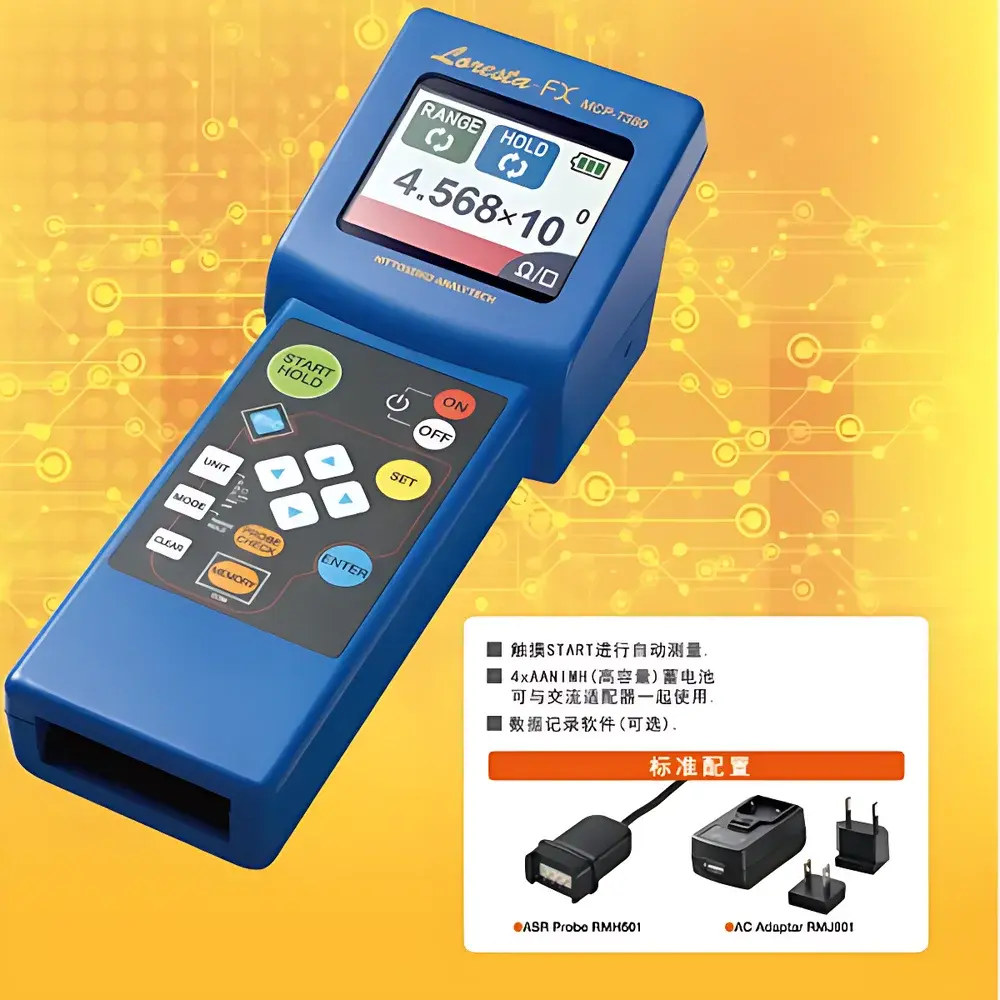
Nittoseiko Analytech MCP-T380 Surface Resistivity Tester
| Brand | Nittoseiko Analytech |
|---|---|
| Origin | Japan |
| Model | MCP-T380 |
| Measurement Principle | Four-Point Probe (Constant Current Method) |
| Resistance Range | 10⁻² to 10⁶ Ω |
| Accuracy | ±0.5% ±3 dgt (typical at mid-range), ±1.0% ±20 dgt (at extremes) |
| Test Current | 1 µA to 100 mA (auto-ranging) |
| Display | LCD |
| Power Supply | DC 6.5 V, 350 mA (rechargeable Ni-MH battery pack) |
| Interface | RS-232C |
| Data Export | USB memory (via optional adapter or PC link) |
| Dimensions | 100 × 230 × 45 mm |
| Weight | 500 g |
| Standard Probe | MCP-TP03P (4-pin, built-in spring-loaded pins, 5 mm pin length, 0.37 mm radius tip) |
| Compliance | Designed for ISO 80000-6, ASTM D257, IEC 60093, JIS K 7194 |
Overview
The Nittoseiko Analytech MCP-T380 Surface Resistivity Tester is a precision handheld instrument engineered for reliable, repeatable low-resistance surface characterization of conductive and antistatic materials. Based on the four-point probe (4PP) method with constant-current excitation, it eliminates errors caused by contact resistance and lead impedance—critical for accurate measurement of thin films, coatings, and layered substrates where interfacial resistivity dominates bulk behavior. Unlike two-point ohmmeters, the MCP-T380 applies current through outer electrodes while sensing voltage drop across inner electrodes, enabling true sheet resistance (Ω/sq) and surface resistivity (Ω/□) calculation independent of probe spacing. Its design adheres to internationally recognized test standards including ASTM D257 (Standard Test Methods for DC Resistance or Conductance of Insulating Materials), IEC 60093 (Methods of Test for Volume Resistivity and Surface Resistivity of Solid Electrical Insulating Materials), and JIS K 7194 (Testing Methods for Surface Resistivity of Plastics). The instrument is optimized for industrial QC labs, R&D environments, and cleanroom-compatible production lines requiring rapid, non-destructive verification of surface conductivity uniformity.
Key Features
- Handheld, ergonomic form factor (500 g) with large backlit LCD display for clear readability under varied lighting conditions
- Auto-ranging constant-current source supporting six discrete test currents: 100 mA, 10 mA, 1 mA, 100 µA, 10 µA, and 1 µA—ensuring optimal signal-to-noise ratio across the full 10⁻²–10⁶ Ω range
- Patented spring-loaded MCP probe family (ASP, ESP, PSP, BSP, QPP, TFP) with integrated pin pressure control—maintaining consistent mechanical contact force and eliminating operator-dependent variability
- Internal compensation for probe cable resistance and contact offset, ensuring traceable measurement integrity without manual correction
- Onboard data hold function activated via single-button press; auto-stabilization algorithm locks value once convergence threshold is met
- Rechargeable Ni-MH battery pack (DC 6.5 V, 350 mA) with hot-swap capability—enabling uninterrupted field operation and lab-to-floor mobility
- Calibration verification mode using certified calibration shunts (sold separately); supports periodic performance validation per GLP/GMP requirements
Sample Compatibility & Compliance
The MCP-T380 is validated for use with flat, solid, non-porous surfaces exhibiting homogeneous conductivity distribution. It accommodates conductive paints, EMI-shielding coatings, antistatic laminates, metallized polymer films, sputtered metal layers, conductive elastomers, carbon-filled plastics, and ceramic-based resistive elements. Sample thickness must exceed probe penetration depth (typically >50 µm) to avoid substrate interference. Measurements comply with ISO/IEC 17025 traceability frameworks when used with NIST-traceable calibration standards. The system supports audit-ready documentation workflows aligned with FDA 21 CFR Part 11 (when paired with compliant PC software), and meets electromagnetic compatibility (EMC) requirements per IEC 61326-1 for laboratory and industrial environments.
Software & Data Management
While the MCP-T380 operates autonomously, measurement data can be exported via RS-232C serial interface to host PCs running custom or third-party acquisition software. Optional USB memory adapter enables direct logging of timestamped readings—including resistance value, selected current range, and probe ID—for offline analysis in Excel or statistical process control (SPC) platforms. All stored records include metadata required for ISO 9001 quality audits: operator ID (manual entry), sample lot number, environmental temperature/humidity (external sensor input supported), and calibration status flag. Firmware supports configurable averaging (1–99 samples) and statistical summary output (mean, SD, min/max) per measurement session.
Applications
- Quality assurance of electrostatic discharge (ESD)-safe work surfaces and packaging materials
- In-line verification of conductive ink uniformity on flexible printed electronics
- R&D evaluation of transparent conductive oxide (TCO) films for touch sensors and OLED substrates
- Process validation of plasma-treated polymer surfaces prior to metallization
- Failure analysis of delamination-induced resistivity spikes in multilayer PCBs
- Batch release testing of conductive rubber gaskets used in RF shielding enclosures
FAQ
What standards does the MCP-T380 support for surface resistivity reporting?
ASTM D257, IEC 60093, ISO 80000-6, and JIS K 7194—all referenced in the instrument’s technical manual and calibration certificate.
Can the MCP-T380 measure curved or textured surfaces?
It is designed for planar, smooth surfaces. For non-flat geometries, optional curvature-compensated probes (e.g., PSP series) may be deployed, though measurement uncertainty increases beyond ±5% for radii <50 mm.
Is firmware upgrade capability available?
Yes—field-upgradable via RS-232C using Nittoseiko’s official utility; version history and release notes are published on their global support portal.
How often should probe calibration be performed?
Recommended before each shift in high-precision QC applications; at minimum, daily verification using the MCP-CAL-01 calibration shunt is advised per ISO/IEC 17025 clause 6.5.
Does the device meet explosion-proof or intrinsically safe requirements?
No—it is rated for general-purpose laboratory and factory floor use (IP20 enclosure); hazardous location deployment requires external barrier systems and risk assessment per ATEX/IECEx guidelines.



