
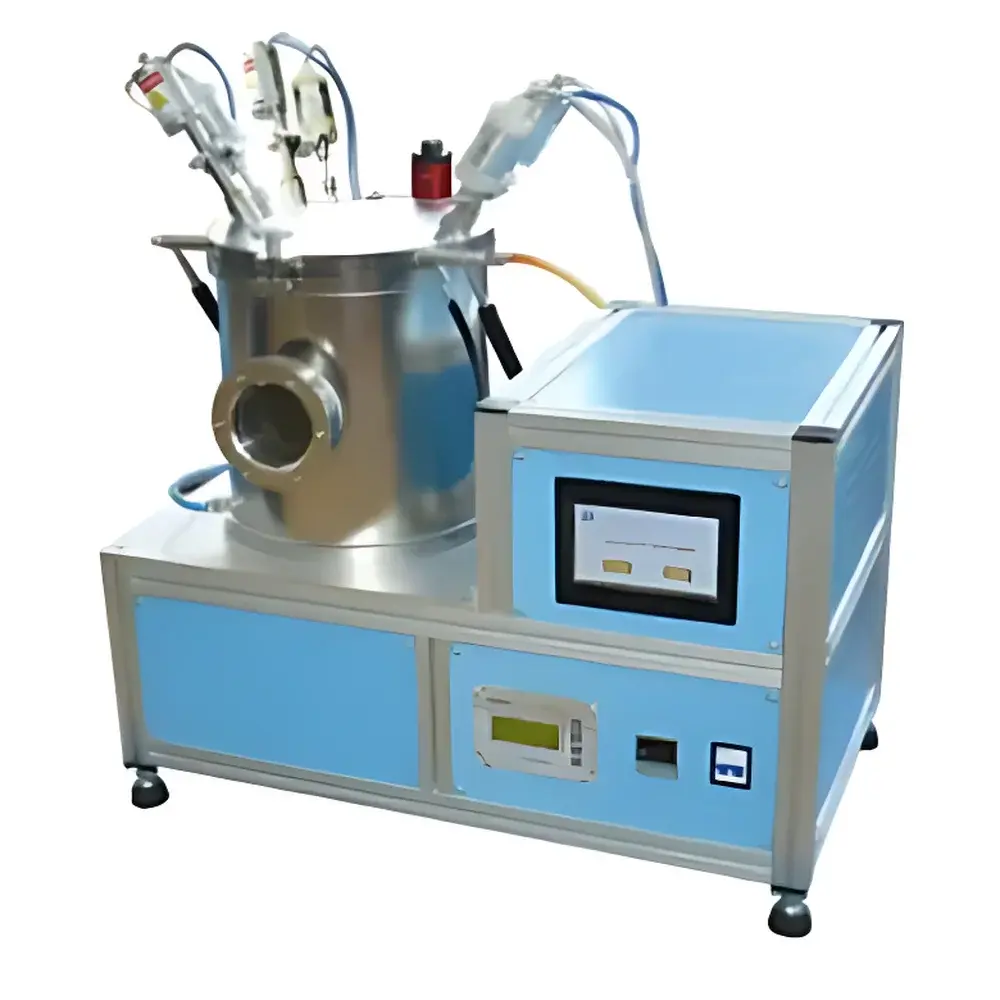
KJ GROUP VTC-600-3HD-1000 Triple-Target Magnetron Sputtering System
| Brand | KJ GROUP |
|---|---|
| Origin | Liaoning, China |
| Manufacturer Type | Direct Manufacturer |
| Origin Category | Domestic (China) |
| Model | VTC-600-3HD-1000 |
| Input Power | 220 V / 50 Hz |
| Number of Sputtering Targets | 3 |
| Chamber Inner Diameter | Ø300 mm |
| Target Cooling | Water-Cooled |
| Ultimate Vacuum | 7.4 × 10⁻⁵ Pa |
| Vacuum Chamber Dimensions | Φ300 × 330 mm |
| Vacuum System | VRD-16 Rotary Vane Pump + FF-100/150 Turbo-Molecular Pump |
| Pump-Down Time | ≤30 min (from atmosphere to 5.0 × 10⁻³ Pa) |
| Gas Inlet System | Dual Mass Flow Controllers (Ar: 100 sccm + 200 sccm |
| Target Size | Φ2 inch (50.8 mm), thickness 0.1–5 mm |
| Substrate Holder | Φ70 mm, heated (RT to 1000 °C) |
| Overall Dimensions | 900 mm (W) × 650 mm (D) × 1100 mm (H) |
Overview
The KJ GROUP VTC-600-3HD-1000 Triple-Target Magnetron Sputtering System is a high-vacuum thin-film deposition platform engineered for precision, reproducibility, and operational flexibility in academic and industrial R&D laboratories. Based on the principle of magnetron-enhanced physical vapor deposition (PVD), this system utilizes crossed electric and magnetic fields to confine electrons near the target surface—increasing plasma density and ionization efficiency while reducing substrate heating and enabling stable low-pressure operation (down to 7.4 × 10⁻⁵ Pa). Its modular three-target configuration supports co-sputtering, sequential layering, and combinatorial synthesis of multilayer heterostructures—making it particularly suited for fabricating functional thin films including ferroelectrics (e.g., PZT, BTO), transparent conductive oxides (e.g., ITO, AZO), transition metal nitrides (e.g., TiN, CrN), dielectric stacks (e.g., SiO₂, Al₂O₃), optical interference coatings, and hard protective coatings.
Key Features
- Triple independent magnetron sputter sources: two RF (13.56 MHz) channels for insulating or semiconducting targets (e.g., oxides, nitrides, polymers) and one DC channel for metallic or conductive targets (e.g., Cu, Al, Ni, Pt).
- Optional high-field magnet assembly available for ferromagnetic target sputtering (e.g., Fe, Co, Ni alloys), mitigating magnetic shielding effects via enhanced confinement geometry.
- Water-cooled target mounting with standardized Φ2-inch (50.8 mm) target holders accommodating thicknesses from 0.1 mm to 5 mm—compatible with bonded and monolithic targets.
- Heated substrate stage (Φ70 mm) with programmable temperature control from room temperature to 1000 °C ± 5 °C, enabling in-situ annealing and stress-modulated growth.
- High-integrity stainless-steel vacuum chamber (Φ300 × 330 mm) with all-metal seals, bake-out capable, and integrated quartz crystal microbalance (QCM) port for real-time deposition rate monitoring (optional).
- Integrated dual-channel mass flow controller system (100 sccm + 200 sccm Ar) with digital setpoint control; additional gas lines (N₂, O₂, CH₄, H₂) can be added via standardized CF-35 ports.
Sample Compatibility & Compliance
The VTC-600-3HD-1000 accommodates standard wafer formats up to Φ70 mm and custom substrates (glass, Si, quartz, sapphire, flexible polymer foils) with minimal geometric constraints. All internal surfaces are electropolished 316L stainless steel, compliant with ISO 10110 optical cleanliness standards for low-particulate environments. The vacuum architecture meets ASTM F2436-22 requirements for residual gas analysis readiness and supports optional integration of residual gas analyzers (RGAs) for process diagnostics. System interlocks, pressure monitoring, and emergency vent protocols conform to IEC 61000-6-2 (EMC) and IEC 61000-6-4 emission standards. Full documentation—including FAT/SAT reports, material traceability certificates, and CE-conformity declarations—is provided upon delivery.
Software & Data Management
Operation is managed via an embedded industrial PC running KJ-SPUTTER v3.2 control software—a deterministic real-time interface supporting recipe-based automation, multi-step process sequencing, and synchronized parameter logging (pressure, power, gas flow, temperature, time). All critical process variables are timestamped with millisecond resolution and stored in SQLite databases compliant with 21 CFR Part 11 audit-trail requirements when configured with user authentication and electronic signature modules. Export formats include CSV, MATLAB (.mat), and HDF5 for interoperability with MATLAB, Python (NumPy/Pandas), and LabVIEW-based analysis pipelines. Remote monitoring via Ethernet (TCP/IP) enables secure access through institutional firewalls without exposing internal network infrastructure.
Applications
- Growth of epitaxial oxide heterostructures for emergent quantum phenomena (e.g., LaAlO₃/SrTiO₃ interfaces).
- Deposition of piezoelectric MEMS transducer layers (AlN, ZnO) with controlled c-axis orientation.
- Fabrication of graded-index optical coatings for anti-reflection and high-reflectance mirrors in UV–VIS–NIR bands.
- Development of corrosion-resistant nanolaminates (e.g., Cr/CrN, Ti/TiN) for aerospace component prototyping.
- In-situ thermal processing of amorphous-to-crystalline phase-change films (e.g., Ge₂Sb₂Te₅) under controlled partial pressure.
- Combinatorial library synthesis for rapid screening of composition–structure–property relationships in battery electrode materials (e.g., LiCoO₂–LiMn₂O₄ gradients).
FAQ
What vacuum level is achievable, and how is base pressure verified?
The system achieves a base pressure of ≤7.4 × 10⁻⁵ Pa after overnight pump-down and bake-out at 80 °C. Base pressure is measured using a calibrated Bayard–Alpert hot-cathode ionization gauge traceable to NIST standards.
Can reactive sputtering (e.g., with O₂ or N₂) be performed safely?
Yes—two dedicated MFC channels support precise reactive gas dosing. Optional plasma emission monitoring (PEM) and closed-loop partial pressure control are available for stoichiometric oxide/nitride synthesis.
Is the system compatible with load-lock integration for high-throughput workflows?
The chamber flange layout (CF-100 top port, CF-35 side ports) supports retrofittable load-lock modules meeting SEMI E10-0212 mechanical interface specifications.
What maintenance intervals are recommended for the turbomolecular pump?
FF-100/150 pumps require bearing inspection every 12,000 operating hours; full service (oil replacement, rotor balancing) is advised every 24,000 hours or per manufacturer’s logbook protocol.
Does the system support substrate rotation or biasing?
Standard configuration includes static substrate placement; optional motorized rotation (0–30 rpm) and RF/DC substrate bias (up to −200 V) kits are available as field-upgradable modules.



