
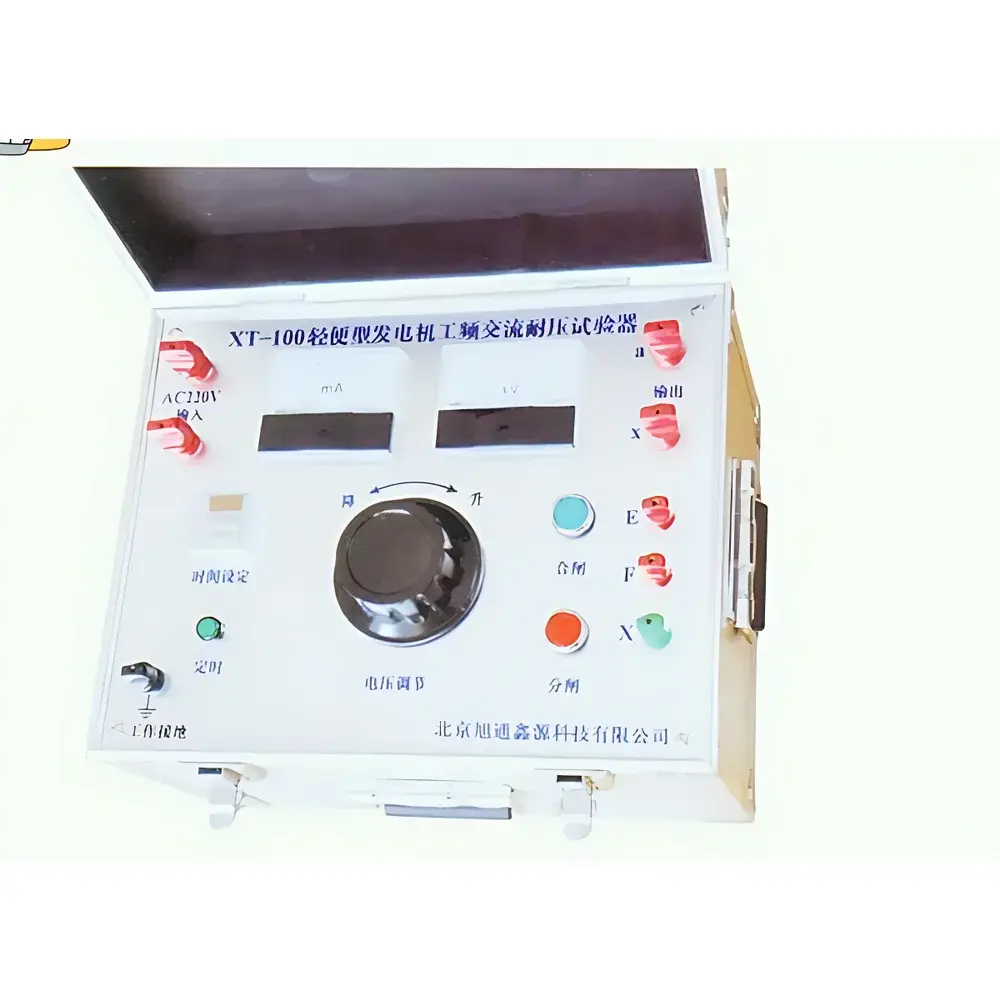
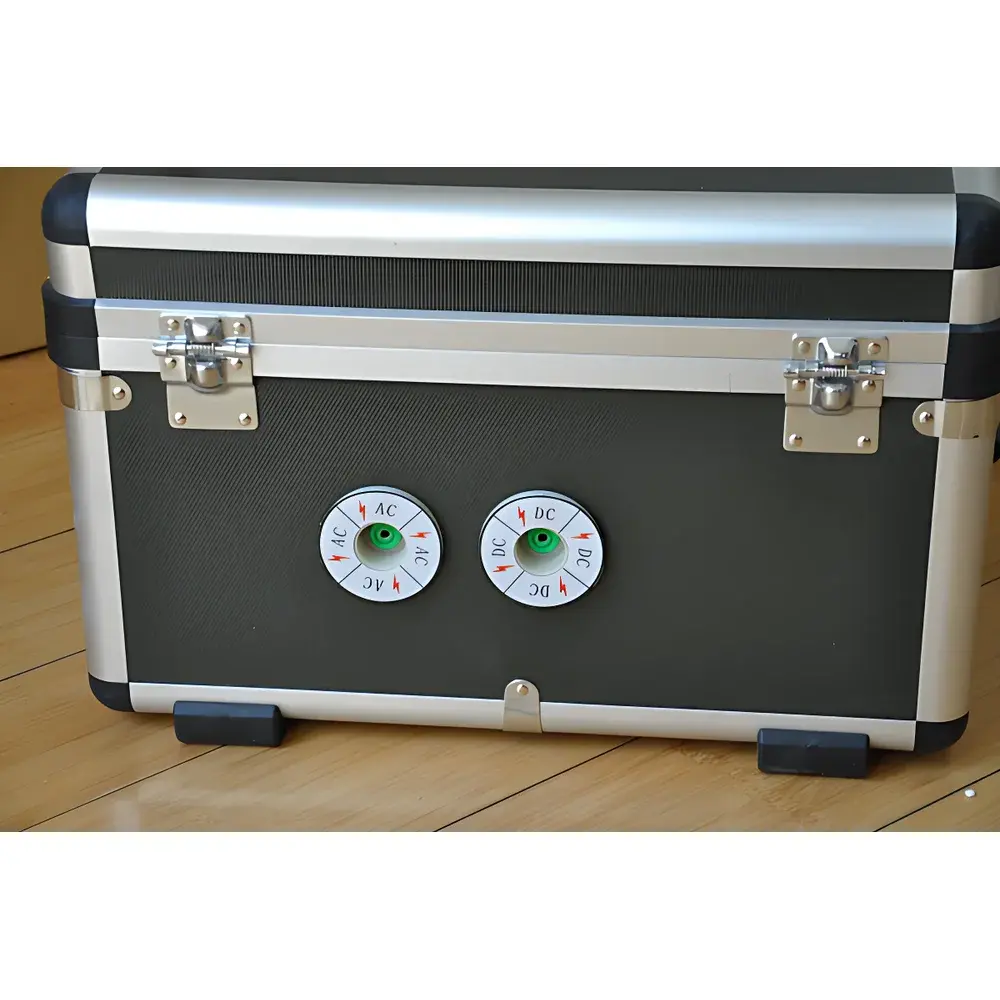
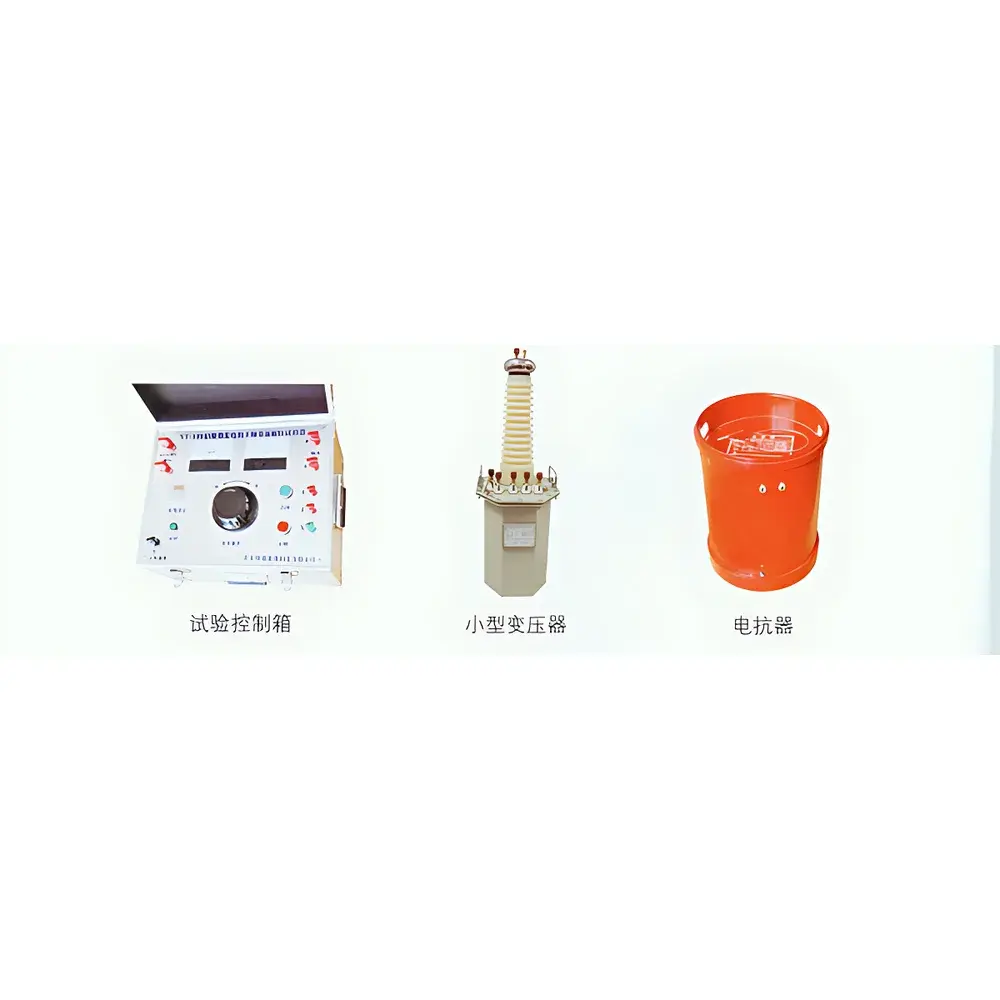
Xutongyongfu XT-100 Portable Power Frequency Withstand Voltage Tester for Generators
| Brand | Xutongyongfu |
|---|---|
| Model | XT-100 |
| Rated Output Voltage | 0–50 kV |
| Max Output Current | 3 A @ 50 kV |
| Rated Capacity | 150 kVA |
| Output Frequency | 50 Hz ±5% |
| Waveform Distortion Rate | <1.0% (sinusoidal) |
| Quality Factor (Q) | 30–80 |
| Continuous Duty Cycle | 15 min at full load |
| Operating Ambient | −10°C to +40°C, RH <90% (non-condensing) |
| Input Power | AC 220 V ±10%, 50 Hz ±1 Hz |
| Protection | Overcurrent auto-trip, zero-position interlock, audible/visual timer alarm (0–99.9 s) |
| Accuracy | ±0.5% |
| Compliance | GB 50150–91, DL/T 596–1996, DL/T 848.2–2004 |
Overview
The Xutongyongfu XT-100 Portable Power Frequency Withstand Voltage Tester is an engineered solution for on-site AC and DC high-voltage dielectric testing of large-capacity synchronous generators in power plants, substations, and commissioning environments. Unlike conventional electromagnetic induction transformers or series-resonant test systems, the XT-100 employs a patented parallel compensation principle—leveraging reactive current cancellation between inductive and capacitive components—to achieve stable 50 Hz sinusoidal voltage generation with minimal source capacity demand. This method preserves fundamental frequency integrity and waveform fidelity (distortion <1.0%), eliminating resonance-induced overvoltage risks and capacitive voltage rise (capacitive “voltage lift”) commonly observed in traditional setups. Designed specifically for generator stator winding insulation assessment, the system delivers calibrated, traceable, and standards-compliant test voltages up to 50 kV RMS while maintaining strict adherence to IEC 60060-1, IEEE Std 4, and national standards including GB 50150–91 and DL/T 848.2–2004.
Key Features
- Weight-optimized architecture: Total mass of only 120 kg—reducing transport logistics and field deployment effort by >95% compared to legacy 3–5 ton test transformers.
- Parallel compensation topology: Single reactor design eliminates complex tuning procedures; ensures fixed 50 Hz output without frequency drift or harmonic amplification during voltage ramp-up.
- AC/DC dual-mode operation: Integrated rectification and filtering circuitry enables seamless transition between AC withstand (50 Hz) and DC withstand tests—eliminating need for separate DC test sets.
- Low source demand: Requires only 7.2 kVA supply input versus 72 kVA for conventional methods—compatible with standard site auxiliary power or portable diesel generators.
- Dual-display interface: Analog pointer gauge and digital meter provide redundant voltage/current readouts with ±0.5% measurement accuracy per IEC 61000-4-30 Class S requirements.
- Fail-safe protection suite: Zero-start interlock, programmable timer (0–99.9 s), overcurrent cutoff, and acoustic/visual alarm ensure operator safety and test repeatability under unattended conditions.
Sample Compatibility & Compliance
The XT-100 is validated for dielectric testing of stator windings in turbo-generators and hydro-generators with rated outputs from 200 MW to 600 MW and nominal voltages ranging from 15.75 kV to 20 kV. Its compensation-based design accommodates typical generator capacitance values between 0.18 µF and 0.21 µF—verified across multiple OEM specifications (e.g., Harbin Electric, Dongfang Electric, Shanghai Electric). All operational parameters comply with mandatory regulatory frameworks for electrical commissioning in China’s power sector, including GB 50150–91 (Acceptance Test Standard for Electrical Installation), DL/T 596–1996 (Preventive Testing Code for Power Equipment), and DL/T 848.2–2004 (General Technical Conditions for Power Frequency High-Voltage Test Systems). The unit supports GLP-aligned documentation protocols and may be integrated into QA/QC workflows requiring audit trails per ISO/IEC 17025.
Software & Data Management
While the XT-100 operates primarily in manual mode via front-panel controls, its analog/digital instrumentation interface supports external data acquisition via 4–20 mA or 0–10 V analog outputs (optional configuration). When paired with third-party DAQ systems compliant with IEEE 1158 or IEC 61850-9-2, real-time voltage, current, and timer status can be logged for post-test analysis. All test records—including start/stop timestamps, peak voltage, duration, and trip events—are retained in non-volatile memory for ≥1,000 test cycles. Export formats include CSV and PDF, enabling direct import into enterprise asset management (EAM) platforms such as SAP PM or IBM Maximo. The device does not implement FDA 21 CFR Part 11 electronic signature functionality, but meets baseline data integrity requirements for non-GxP industrial applications.
Applications
- Commissioning acceptance testing of newly installed or refurbished generator stator windings prior to grid synchronization.
- Periodic preventive maintenance testing per DL/T 596–1996 schedules—especially in remote hydropower stations where crane access and transformer mobility are constrained.
- Field verification of insulation integrity after transportation, rewinding, or moisture exposure incidents.
- Comparative diagnostic testing across multiple generator units within a single plant to identify aging trends or manufacturing inconsistencies.
- Supporting root cause analysis during insulation failure investigations when combined with partial discharge (PD) monitoring accessories (externally coupled).
FAQ
Does the XT-100 require external tuning or frequency adjustment during operation?
No. The parallel compensation circuit is pre-calibrated for 50 Hz operation; no user tuning is necessary before or during voltage application.
Can the XT-100 perform both AC and DC withstand tests on the same generator without hardware reconfiguration?
Yes. Internal solid-state rectification allows immediate switching between AC and DC modes using the front-panel selector switch.
What is the maximum allowable generator capacitance for stable operation at 50 kV?
The system maintains waveform fidelity and voltage regulation for capacitances between 0.18 µF and 0.21 µF—covering >95% of utility-scale turbine generators manufactured since 2010.
Is the XT-100 certified for use in explosion-hazardous areas (e.g., near hydrogen-cooled generators)?
It is not intrinsically safe or ATEX-certified. Use requires adherence to NFPA 70E arc-flash boundaries and local site-specific hazardous area permits.
How is calibration traceability maintained across service intervals?
Calibration certificates reference NIM (National Institute of Metrology, China) traceable standards. Annual recalibration is recommended; internal self-check routines verify sensor linearity and protection thresholds prior to each test sequence.



