
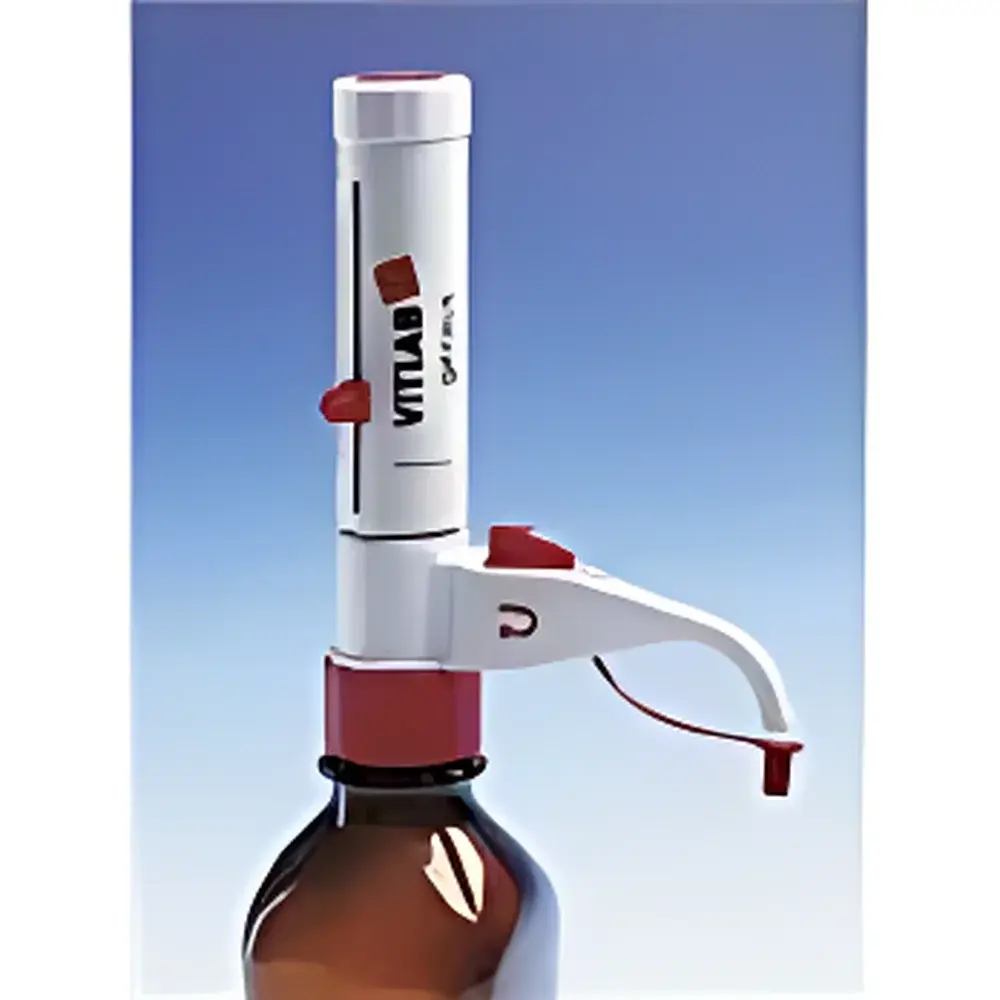
Vitlab Genius Bottle Top Dispenser
| Brand | Vitlab |
|---|---|
| Origin | Germany |
| Type | Manual Bottle Top Dispenser |
| Volume Range | 2.5–100 mL |
| Minimum Graduation | 1 mL |
| Accuracy | ±0.1% of set volume |
| Maximum Permissible Error | ±0.5% |
| Sterilization | Autoclavable at 121 °C / 2 bar (DIN EN 285) |
| Compliance | DIN EN ISO 8655-5 & -6, DIN 12600 |
| Wetted Materials | PTFE, PFA, Borosilicate Glass (Duran®), Platinum-Iridium Alloy |
| Valve Technology | Patented reflux valve (EP 542 241 B1) |
| Calibration | In-situ, tool-free, traceable adjustment without downtime |
| Cylinder Construction | Double-walled borosilicate glass cylinder with protective polymer overmold |
| Sealing Mechanism | PFA-coated displacement piston with wiper-style seal to prevent crystallization buildup |
| Adjustable Delivery Tube | Telescopic PTFE-coated tube (200–350 mm) |
| Included Accessories | Three PP threaded adapters (GL28, GL32, S40 for 2.5–10 mL |
Overview
The Vitlab Genius Bottle Top Dispenser is a precision-engineered manual liquid handling instrument designed for repeatable, contamination-free dispensing of aggressive and sensitive reagents in analytical, quality control, and research laboratories. Based on the proven piston-driven positive displacement principle, it delivers volumetric accuracy traceable to DIN EN ISO 8655-5 and -6 under standardized conditions (20 °C, deionized water, matched thermal equilibrium). Its core architecture integrates a borosilicate glass (Duran®) measuring cylinder—hermetically sealed and overmolded with impact-resistant polymer—to ensure dimensional stability and optical clarity while eliminating leaching or adsorption artifacts. The patented reflux valve (EP 542 241 B1) prevents vapor loss and reagent escape during venting, critical for volatile, toxic, or low-boiling-point solvents. Unlike spring-loaded or air-cushioned systems, the Genius employs a direct-coupled, linear-displacement piston actuated via ergonomic rotary handle, minimizing hysteresis and ensuring high reproducibility across repeated cycles.
Key Features
- Chemical resistance across broad pH range (−1 to +14) and organic solvent classes, enabled by full-wetted path construction using PTFE, PFA, Duran® borosilicate glass, and platinum-iridium alloy components.
- Telescopic delivery tube (200–350 mm) with PTFE coating accommodates variable bottle heights and minimizes splashing or droplet carryover.
- Wiper-style PFA sealing element continuously clears crystallizing or viscous media from the cylinder wall during piston travel—eliminating clogging and drift in long-term use with salts, buffers, or concentrated acids.
- Tool-free, in-place calibration system allows real-time verification and adjustment against certified reference volumes without disassembly or service interruption.
- Autoclavable at 121 °C / 2 bar per DIN EN 285, validated for steam sterilization cycles required in pharmaceutical, biotech, and GLP-compliant environments.
- Dual-certified compliance: meets DIN 12600 for mechanical safety and functional reliability, and DIN EN ISO 8655-5/-6 for metrological performance—including accuracy (±0.1%), maximum permissible error (±0.5%), and coefficient of variation (CV ≤ 0.1% at nominal volume).
Sample Compatibility & Compliance
The Genius dispenser is validated for use with corrosive, oxidizing, and organically miscible liquids—including hydrochloric acid (up to 37%), nitric acid (up to 65%), sulfuric acid (up to 96%), sodium hydroxide (up to 50%), acetone, acetonitrile, chloroform, and ethanol. Its inert wetted materials eliminate catalytic degradation, metal ion leaching, or surface adsorption—ensuring integrity of trace-metal analysis, HPLC mobile phase preparation, and cell culture reagent handling. Regulatory alignment includes full traceability to ISO/IEC 17025 calibration protocols, compatibility with FDA 21 CFR Part 11–compliant electronic lab notebooks (when paired with optional digital loggers), and suitability for GMP/GLP audit trails when operated within documented SOPs.
Software & Data Management
As a fully manual, non-electronic instrument, the Vitlab Genius requires no firmware, drivers, or software integration. All operational parameters—including volume setting, calibration status, and sterilization history—are physically engraved or recorded in paper-based logbooks per ISO 15195 and CLSI EP29-A guidelines. For laboratories implementing digital quality management systems (QMS), the included certificate of conformity provides metrological traceability to national standards (e.g., PTB, NIST), and calibration events may be logged into LIMS or ELN platforms via structured metadata entry (e.g., instrument ID, date, operator, reference standard used, deviation values). No proprietary software dependencies or cloud connectivity are involved—ensuring data sovereignty and long-term archival stability.
Applications
- Preparation of standardized titrants and buffer solutions in ISO/IEC 17025-accredited testing labs.
- Dispensing of hazardous reagents (e.g., HF, bromine, osmium tetroxide) in fume hoods, leveraging the reflux valve’s vapor containment capability.
- Pharmaceutical QC workflows requiring autoclavable, non-pyrogenic liquid handlers compliant with USP and EU Annex 15.
- Environmental testing labs performing EPA Method 300.0–300.1 anion analysis, where chloride/bromide carryover must be eliminated between samples.
- Academic research involving cryogenic solvents (e.g., THF, diethyl ether) where thermal contraction-induced leakage is mitigated by the zero-backlash piston design.
FAQ
Is the Vitlab Genius compatible with narrow-neck reagent bottles?
Yes—the included set of polypropylene threaded adapters (GL28, GL32, GL38, S40, GL45) ensures secure, leak-tight connection to standard laboratory bottle necks, including those with reduced-diameter openings.
Can it dispense viscous liquids such as glycerol or concentrated sucrose solutions?
It is optimized for viscosities up to 500 mPa·s at 20 °C; for higher-viscosity applications, pre-warming the reagent and using the lowest practical dispensing speed is recommended to maintain accuracy.
Does the autoclaving process affect long-term calibration stability?
No—repeated sterilization cycles (up to 500×) have been validated per DIN EN 285 to cause no measurable dimensional drift in the glass cylinder or piston assembly, preserving metrological integrity.
How is traceability maintained after field calibration?
Each calibration event must be documented manually with date, operator ID, reference standard used (e.g., Class A volumetric flask), and measured deviation; this record satisfies ISO/IEC 17025 clause 7.7.1 and supports internal audit readiness.
Are replacement parts available separately?
Yes—original Vitlab spare kits (piston seals, reflux valves, delivery tubes, and adapter sets) are supplied with batch-specific certificates of conformance and are interchangeable across all Genius models rated for the same volume range.



