
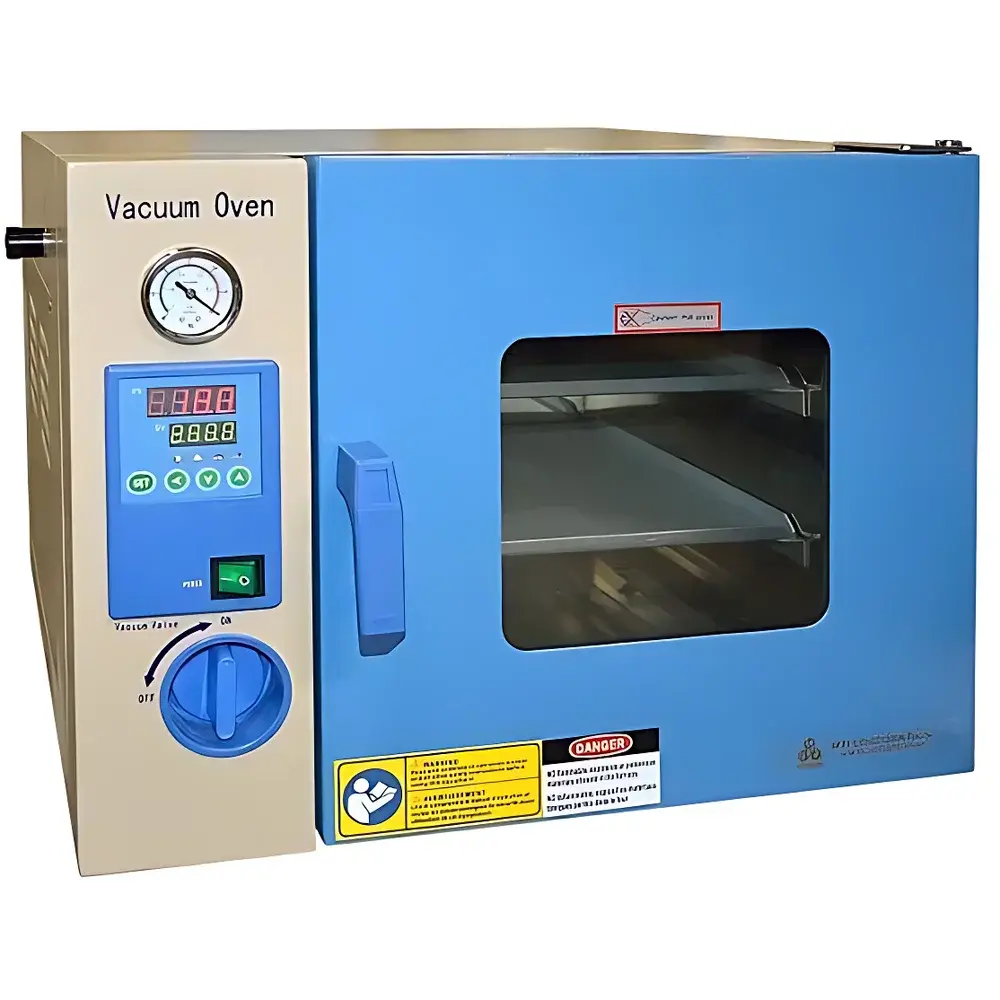
KJ GROUP DZF Series Vacuum Drying Oven
| Brand | KJ GROUP |
|---|---|
| Origin | Liaoning, China |
| Manufacturer Type | Authorized Distributor |
| Country of Origin | China |
| Model | DZF Series |
| Pricing | Upon Request |
| Power Supply | 220 V / 50 Hz |
| Heating Power | 1000 W (DZF-6020) / 1400 W (DZF-6050) |
| Temperature Range | 50–250 °C |
| Temperature Uniformity | ±1% |
| Ultimate Vacuum | <133 Pa |
| Chamber Dimensions (DZF-6020) | 300 × 300 × 275 mm |
| Chamber Dimensions (DZF-6050) | 415 × 370 × 345 mm |
| External Dimensions (DZF-6020) | 590 × 490 × 450 mm |
| External Dimensions (DZF-6050) | 710 × 560 × 550 mm |
| Interior Material | Stainless Steel (304-grade equivalent) |
| Door | Double-layer tempered safety glass with silicone gasket |
| Insulation | High-purity alumina fiber |
| Atmosphere Control | Integrated float-type flowmeter for inert gas purging (N₂, Ar) |
| Temperature Control | 28-segment programmable PID controller |
| Standard Shelves | 2 adjustable stainless steel shelves |
| Warranty | 12 months (excludes consumables: door seals, gaskets, etc.) |
Overview
The KJ GROUP DZF Series Vacuum Drying Oven is an engineered solution for thermal processing under reduced-pressure environments. Designed in accordance with fundamental principles of vacuum thermodynamics, it operates by lowering the ambient pressure inside the chamber to reduce the boiling point of volatile solvents and moisture—enabling gentle, uniform drying of heat-sensitive, oxidation-prone, or chemically unstable materials. Unlike conventional convection ovens, the DZF series eliminates reliance on air circulation, thereby preventing particle displacement, surface oxidation, and thermal degradation during dehydration. Its architecture integrates a robust vacuum-tight chamber, high-efficiency insulation, and precise programmable temperature control—making it suitable for applications ranging from pharmaceutical lyophilization pre-drying and polymer solvent removal to ceramic precursor stabilization and analytical sample preparation.
Key Features
- Double-walled, double-glazed observation door with tempered and laminated safety glass—provides real-time visual monitoring without compromising vacuum integrity.
- One-piece molded silicone door gasket with adjustable compression mechanism ensures repeatable sealing performance and long-term vacuum retention (<133 Pa).
- Chamber constructed from electropolished stainless steel (equivalent to ASTM A240 Type 304), offering corrosion resistance, non-reactivity, and ease of cleaning—critical for GLP-compliant laboratories.
- High-purity alumina fiber insulation (≥99.5% Al₂O₃ content) minimizes thermal loss and enables rapid heating cycles—reducing typical drying time by over 50% compared to legacy vacuum ovens.
- 28-segment programmable PID temperature controller supports complex ramp-soak-hold profiles, enabling reproducible thermal protocols aligned with USP & ISO 8573-1 drying validation requirements.
- Integrated float-type flowmeter allows controlled inert gas (N₂ or Ar) backfilling to maintain defined partial pressures or purge reactive atmospheres—essential for handling pyrophoric compounds or oxygen-sensitive catalysts.
Sample Compatibility & Compliance
The DZF Series accommodates heterogeneous sample forms—including powders, gels, thin-film coatings, porous ceramics, metal-organic frameworks (MOFs), and multi-component composites—without mechanical disturbance. Its vacuum-assisted moisture removal is particularly effective for capillary-bound water in hydrogels, residual solvents in spin-coated films, and entrapped volatiles in sintered green bodies. The system complies with structural and operational benchmarks referenced in ISO 554 (standard atmospheres for conditioning), ASTM D2243 (vacuum drying of plastics), and ICH Q5C (stability testing of biopharmaceuticals). While not certified for Class I Division 1 hazardous locations, its inert-gas compatibility and absence of internal ignition sources support safe operation per NFPA 45 guidelines for laboratory-scale chemical drying.
Software & Data Management
The embedded microprocessor controller logs temperature setpoints, actual chamber readings, vacuum status, and program execution timestamps at user-defined intervals (1–60 sec resolution). Data export is supported via RS-232 interface to external PCs running compliant data acquisition software. Audit trail functionality includes operator ID tagging, parameter change history, and event-driven alarms (e.g., vacuum breach, overtemperature). When integrated with validated LIMS platforms, the DZF Series supports 21 CFR Part 11–compliant electronic records—provided third-party software enforces role-based access control, electronic signatures, and immutable archival.
Applications
- Pretreatment of battery electrode slurries prior to calendaring—removing NMP solvent while preserving binder morphology.
- Drying of nanoscale metal oxide precursors (e.g., NiO, Co₃O₄) to prevent agglomeration and retain specific surface area (>80 m²/g).
- Dehydration of freeze-dried protein formulations before secondary packaging—minimizing residual moisture to <0.5% w/w.
- Outgassing of optical components and vacuum chamber subassemblies in semiconductor R&D labs.
- Stabilization of perovskite thin films for photovoltaic device fabrication—avoiding halide segregation induced by ambient humidity or thermal gradients.
FAQ
What vacuum level can the DZF Series achieve, and how is it measured?
The chamber achieves a base pressure of <133 Pa (1 Torr) using a standard two-stage rotary vane pump (not included). Pressure is monitored via built-in analog vacuum gauge calibrated against NIST-traceable references.
Can the DZF oven be used for outgassing polymers under high vacuum?
It is rated for rough vacuum operation only; for high-vacuum outgassing (<10⁻³ Pa), integration with a turbomolecular pumping station and vacuum flange adaptation is required.
Is the temperature controller validated for GxP environments?
The unit supports IQ/OQ documentation packages; however, full PQ validation must be performed on-site using calibrated traceable sensors per ASTM E2876.
How often should the silicone door seal be replaced?
Under normal use (≤200 °C, daily cycling), replacement is recommended every 12–18 months—or immediately if vacuum hold time drops below 30 minutes after pump-off.
Does the DZF Series comply with CE or UL safety standards?
The design adheres to IEC 61010-1:2010 for electrical safety and EN 60529 IP20 enclosure rating; CE marking requires end-user responsibility for local conformity assessment.



