
Stevens HydraProbe Soil Tri-Parameter Sensor
| Brand | Stevens |
|---|---|
| Origin | USA |
| Manufacturer Type | Authorized Distributor |
| Origin Category | Imported |
| Model | HydraProbe |
| Instrument Type | Multiparameter Soil Analyzer |
| Measurement Range & Resolution | 0–100% Volumetric Water Content (VWC) |
| Electrical Conductivity | 1–80 dS/m (equivalent to 0.01–1.5 S/m) |
| Temperature | −40 °C to +75 °C |
| Power Supply | 9–16 VDC |
| Dimensions | 124 × 40 mm (L × Ø) |
Overview
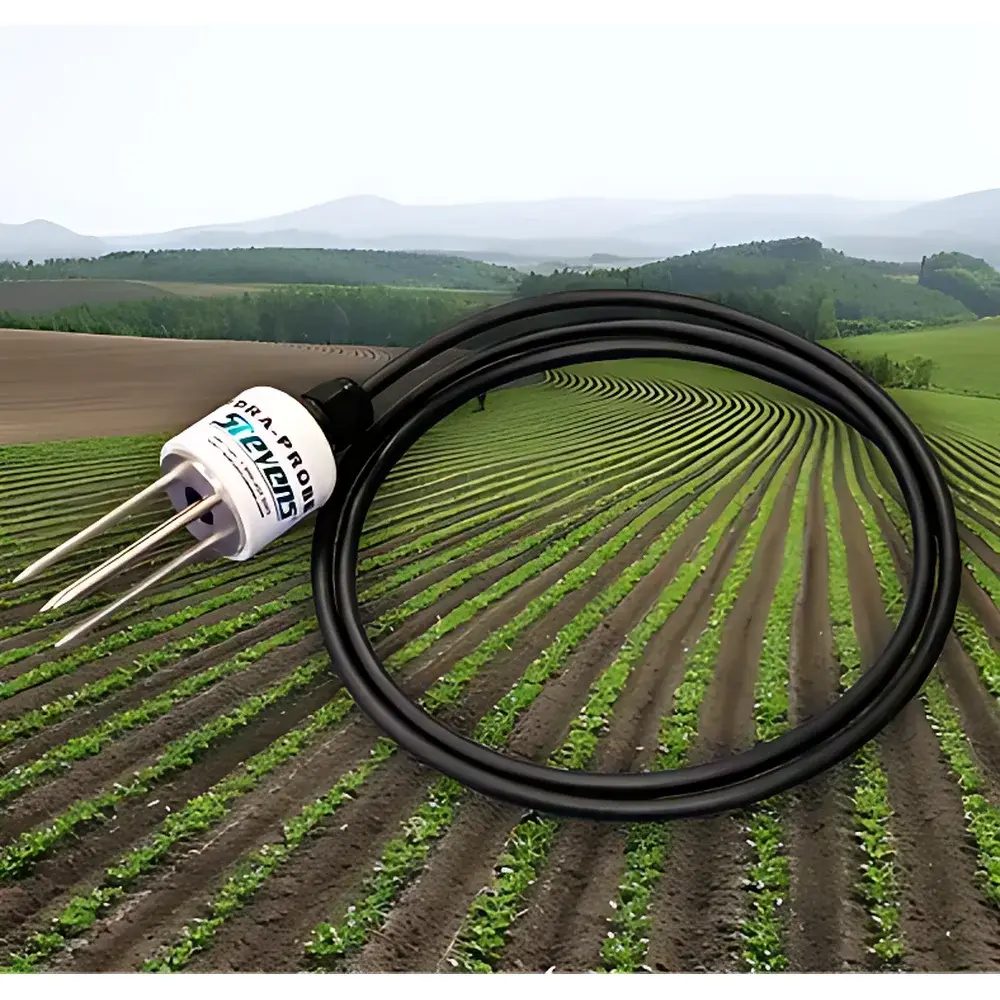
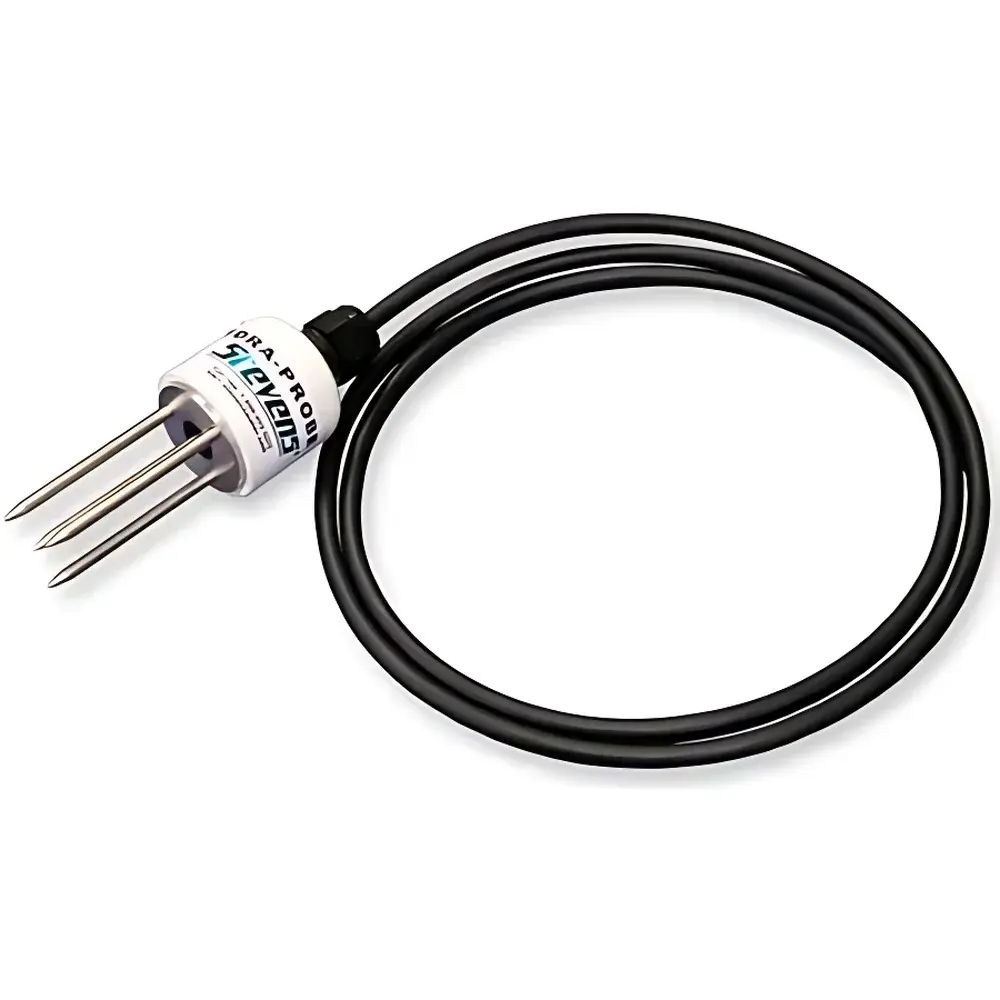
The Stevens HydraProbe Soil Tri-Parameter Sensor is a research-grade, field-deployable in-situ probe engineered for continuous, simultaneous measurement of three fundamental soil physical properties: volumetric water content (VWC), bulk electrical conductivity (EC), and soil temperature. Unlike traditional capacitance or TDR-based sensors, the HydraProbe employs patented dielectric impedance spectroscopy — a multi-frequency, four-electrode measurement technique that directly quantifies the complex dielectric permittivity (ε′ and ε″) of the soil matrix across a defined frequency band. This physics-based approach eliminates empirical calibration dependencies and delivers high reproducibility under variable soil texture, salinity, and density conditions. Designed for unattended operation in remote and harsh environments — including arid deserts, permafrost margins, agricultural fields, and landfill cover systems — the HydraProbe features a hermetically sealed, UV-stabilized cable assembly and a corrosion-resistant 304 stainless steel sensing rod. Its robust architecture supports long-term burial (up to 10+ years) without recalibration, making it a foundational tool for hydrological modeling, irrigation scheduling, vadose zone monitoring, and climate change impact studies.
Key Features
- Simultaneous, real-time acquisition of volumetric water content (0–100%), bulk electrical conductivity (0.01–1.5 S/m), and temperature (−40 °C to +75 °C)
- Dielectric impedance spectroscopy technology — immune to electrode polarization, mineral dissolution, and contact resistance artifacts common in two-electrode EC sensors
- No factory or field recalibration required; stable performance across clay, sand, loam, and organic soils
- IP68-rated electronics housing with UV-resistant, direct-burial-rated polyethylene jacketed cable (standard 7.62 m, optional up to 30.48 m)
- Low-power operation: <1 mA quiescent current (SDI-12 mode); compatible with solar-powered data loggers and battery-operated telemetry systems
- Dual communication interfaces: SDI-12 v1.2 compliant (1200 baud) and RS-485 (9600 baud), enabling integration into legacy and modern environmental monitoring networks
- Operating temperature range: −10 °C to +55 °C (ambient); 0 °C to +55 °C (in-soil); extended-range variants available for −30 °C to +55 °C deployment
Sample Compatibility & Compliance
The HydraProbe is validated for use in mineral soils, volcanic ash, peat, and engineered landfill covers. It does not require soil-specific calibration curves and maintains accuracy across bulk densities from 1.0 to 1.8 g/cm³ and pore-water EC up to 15 dS/m. The sensor complies with ASTM D5365 (Standard Test Method for Determining Dielectric Constant of Soils), ISO 11272 (Soil Quality — Determination of Dry Matter and Water Content), and supports GLP-compliant data collection when paired with audit-trail-enabled dataloggers. Its SDI-12 output meets USGS NWIS and USDA ARS network interoperability standards. The probe’s passive design and lack of consumables ensure compliance with long-term ecological research site (LTER) instrumentation requirements.
Software & Data Management
HydraProbe data are natively compatible with Campbell Scientific CR series, Onset HOBO, METER Group EM50, and Decagon (now Meter Group) ZL6 loggers. Raw impedance spectra can be post-processed using Stevens’ proprietary HydraPro software (Windows-based) to derive calibrated VWC, EC, and temperature values using peer-reviewed dielectric mixing models (e.g., Topp equation, Roth model, and Complex Refractive Index Model). Export formats include CSV, NetCDF, and JSON. When integrated with cloud platforms such as FieldClimate or AQUA4D, the sensor supports automated threshold alerts, time-series visualization, and API-driven model coupling (e.g., HYDRUS-1D, SWAT). Firmware updates are delivered via UART or SDI-12 command set, ensuring future-proof adaptability.
Applications
- Real-time irrigation management in precision agriculture and viticulture
- Vadose zone flux estimation and unsaturated hydraulic property characterization
- Landfill leachate plume tracking and capillary barrier performance assessment
- Permafrost active layer monitoring and thaw settlement modeling
- Soil moisture network densification for regional drought early-warning systems
- Calibration and validation of satellite-based soil moisture products (e.g., SMAP, Sentinel-1)
- Long-term ecological research (LTER) and Critical Zone Observatory (CZO) infrastructure
FAQ
Does the HydraProbe require periodic calibration?
No. The sensor is factory-calibrated using NIST-traceable dielectric standards and requires no user calibration throughout its service life.
Can it be installed in frozen or saline soils?
Yes. The probe operates reliably down to −40 °C and handles bulk EC up to 1.5 S/m without signal drift or electrode fouling.
What is the maximum recommended cable length for SDI-12 communication?
60 meters with standard termination; longer runs require active repeaters or RS-485 conversion.
Is the HydraProbe compatible with ISO/IEC 17025-accredited laboratories?
While the probe itself is not certified, its traceable measurement principle and documented uncertainty budget (±0.03 m³/m³ VWC, ±2% EC, ±0.1 °C temp) support inclusion in accredited environmental testing workflows.
How is temperature compensation applied to VWC and EC measurements?
Embedded thermistor readings are used in real time to correct both dielectric and conductive components via built-in polynomial algorithms derived from controlled lab studies.
Related Products







