
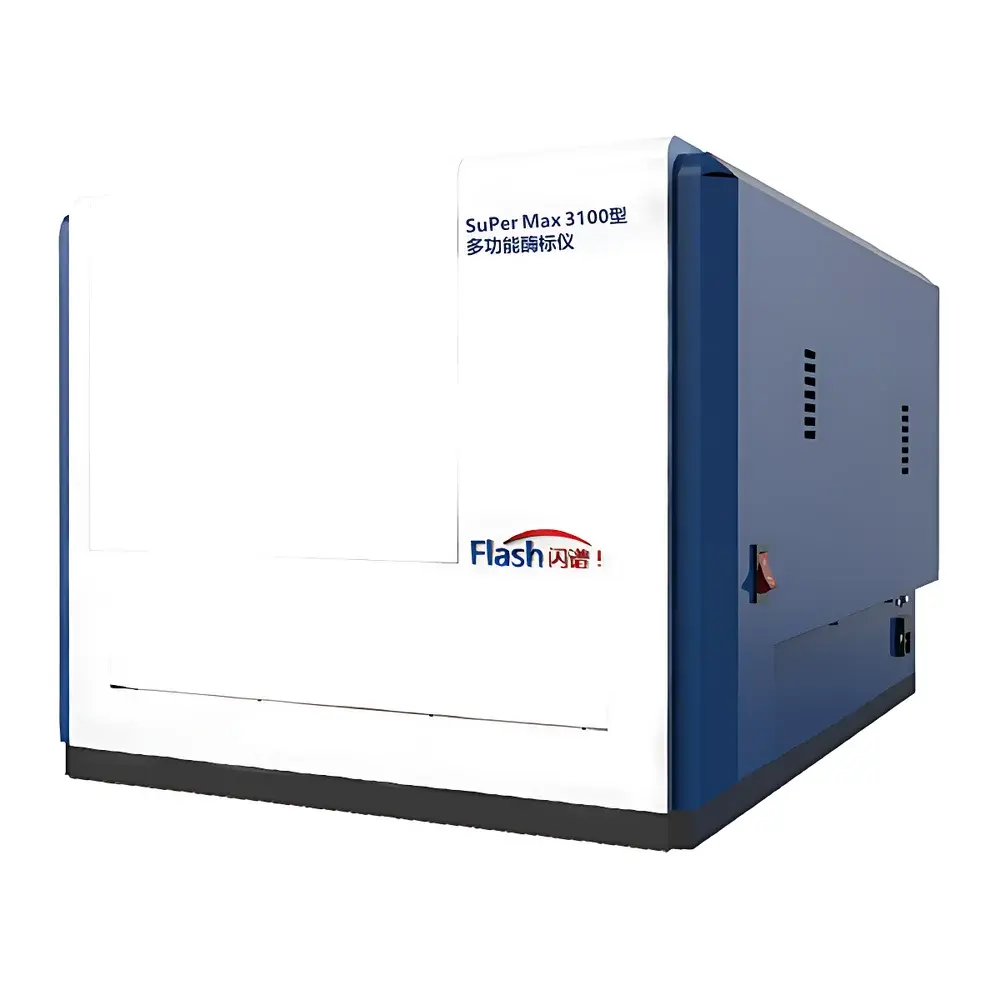
Flash Spectrum SuPerMax 3100 Multi-Mode Microplate Reader
| Brand | Flash Spectrum |
|---|---|
| Origin | Shanghai, China |
| Model | SuPerMax 3100 |
| Function Type | Multi-Mode |
| Automation Level | Fully Automated |
| Assay Modes | Endpoint, Kinetic, Spectral Scan |
| Curve Fitting | Linear |
| Detectors | Photomultiplier Tube (PMT) for Fluorescence & Luminescence, Photodiode for Absorbance |
| Wavelength Range | 190–1000 nm (monochromator-based) |
| Absorbance Range | 0–4 Abs (96-well, 450 nm) |
| Absorbance Linearity | 0–4 Abs (±2% at 450 nm, 96-well) |
| Wavelength Accuracy | ±1.0 nm |
| Kinetic Read Time (Single Wavelength) | 6 sec |
| Excitation Range | 190–1000 nm |
| Emission Range | 270–850 nm |
| Fluorescence Sensitivity (Top Read) | <0.5 fmol FITC/well (384-well) |
| Chemiluminescence Sensitivity | <7 amol ATP/well (flash reaction) |
| Temperature Control | Ambient +2°C to 65°C |
| Plate Formats | 96-, 384-well (custom formats supported) |
| Reading Modes | Top & Bottom |
| Light Source | Xenon Flash Lamp |
| Data Interface | USB 2.0 |
| Software | SuPerMax Workstation with Audit Trail (optional) |
Overview
The Flash Spectrum SuPerMax 3100 Multi-Mode Microplate Reader is an engineered platform for quantitative, high-throughput microplate-based assays in life science research and pharmaceutical development. Based on monochromator-driven optical architecture, it supports three core detection modalities—absorbance (ABS), fluorescence intensity (FI), and luminescence (LUM)—within a single instrument chassis. Its 190–1000 nm tunable excitation and emission capability enables precise spectral characterization of diverse fluorophores, while the xenon flash lamp ensures stable, low-noise illumination across UV-Vis-NIR bands. Designed for rigorous assay reproducibility, the system integrates dual optical paths: a primary signal detector (PMT for FI/LUM; photodiode for ABS) and a reference detector for real-time intensity normalization. The instrument complies with fundamental design principles outlined in ISO/IEC 17025 for measurement traceability and supports GLP/GMP-aligned workflows when equipped with optional audit trail functionality.
Key Features
- Fully automated operation with programmable plate handling, temperature control (ambient +2°C to 65°C), and orbital/linear/circular shaking—eliminating external incubators or shakers.
- Dual reading modes (top and bottom) optimized for heterogeneous assays including cell-based fluorescence, adherent reporter assays, and bottom-read ELISA formats.
- Monochromator-based wavelength selection with 1 nm resolution and <0.2 nm wavelength repeatability—enabling accurate spectral scanning and narrow-band excitation/emission optimization.
- Kinetic mode with 6-second cycle time per wavelength for real-time enzyme kinetics, calcium flux, or cAMP accumulation assays.
- Integrated photometric calibration and self-diagnostic routines accessible via USB interface; firmware updates and parameter configuration managed through workstation software.
- Optional reagent dispensing module (1 or 2 channels, 10–1000 µL volume range) for synchronized add-read protocols in luciferase reporter or ATP viability assays.
- High-sensitivity detection architecture: top-read fluorescence LOD 7 decades in flash ATP assays.
Sample Compatibility & Compliance
The SuPerMax 3100 accommodates standard microplate formats (96-, 384-well), with mechanical adaptability for custom plate geometries. Its optical path design minimizes well-to-well crosstalk (<0.2% in white plates) and supports opaque, clear, and black-walled plates for absorbance, fluorescence polarization, and luminescence applications respectively. The system meets essential performance criteria referenced in ASTM E2517-17 (Standard Practice for Performance Verification of Microplate Readers) and aligns with analytical method validation expectations under ICH Q2(R2). When configured with audit trail and electronic signature modules, it satisfies documentation requirements for FDA 21 CFR Part 11 compliance in regulated environments.
Software & Data Management
The SuPerMax Workstation software provides a unified interface for protocol definition, real-time data acquisition, and post-acquisition analysis. It supports multi-parameter kinetic plotting, spectral deconvolution, and built-in curve fitting (linear, quadratic, four-parameter logistic, and user-defined models). Raw data export is available in CSV, Excel, and XML formats; metadata—including instrument parameters, timestamps, and operator ID—is embedded in all output files. Optional audit trail functionality logs all critical events (e.g., parameter changes, calibration actions, data exports) with immutable timestamps and user attribution—enabling full traceability during internal audits or regulatory inspections.
Applications
- Enzyme activity profiling: kinase, phosphatase, protease, GST, NADH-dependent reactions using endpoint or kinetic readouts.
- Nucleic acid quantification: PicoGreen® (dsDNA), RiboGreen® (RNA), and UV260-based methods.
- Protein quantification: Bradford, Lowry, NanoOrange®, and direct UV-A280 measurements.
- Cell health and function: MTT/XTT proliferation, LDH cytotoxicity, intracellular ROS detection, ATP bioluminescence, and cAMP immunoassays.
- Reporter gene assays: dual-luciferase, β-galactosidase, alkaline phosphatase, and GFP/RFP expression monitoring.
- Microbial analysis: bacterial growth kinetics, endotoxin detection (LAL), and metabolic activity screening.
- Spectral characterization: emission/excitation scans for novel fluorophore validation and multiplex assay development.
FAQ
Does the SuPerMax 3100 support FDA 21 CFR Part 11 compliance?
Yes—when equipped with the optional audit trail and electronic signature module, the system maintains secure, time-stamped records of all user actions and data modifications, fulfilling core requirements for electronic records and signatures.
What is the maximum temperature achievable in the integrated incubation module?
The onboard temperature control system reaches up to 65°C, supporting high-temperature enzymatic reactions, thermal shift assays, and accelerated stability testing.
Can the instrument perform simultaneous dual-wavelength kinetic measurements?
No—it acquires data sequentially per wavelength; however, its 6-second per-wavelength kinetic cycle enables high-temporal-resolution profiling suitable for most enzymatic and cellular kinetic assays.
Is cuvette-based measurement supported?
No—the SuPerMax 3100 is designed exclusively for microplate-based detection; no cuvette adapter or flow cell option is available.
What are the minimum and maximum dispensing volumes with the optional injector module?
The configurable dispenser delivers volumes from 10 µL to 1000 µL per well, with precision validated across the full range per ISO 8655-6 standards.






