
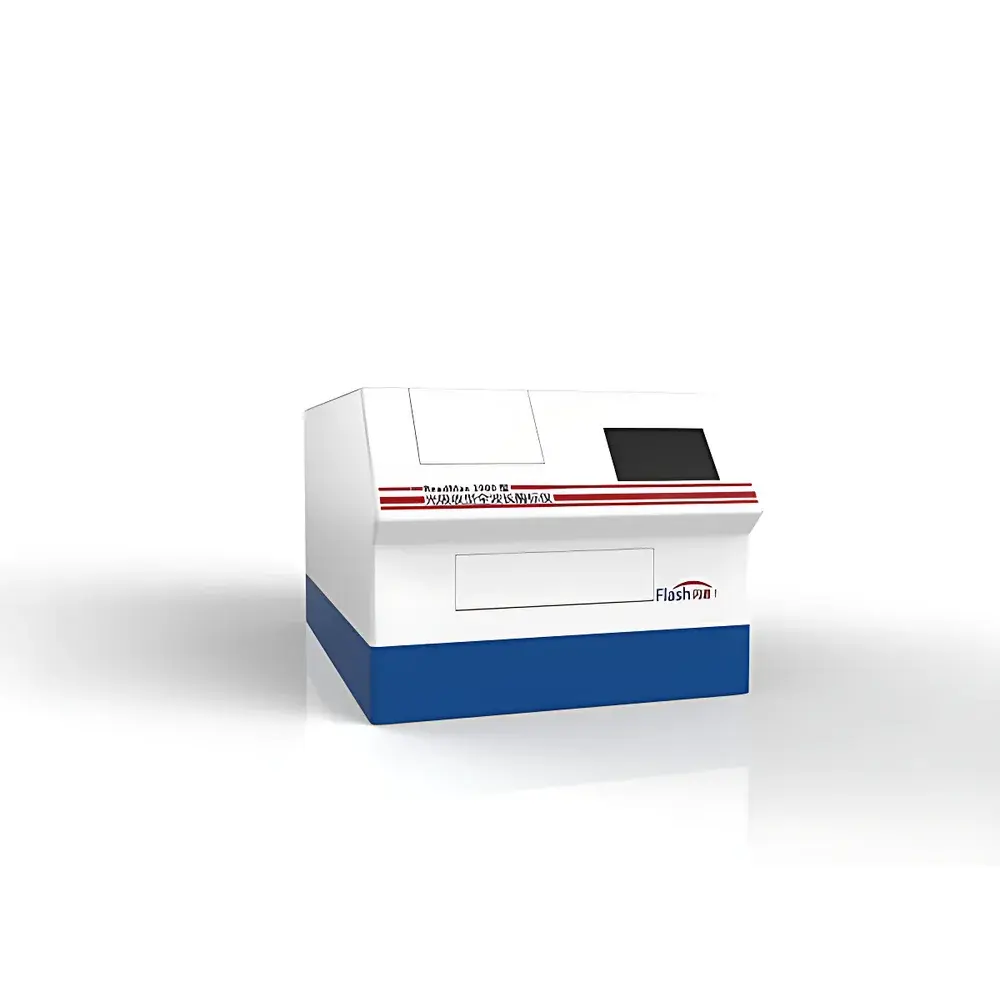
Flash Spectrum ReadMax 1900 UV-Vis Absorbance Microplate Reader
| Brand | Flash Spectrum |
|---|---|
| Origin | Shanghai, China |
| Model | ReadMax 1900 |
| Detection Principle | Absorbance (Photometric) |
| Wavelength Range | 190–900 nm |
| Optical Density Range | 0–4.000 OD |
| Wavelength Accuracy | ±1.0 nm |
| Wavelength Repeatability | <0.2 nm |
| Spectral Bandwidth | 2–10 nm (customizable) |
| Incubation Temperature Range | Ambient to 45 °C |
| Plate Formats | Standard 96-well and UV-transparent 96-well microplates |
| Detection Modes | Single-, Dual-, and Multi-wavelength |
| Data Interface | USB 2.0 |
| Software Compliance | FDA 21 CFR Part 11, IQ/OQ/PQ protocols, GLP/GMP-ready |
| Optional Accessories | Dual-cuvette adapter plate (NA-10), incubation-shaking module (MF-10), multi-mode washer (MX-10), LIMS server (WS-10) |
Overview
The Flash Spectrum ReadMax 1900 is a high-performance, grating-based UV-Vis absorbance microplate reader engineered for precision quantification and kinetic analysis in regulated life science environments. Operating on the principle of photometric absorbance measurement—based on the Beer-Lambert law—the instrument delivers accurate optical density (OD) readings across a continuous spectral range from 190 nm to 900 nm. Its core architecture integrates a stable xenon flash lamp, a high-resolution monochromator with tunable bandwidth (2–10 nm), dual photodetectors (sample + reference), and a thermally controlled microplate incubation chamber (up to 45 °C). Designed specifically to meet the operational and compliance requirements of pharmaceutical quality control laboratories, biotech R&D facilities, and academic core facilities, the ReadMax 1900 supports endpoint and kinetic assays—including ELISA, EIA, MTT, LAL endotoxin testing, nucleic acid quantification (dsDNA/ssDNA/RNA), protein assays (UV280, Bradford, Lowry), and microbial growth monitoring—without requiring external instrumentation.
Key Features
- Grating monochromator with wavelength accuracy of ±1.0 nm and repeatability better than 0.2 nm—enabling reliable spectral identification and method transfer.
- Dual-detector optical path design minimizes drift and enhances measurement reproducibility across full OD range (0–4.000).
- Integrated temperature-controlled incubation (ambient to 45 °C) and orbital shaking ensure consistent reaction kinetics and sample homogeneity during assay runtime.
- Spectral scanning mode generates full UV-Vis absorbance spectra (190–900 nm) for method development, peak identification, and purity assessment.
- Optical path normalization algorithm converts microplate well pathlength to equivalent 10-mm cuvette pathlength—facilitating direct comparison with traditional spectrophotometric data.
- Expandable hardware platform: optional dual-cuvette adapter (NA-10) enables low-volume UV-Vis cuvette measurements alongside standard microplate workflows.
- USB 2.0 interface enables direct PC control, real-time data streaming, and seamless integration into laboratory network infrastructures.
Sample Compatibility & Compliance
The ReadMax 1900 accommodates all ANSI/SBS-compliant 96-well microplates—including standard polystyrene, black/clear-bottom, and UV-transparent plates—as well as custom formats upon request. It is validated for use in GMP-compliant environments per ICH Q5A, USP , , and , and supports turbidimetric and chromogenic LAL endotoxin testing per FDA guidance. The system’s firmware and S-Pro software are architected to fulfill regulatory data integrity requirements: audit trails, electronic signatures, role-based user access control, and full 21 CFR Part 11 compliance—including secure login, session timeout, and immutable record retention. IQ/OQ/PQ documentation packages are provided for installation qualification, operational verification, and performance validation under GLP or GMP audit conditions.
Software & Data Management
S-Pro Microplate Analysis Workstation is a Windows-based application offering modular assay modules, built-in pharmacological curve-fitting engines (4PL, 5PL, linear, quadratic, log-log), and customizable report templates compliant with ISO/IEC 17025 reporting standards. The software includes dedicated databases for pharmaceutical QC workflows—supporting batch release testing, stability studies, and potency assays—with configurable pass/fail criteria and automated outlier detection. Raw data files (.xls, .csv, .xml) retain full metadata (timestamp, operator ID, plate map, instrument settings). Optional WS-10 LIMS server enables centralized management of multiple ReadMax units, cross-instrument trending, and long-term archival aligned with ALCOA+ principles (Attributable, Legible, Contemporaneous, Original, Accurate, Complete, Consistent, Enduring, Available).
Applications
- Quantitative immunoassays: Endpoint and kinetic ELISA/EIA for cytokine profiling, antibody titer determination, and vaccine potency testing.
- Nucleic acid analysis: dsDNA/ssDNA/RNA quantification using A260/A280 ratios and extinction coefficient-based calculations.
- Protein characterization: Direct UV absorbance at 280 nm; colorimetric assays (Bradford, Lowry, BCA) with integrated standard curve generation.
- Cytotoxicity and proliferation: MTT, XTT, and resazurin-based metabolic activity assays supporting IC50/EC50/LD50 modeling.
- Microbial enumeration: Turbidimetric growth monitoring and bacterial concentration estimation via OD600.
- ADME screening: Enzyme inhibition kinetics (e.g., CYP450), substrate turnover rates, and cofactor dependency studies.
- Endotoxin detection: Both turbidimetric and chromogenic LAL methods per USP , with automatic clot-point detection and interpolation.
FAQ
Does the ReadMax 1900 support FDA 21 CFR Part 11 compliance?
Yes—S-Pro software includes electronic signature capability, audit trail logging, user authentication, and data integrity safeguards required for regulated submissions.
Can it perform spectral scans across the full 190–900 nm range?
Yes—scanning resolution is adjustable (1–5 nm step size), with data export in absorbance vs. wavelength format for spectral library matching.
What is the maximum allowable OD for linear response?
The instrument maintains linearity up to 4.000 OD at all wavelengths; nonlinearity correction algorithms are available for extended dynamic range.
Is temperature control available during kinetic reads?
Yes—incubation is active and stable throughout assay runtime, with PID-controlled heating and real-time monitoring displayed in the software interface.
Are validation documents (IQ/OQ/PQ) included with purchase?
Yes—comprehensive qualification kits, protocol templates, and executed reports are supplied as part of the standard delivery package.






