
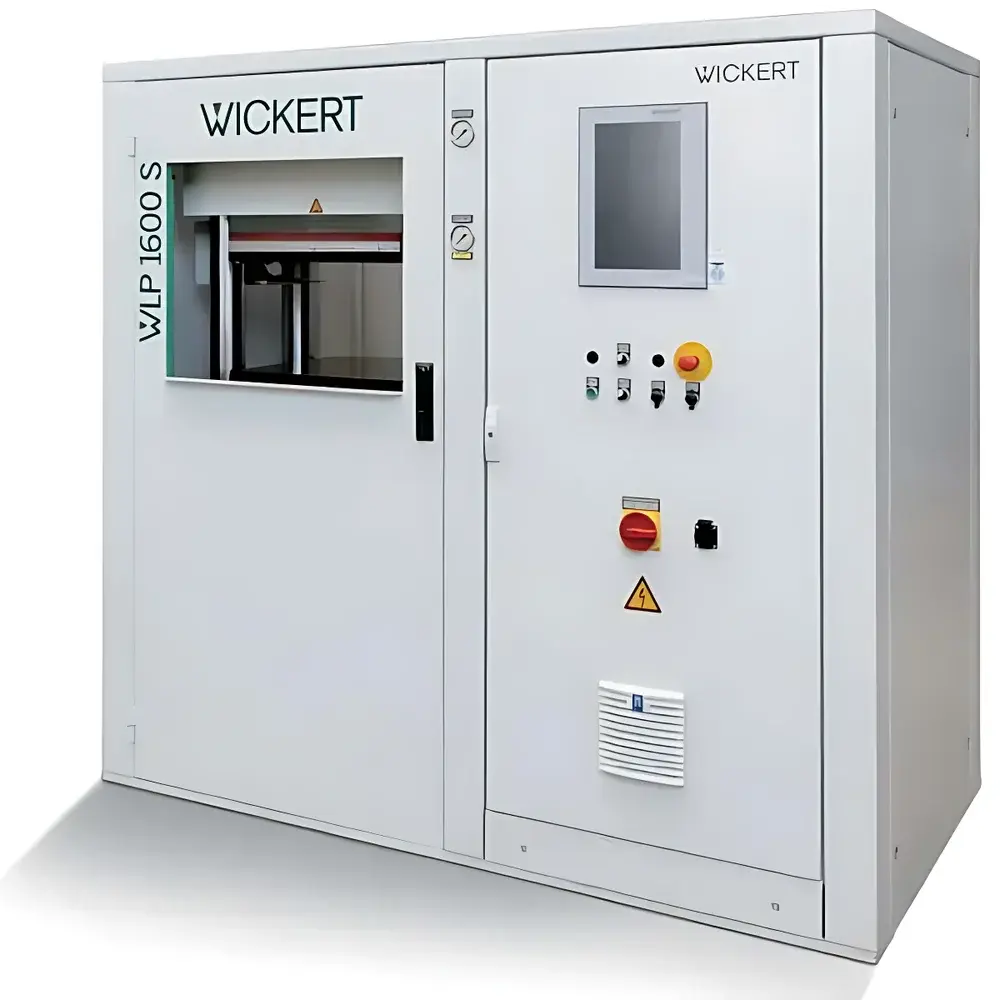
Wickert WLP S Series Laboratory平板 Vulcanizer
| Key | Brand: Wickert |
|---|---|
| Origin | Germany |
| Model | WLP S Series |
| Compliance | GB/T 6038, ISO 2393, ASTM D3182 |
| Type | Laboratory-scale hydraulic平板 vulcanizer for rubber sample curing |
Overview
The Wickert WLP S Series Laboratory平板 Vulcanizer is a precision-engineered, hydraulically actuated press system designed exclusively for controlled rubber compound curing and specimen preparation in R&D laboratories and quality control environments. Operating on the principle of heat-and-pressure-induced crosslinking (vulcanization), the system applies uniform, programmable temperature and pressure profiles to uncured rubber sheets or molded preforms—enabling reproducible production of standardized test specimens per international material testing protocols. Unlike industrial-scale vulcanizers, the WLP S Series prioritizes thermal homogeneity, pressure stability, and process repeatability over throughput, making it ideal for formulation development, batch qualification, and comparative material evaluation under GLP-compliant workflows.
Key Features
- Hydraulic pressure generation with closed-loop feedback control ensures consistent force application across the entire platen surface—critical for minimizing voids and achieving uniform crosslink density.
- Electrically heated platens with PID-controlled dual-zone heating (top and bottom) maintain ±0.5 °C temperature uniformity across the working area, verified per ASTM D5289 Annex A2.
- Adjustable stroke limit and programmable dwell time allow precise replication of cure cycles defined in ISO 2393 (rubber mixing and sheeting) and ASTM D3182 (standard practice for rubber compounding).
- Robust cast-iron frame with reinforced platen alignment mechanism minimizes deflection under load, preserving dimensional accuracy of cured specimens (e.g., dumbbell tensile bars, compression set discs).
- Integrated safety interlocks—including light curtain, mechanical platen stop, and overtemperature cutoff—meet CE Machinery Directive 2006/42/EC and EN 692 requirements.
Sample Compatibility & Compliance
The WLP S Series accommodates standard specimen geometries used in rubber physical testing, including but not limited to: ASTM D412 dumbbells (Type C), ISO 37 tensile strips (1A, 2, 4), ASTM D395 compression set cylinders (25 mm × 12.7 mm), and ISO 48 hardness test pads (10 mm thick). All models are validated for use with natural rubber (NR), styrene-butadiene rubber (SBR), nitrile rubber (NBR), ethylene propylene diene monomer (EPDM), and silicone elastomers. The system supports full traceability of cure parameters (time, temperature, pressure) required for ISO/IEC 17025-accredited testing labs and satisfies documentation prerequisites for FDA-regulated medical device elastomer validation per ISO 10993-12.
Software & Data Management
While the base WLP S Series operates via intuitive front-panel controls with real-time digital display of platen temperature, elapsed cure time, and applied pressure, optional PC-based software (Wickert VulcanControl™ v3.2) enables automated cycle logging, CSV export of time-temperature-pressure profiles, and audit-trail generation compliant with 21 CFR Part 11. Data files include operator ID, timestamp, calibration certificate reference, and deviation alerts—facilitating integration into LIMS environments and supporting GMP/GLP audit readiness. Firmware updates are delivered via secure USB interface with cryptographic signature verification.
Applications
- Preparation of standardized test specimens for tensile strength (ASTM D412), elongation at break (ISO 37), tear resistance (ASTM D624), and hardness (ISO 48).
- Cure kinetics studies using rheometer-coupled protocols (e.g., correlating Mooney viscosity with optimal press cure time).
- Batch-to-batch consistency verification during raw material qualification or supplier changeovers.
- Accelerated aging preconditioning prior to environmental stress cracking (ESC) or ozone resistance testing (ASTM D1149).
- Development of low-heat-buildup compounds for dynamic applications (e.g., tire treads, engine mounts).
FAQ
What standards does the WLP S Series support for specimen preparation?
It is fully compatible with GB/T 6038, ISO 2393, ASTM D3182, ASTM D5289, and ISO 22850 for rubber mixing, sheeting, and vulcanization procedures.
Can the WLP S Series be integrated into an automated lab workflow?
Yes—via optional RS-485 Modbus RTU or Ethernet/IP interface, enabling synchronization with upstream extruders or downstream tensile testers in Industry 4.0-compliant QC lines.
Is calibration documentation provided with each unit?
Each WLP S system ships with a factory-issued calibration certificate traceable to PTB (Physikalisch-Technische Bundesanstalt), covering platen temperature uniformity, pressure transducer linearity, and timer accuracy.
How does the WLP S Series differ from the R-series variants?
The “S” models feature solid steel platens optimized for high-precision flat-sheet vulcanization; the “R” series includes recessed platens with vacuum-assisted cavity sealing for molded part replication (e.g., O-rings, gaskets).
What maintenance intervals are recommended?
Platen surface inspection and hydraulic oil analysis every 500 operating hours; full recalibration recommended annually or after 2,000 cycles—whichever occurs first.
Related Products






