Elastocon EB03 Fogging Tester
| Brand | Elastocon |
|---|---|
| Origin | Sweden |
| Model | EB03 |
| Temperature Range (Heating Bath) | 40–130 °C |
| Temperature Range (Cooling Bath) | 20–80 °C |
| Temperature Accuracy | ±0.5 °C (both baths) |
| Dimensions (W×D×H, mm) | 955 × 435 × 585 |
| Weight | ~57 kg |
| Power Supply | 220–240 V, 1-phase, 50 Hz |
| Power Consumption | 2100 W |
| Cooling Water Flow Rate | 0.1–1.0 L/min (inlet ≤18 °C) |
| Optional Integrated Peltier Cooling Unit (EB03C variant) | 200 W |
| Compliance | ISO 6452, ASTM D5393 |
| Construction | Stainless steel and painted steel bath chambers |
Overview
The Elastocon EB03 Fogging Tester is an engineered laboratory instrument designed for quantitative determination of volatile condensable substances emitted from automotive interior materials—primarily under controlled thermal conditions. It operates on the principle of cold-finger condensation, where volatile organic compounds (VOCs) released from test specimens (e.g., polyurethane foam, PVC trim, adhesives, or leather) are thermally driven toward a cooled surface (typically a glass or aluminum mirror) positioned above the sample. The mass of condensed fog deposit is gravimetrically measured after conditioning, providing a direct metric of fogging potential in vehicle cabins. This method is standardized under ISO 6452 (“Rubber, vulcanized or thermoplastic — Determination of fogging characteristics of interior components”) and ASTM D5393 (“Standard Test Method for Fogging of Interior Automotive Materials”), both widely adopted by OEMs and Tier-1 suppliers for material qualification and process validation.
Key Features
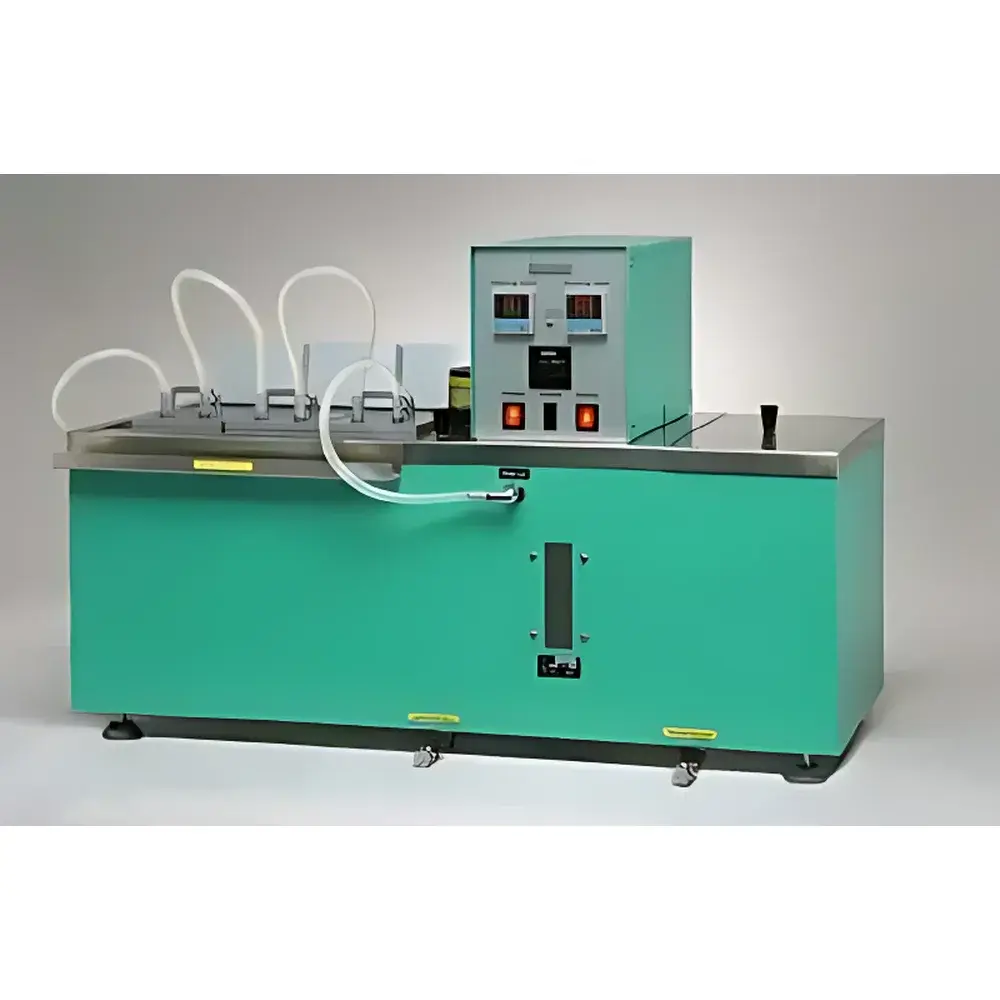
- Integrated dual-temperature bath architecture: A single compact enclosure houses both heating and cooling functionality—eliminating external chiller dependency in standard operation.
- Precision temperature control: Independent PID-regulated heating bath (40–130 °C, ±0.5 °C accuracy) and cooling bath (20–80 °C, ±0.5 °C accuracy), each with calibrated Pt100 sensors embedded in critical thermal loops.
- Flexible cooling options: Standard configuration uses tap water (≤18 °C inlet, 0.1–1.0 L/min flow); optional EB03C variant integrates a solid-state Peltier cooling module (200 W) for closed-loop operation without external water supply.
- Robust mechanical construction: Bath chambers fabricated from corrosion-resistant stainless steel and powder-coated structural steel; optimized for long-term stability in high-humidity, cyclic thermal environments.
- Gravimetric measurement readiness: Accommodates six standardized fogging test cups (per ISO 6452 specifications), enabling parallel evaluation of multiple material samples per run.
- Safety-integrated design: Over-temperature cut-off, ground-fault circuit interruption (GFCI), and sealed electrical compartments compliant with IEC 61010-1 for laboratory equipment safety.
Sample Compatibility & Compliance
The EB03 accommodates standard-sized test specimens (e.g., 25 g of foam, 10 cm × 10 cm sheet materials, or molded parts weighing ≤50 g) placed in aluminum or glass fogging cups. It supports all three primary fogging methods defined in ISO 6452: the reflective glass plate method (for optical haze assessment), the glass slide method (for mass deposition), and the aluminum foil method (for volatile residue quantification). All operational parameters—including exposure time (typically 16 h at 100 °C), cold-finger temperature (23 ± 2 °C), and chamber ventilation—are configurable to align with OEM-specific internal standards beyond ISO/ASTM baselines. Instrument documentation and calibration records support GLP-compliant audit trails, and temperature validation procedures meet requirements for ISO/IEC 17025-accredited testing laboratories.
Software & Data Management
While the EB03 operates as a standalone hardware platform without embedded microprocessor control, its thermal performance is fully compatible with external data acquisition systems. Analog outputs (0–10 V or 4–20 mA) for bath temperatures and digital I/O signals for cycle status enable integration into centralized lab monitoring networks (e.g., LabVIEW, SCADA, or MES platforms). Calibration certificates traceable to national metrology institutes (e.g., SP Technical Research Institute of Sweden) are provided with each unit. For regulated environments, users may implement electronic logbooks with time-stamped temperature logs, operator ID fields, and PDF report generation—fully satisfying FDA 21 CFR Part 11 requirements when paired with validated software infrastructure.
Applications
The EB03 serves as a core tool in automotive material development labs, quality assurance departments, and third-party testing facilities. Typical use cases include: screening of low-VOC polymer formulations prior to pilot production; root-cause analysis of haze formation on HUD-compatible windshields; comparative evaluation of alternative plasticizers or flame retardants; verification of cleaning agent residues on interior substrates; and compliance verification for global OEM specifications (e.g., VW TL 52258, Ford WSS-M99P1111-A, GMW 15634). Its reproducibility and inter-laboratory correlation have been validated across European and North American certification bodies.
FAQ
What standards does the EB03 directly support?
ISO 6452 and ASTM D5393 are natively implemented through fixed geometry, thermal profiles, and specimen handling protocols.
Can the EB03 be used for non-automotive applications?
Yes—its cold-finger condensation principle applies to any industry requiring VOC emission profiling, including aerospace cabin interiors, medical device packaging, and furniture manufacturing—provided test parameters are adapted accordingly.
Is external water cooling mandatory?
No—tap water cooling is standard, but the EB03C variant replaces it with an integrated Peltier system for locations lacking stable ≤18 °C water supply.
How often does the instrument require recalibration?
Annual calibration of temperature sensors and verification of thermal uniformity across bath zones is recommended; full metrological recalibration every two years ensures continued compliance with ISO/IEC 17025.
Does Elastocon provide installation and operator training?
Yes—on-site commissioning, IQ/OQ documentation support, and hands-on user training are available as optional service packages.
Related Products