
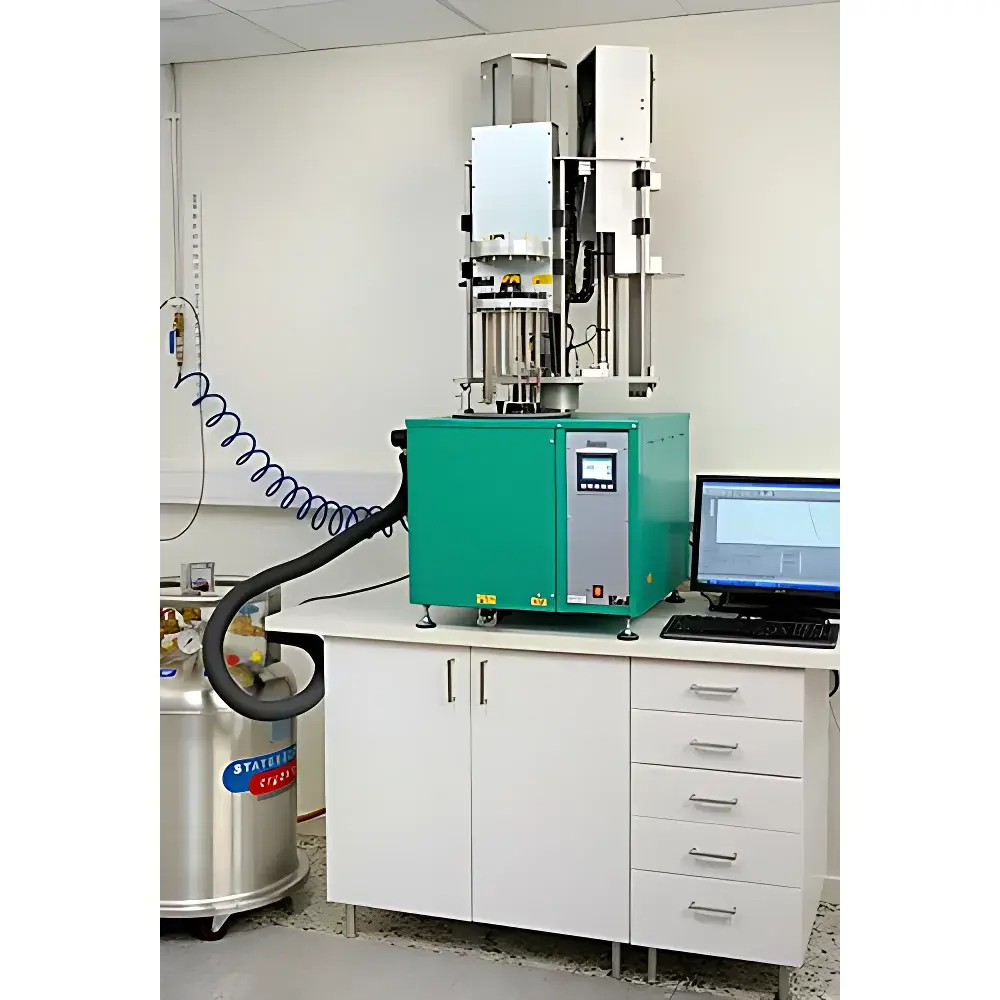
Elastocon ET 06BASEII Tri-Function Low-Temperature Tester for Rebound, Brittleness, and Gere Twist Testing
| Brand | Elastocon |
|---|---|
| Origin | Sweden |
| Model | ET 06BASEII |
| Temperature Range | −80 °C to +20 °C |
| Temperature Stability | ±0.5 °C |
| Temperature Uniformity | ±0.5 °C |
| Heating Rate | 1 °C/min |
| Cooling Rate | 0.5 °C/min |
| Temperature Resolution | 0.1 °C |
| Test Stations | 6 |
| Compliance | ISO 2921, ASTM D1329, ISO 812, ASTM D746, ISO 2818 (Gere twist), ASTM D1043 |
Overview
The Elastocon ET 06BASEII is a fully integrated, computer-controlled tri-function low-temperature testing platform engineered for precise characterization of elastomeric and polymeric materials under cryogenic conditions. It uniquely consolidates three standardized low-temperature mechanical test methods—rebound resilience (TR test), brittleness temperature determination (impact-type), and Gere twist stiffness—into a single instrument architecture. The system operates on the principle of controlled thermal ramping within a high-stability cryogenic chamber, enabling sequential or independent execution of each test protocol without manual reconfiguration. Its core measurement methodology relies on real-time dimensional monitoring (via calibrated linear transducers) and dynamic mechanical response recording during programmable temperature sweeps. Designed specifically for rubber, thermoplastic elastomers (TPEs), silicone compounds, and automotive sealing materials, the ET 06BASEII supports rigorous quality control, formulation development, and regulatory compliance workflows in R&D and production laboratories.
Key Features
- Six parallel test stations with independent sample holders—enabling high-throughput screening while maintaining inter-test comparability;
- Integrated cryogenic chamber with dual-stage refrigeration and optional liquid nitrogen assist for rapid sub-−60 °C stabilization;
- Programmable thermal profiles: linear heating/cooling ramps (0.1–5 °C/min), isothermal holds, and multi-step cycles;
- Automated sample release mechanism synchronized with pre-cooling phase—eliminating operator-induced timing variance;
- High-resolution digital length transducers (0.001 mm resolution) coupled with synchronized temperature logging at 0.1 °C intervals;
- Modular test head design supporting interchangeable fixtures for rebound pendulum, impact striker (brittleness), and torsional Gere twist arm;
- Robust stainless-steel chamber construction with double-wall vacuum insulation and anti-condensation air purge ports;
- Compliance-ready architecture featuring audit trail logging, user-level access control, and electronic signature support per FDA 21 CFR Part 11 requirements.
Sample Compatibility & Compliance
The ET 06BASEII accommodates standard test specimens per ISO 2921 (dumbbell-shaped rubber strips, 25 × 6 × 2 mm), ASTM D1329 (Type A or B test pieces), ISO 812 (brittleness test strips), and ISO 2818 / ASTM D1043 (Gere twist bars, typically 100 × 10 × 2 mm). Specimen clamping systems are precision-machined to ensure repeatable alignment and minimal edge deformation. All test protocols adhere to international standards governing low-temperature behavior of elastomers—including ISO 2921:2022 (Rubber — Determination of low-temperature characteristics — Temperature-retraction method), ASTM D1329 − 22 (Standard Test Method for Rubber Property—Brittleness Temperature of Flexible Polymers and Elastomers), and ASTM D1043 − 21 (Standard Test Method for Stiffness Properties of Plastics and Elastomers in Flexure). The system’s calibration traceability follows ISO/IEC 17025 guidelines, with documented uncertainty budgets for temperature and displacement measurements.
Software & Data Management
Control and analysis are executed via Elastocon’s proprietary Windows-based software suite, compliant with GLP and GMP documentation requirements. The interface provides real-time visualization of temperature vs. specimen elongation/deflection curves, automatic calculation of TR10, TR30, TR50, and TR70 values per ISO 2921, as well as brittle point (Tb) and Gere twist modulus (G) outputs. Raw data files (.csv and .elx formats) include full metadata: operator ID, timestamp, environmental chamber status, calibration certificate IDs, and version-controlled firmware logs. Export functions support direct integration into LIMS environments and statistical process control (SPC) platforms. Audit trail records capture all parameter changes, test initiations, result modifications, and user logins—retained for ≥36 months and exportable in PDF/A-2 format for regulatory submission.
Applications
- Formulation optimization of synthetic rubbers (e.g., NBR, EPDM, FKM) and thermoplastic elastomers for aerospace seals and automotive bushings;
- Batch release testing of cold-weather cable jacketing and winter-grade tire compounds;
- Comparative evaluation of polymer aging effects on low-temperature flexibility and crack resistance;
- Supporting IATF 16949 and ISO 9001 internal audits through automated reporting and traceable calibration records;
- Research into cryogenic performance of bio-based elastomers and recycled rubber blends;
- Validation of material suitability for Arctic infrastructure components (e.g., pipeline gaskets, offshore O-rings).
FAQ
Does the ET 06BASEII require external liquid nitrogen supply for operation below −60 °C?
Yes—while the standard two-stage compressor system achieves −80 °C, continuous operation below −60 °C at specified cooling rates (0.5 °C/min) requires optional LN2 assist; the system includes integrated dewar interface and pressure-regulated delivery.
Can TR and brittleness tests be run simultaneously on different stations?
No—thermal ramp sequencing is synchronized across all six stations; however, different test types (e.g., rebound on stations 1–3, brittleness on 4–6) may be scheduled consecutively within a single thermal cycle.
Is third-party calibration certification included with shipment?
A factory-issued calibration certificate (traceable to SWEDAC-accredited standards) is provided; on-site UKAS or DAkkS-certified calibration services are available upon request.
What software validation documentation is supplied for regulated environments?
IQ/OQ protocols, software requirements specification (SRS), and 21 CFR Part 11 configuration assessment reports are delivered with the system.
Are custom specimen fixtures available for non-standard geometries?
Yes—Elastocon offers engineering consultation and CNC-machined fixture development under NDA, subject to minimum order quantities and lead time confirmation.



