
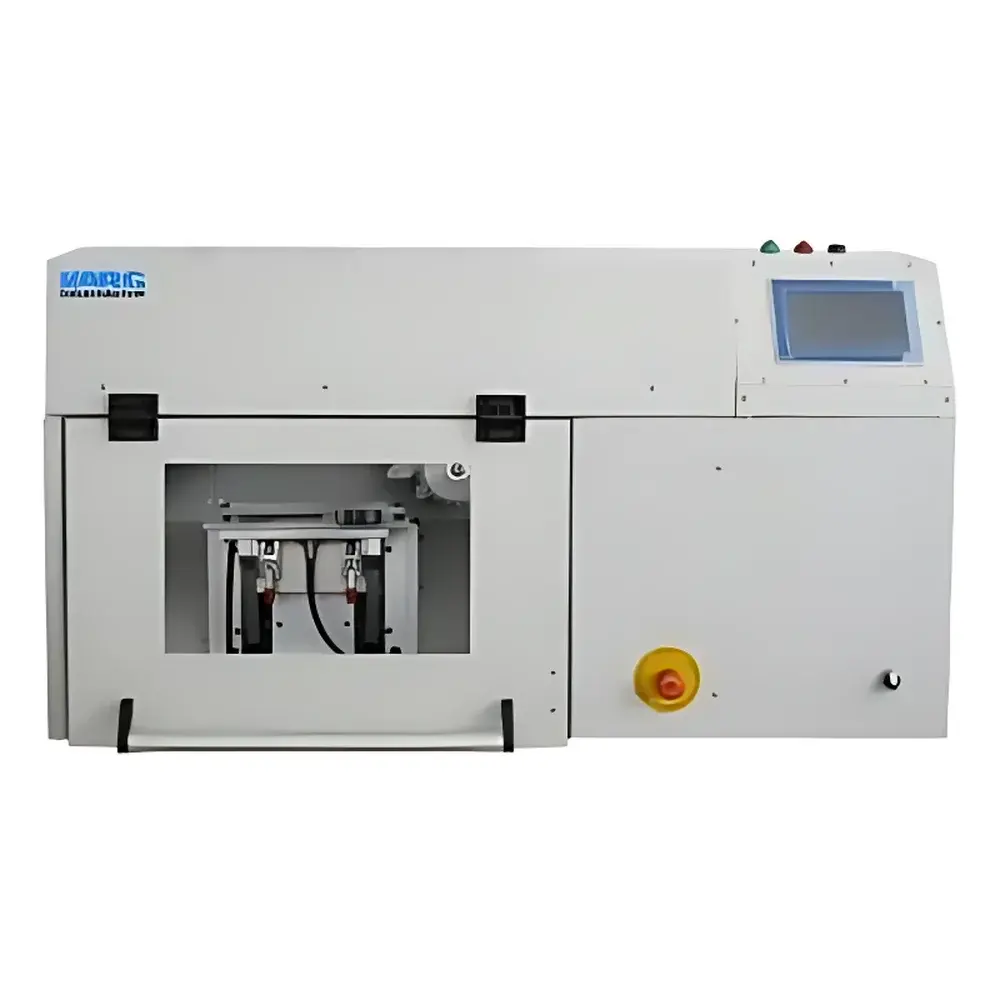
KARG AKM Fully Automatic Notched Specimen Preparation Machine
| Brand | KARG |
|---|---|
| Origin | Germany |
| Manufacturer Type | Authorized Distributor |
| Origin Category | Imported |
| Model | AKM |
| Quotation | Upon Request |
| Blade Travel Speed | 0–800 mm/s |
| Stroke Length | 208 mm |
| Notch Type | V-Notch |
| Feed Rate (Notching) | 0.01–0.3 mm/rev |
| (Fine Adjustment) | 0.01–0.1 mm/rev |
| Saw Cutting Speed | 0.3–1 m/min |
| Saw Rotational Speed | 1000–2000 rpm |
| Notch Depth (Z-axis) | 0.01–0.25 mm |
| Machining Length | ~200 mm |
| Width | 1200 mm |
| Height | 700 mm |
| Depth | 540 mm |
| Weight | 150 kg |
| Power Consumption | ~1 kW |
| Supply Voltage/Frequency | 230 V / 110 V, 50/60 Hz |
Overview
The KARG AKM Fully Automatic Notched Specimen Preparation Machine is an engineered solution for high-precision, repeatable preparation of standardized notched test specimens used in impact testing protocols—including Charpy, Izod, and tensile impact methods per ASTM E23, ISO 148, ISO 180, DIN 53438, and related international standards. Based on a dual-axis motion architecture—where the specimen moves along the Z-axis and the tooling assembly (notching knife and optional circular saw) traverses independently along the X-axis—the AKM ensures mechanical decoupling of feed and cutting motions, minimizing vibration-induced deviations and maximizing dimensional fidelity. Its core function is the reproducible generation of V-notches with precisely controlled depth, root radius, and flank angle—critical parameters directly influencing fracture initiation behavior in standardized impact assessments. Designed for integration into quality control laboratories, R&D facilities, and accredited testing centers, the AKM supports compliance-driven workflows requiring documented traceability, operator safety, and material-specific thermal management.
Key Features
- Dual independent motion systems: Z-axis specimen positioning and X-axis tool carriage enable synchronized, low-vibration notching and sawing operations
- Adjustable notching feed rate (0.01–0.3 mm/rev) with fine-resolution setting (0.01–0.1 mm/rev) for controlled notch geometry across brittle, ductile, and fiber-reinforced polymers
- Integrated high-torque circular saw module (optional) with variable rotational speed (1000–2000 rpm) and linear feed (0.3–1 m/min) for specimen separation and edge conditioning
- Patented sealed cooling system delivering directed coolant flow to both notching knife and saw blade—essential for heat-sensitive thermoplastics and composites containing glass or carbon fibers
- Reinforced polycarbonate safety enclosure with interlocked access doors and integrated safety switches compliant with EN ISO 13857 and EN 60204-1
- 7-inch full-color capacitive touchscreen HMI supporting intuitive cycle programming, parameter recall, and real-time status monitoring
- Tool magazine compatibility for rapid changeover between V-notch knives (standard 45°, 60°, or custom angles) and saw blades optimized for specific polymer families or filled composites
Sample Compatibility & Compliance
The AKM accommodates rigid and semi-crystalline thermoplastics (e.g., PC, ABS, PA6, POM), thermosets (epoxy, phenolic), and fiber-reinforced composites (GF/CF-PA, GF-PP) with thicknesses up to 20 mm. Its mechanical rigidity and thermal stability allow consistent notch geometry across batched production samples—enabling direct correlation with ASTM D6110 (Charpy), ISO 179 (Izod), and ISO 8256 (tensile impact) test results. All operational parameters—including feed rate, stroke depth, and coolant activation—are logged with timestamped audit trails, supporting GLP/GMP documentation requirements and FDA 21 CFR Part 11 readiness when paired with validated LIMS integration. The machine meets CE marking requirements under the Machinery Directive 2006/42/EC and electromagnetic compatibility per EN 61000-6-2/-6-4.
Software & Data Management
The embedded firmware provides non-volatile storage for up to 100 user-defined machining cycles, each configurable with unique tool paths, feed profiles, dwell times, and coolant activation thresholds. Cycle data—including actual feed rate, achieved notch depth, and motor load feedback—is exportable via USB 2.0 in CSV format for statistical process control (SPC) analysis. Optional Ethernet connectivity enables remote diagnostics and centralized parameter synchronization across multi-unit installations. Software updates are delivered via signed firmware packages to maintain integrity and version control in regulated environments.
Applications
- Precision V-notch preparation for ISO 148-1 Charpy impact bars (10 × 10 × 55 mm) and ASTM E23 subsize specimens
- Izod specimen conditioning per ISO 180 and ASTM D256, including side-notched and end-notched configurations
- Edge trimming and blank separation of injection-molded or machined polymer test coupons prior to mechanical testing
- Preparation of notched specimens for fracture toughness evaluation (KIC, GIC) in aerospace-grade composites
- Routine QC in automotive polymer suppliers where notch geometry repeatability directly impacts pass/fail decisions against OEM specifications (e.g., VW TL 52255, GMW 15635)
FAQ
What standards does the AKM support for notch geometry verification?
The AKM is calibrated and validated for compliance with ISO 20753 Annex B (V-notch tolerances), ASTM D6110 Figure 2 (Charpy notch profile), and ISO 179-1 Table 1 (Izod notch dimensions). Verification templates and gauge blocks are supplied for routine in-house calibration.
Can the AKM prepare U-notches?
Standard configuration supports only V-notches per ISO/ASTM requirements. U-notch capability requires factory-installed custom tooling and modified firmware—available as a certified option upon request.
Is the machine compatible with automated sample handling systems?
Yes—the AKM features RS-485 and digital I/O ports for integration with robotic arms or conveyor-based loading/unloading modules. Custom API documentation is provided under NDA for system integrators.
How is tool wear compensated during extended operation?
The firmware includes automatic tool offset compensation based on periodic zero-point calibration using a reference block. Tool life tracking is enabled per knife and saw blade ID, triggering maintenance alerts at user-defined usage thresholds.
What maintenance intervals are recommended?
Lubrication of linear guides every 500 operating hours; coolant filter replacement every 200 hours; annual torque verification of motion system fasteners and encoder alignment check by certified service technician.



