
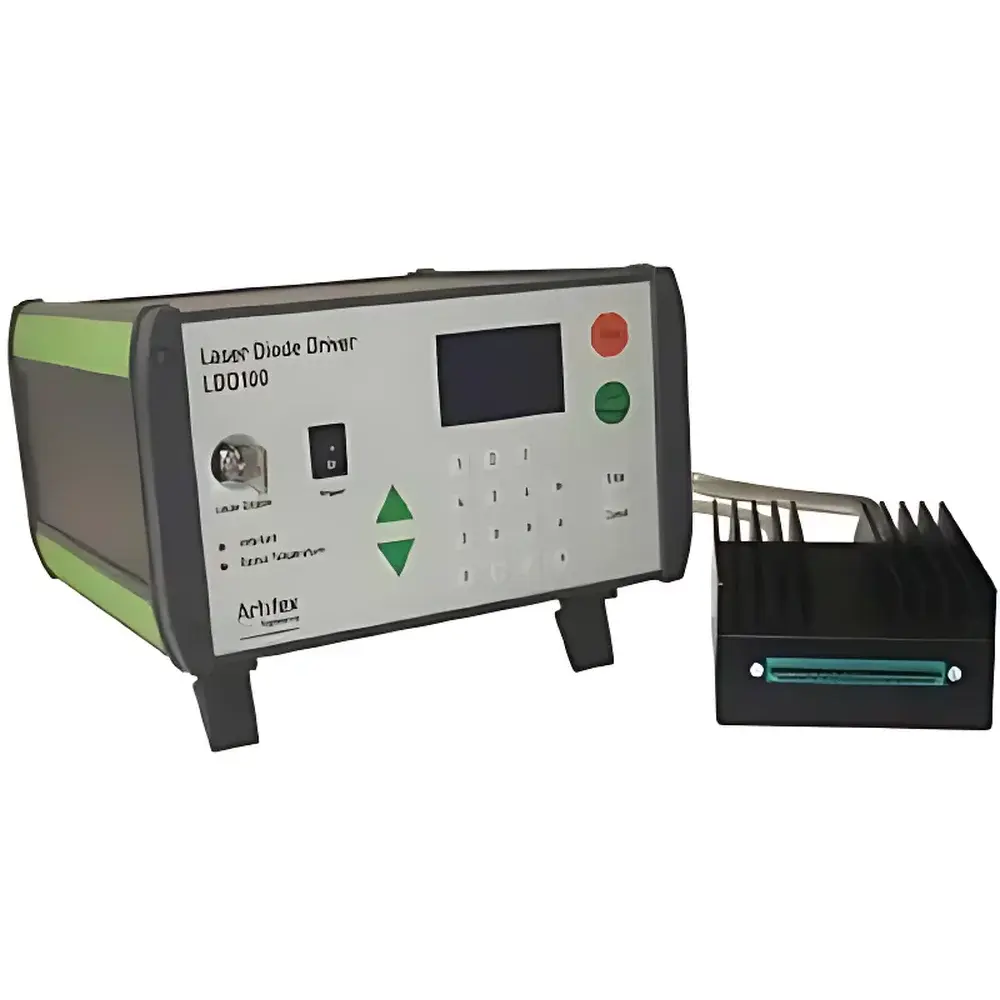
Artifex LDD100 High-Current Pulsed Semiconductor Laser Driver
| Brand | Artifex |
|---|---|
| Origin | Germany |
| Model | LDD100 |
| Output Current Range | 1–400 A (configurable variants: LDD100-40 / LDD100-120 / LDD100-200) |
| Rise Time | 50 ns (at 60 A, fast mode) |
| Pulse Width | 50 ns – 3 s |
| Pulse Repetition Rate | up to 100 kHz |
| Trigger Options | Internal / External (sequential or single-shot) |
| Interface | USB 2.0 |
| Compliance | CE, RoHS |
| Cooling | Passive (L-Version) or Active (F-Version) |
| Dimensions (Control Unit) | 250 × 235 × 150 mm |
| Input Power | 88–264 VAC, 47–63 Hz, PF ≥ 0.95 |
| Accuracy | ±2%, Repeatability: ±1%, Linearity: ±1% |
| Connector Types | LEMO for control, stripline for laser head |
Overview
The Artifex LDD100 is a high-performance, digitally controlled pulsed current source engineered specifically for demanding semiconductor laser diode characterization and reliability testing. Based on precision-switched current-source architecture with fast solid-state switching and low-inductance stripline output delivery, the LDD100 delivers tightly regulated, nanosecond-scale current pulses with exceptional temporal fidelity and amplitude stability. Its design adheres to fundamental requirements of laser diode LIV (Light–Current–Voltage), aging, burn-in, and transient response analysis—applications where pulse shape integrity, current accuracy, and timing reproducibility are critical for valid device qualification under IEC 60825-1, JEDEC JESD22-A108, and ISO/IEC 17025-accredited test environments.
Key Features
- Three scalable output configurations: LDD100-40 (up to 40 A), LDD100-120 (up to 120 A), and LDD100-200 (up to 200 A), with optional extended-range modules supporting up to 400 A in OEM integration scenarios
- Sub-50 ns rise time (measured at 60 A in fast mode), enabling accurate stimulation of ultrafast laser diodes including VCSELs and high-speed edge emitters
- Programmable pulse width from 50 ns to 3 seconds, with resolution down to 50 ns in short-pulse regime and 1 ms in long-pulse regime
- Dual cooling architectures: L-Version (passive convection-cooled) for benchtop lab use; F-Version (forced-air actively cooled) for sustained high-duty-cycle operation
- Full local control via integrated 320×240 LCD and membrane keypad, supporting real-time parameter adjustment, waveform preview, and storage of up to nine user-defined pulse profiles
- USB 2.0 interface compliant with CDC ACM class for seamless integration into automated test systems using Python, LabVIEW, or MATLAB-based instrument control frameworks
- Comprehensive trigger flexibility: internal clock-synchronized generation, external TTL-triggered single-shot mode, and external sequential triggering with jitter < 5 ns (RMS)
Sample Compatibility & Compliance
The LDD100 is compatible with all common semiconductor laser diode packages—including TO-can, butterfly, C-mount, and fiber-pigtailed configurations—when interfaced via its low-impedance stripline output stage optimized for minimal ringing and overshoot. It meets EN 61326-1 (EMC for laboratory equipment), EN 61010-1 (safety requirements for electrical equipment), and RoHS 2011/65/EU directives. For regulated industries, the device supports audit-ready operation when used within GLP-compliant test protocols; its deterministic timing behavior and ±1% pulse-to-pulse repeatability satisfy traceability requirements outlined in ISO/IEC 17025:2017 clause 7.7. The USB interface enables full command logging, supporting 21 CFR Part 11-aligned electronic record practices when paired with validated host software.
Software & Data Management
Artifex provides the LDD100 Control Suite—a Windows-native application featuring intuitive graphical waveform construction, real-time oscilloscope-style monitoring, and batch parameter scripting. All settings—including current amplitude, pulse width, delay, repetition rate, and trigger source—are stored in non-volatile memory with timestamped versioning. Export options include CSV (for post-processing in Origin or Python pandas), PNG/SVG (for report-ready plots), and binary .ldd files for system-level integration. The SDK includes C/C++, .NET, and Python bindings with full documentation, enabling custom automation in production test stands or university research platforms requiring synchronized multi-instrument triggering (e.g., combined with photodetectors, digitizers, or spectrometers).
Applications
- Laser diode LIV curve acquisition under pulsed bias to eliminate thermal drift effects during threshold and slope efficiency measurement
- Accelerated life testing (ALT) and burn-in validation per MIL-STD-750 Method 1021, where precise current pulsing mitigates junction overheating while maintaining statistical relevance
- Transient optical response analysis for high-speed modulation characterization of 25G/50G/100G VCSEL arrays in datacom transceivers
- Photonic integrated circuit (PIC) probe station integration, where compact form factor and low EMI emission enable co-location with sensitive RF or cryogenic measurement setups
- Time-resolved photoluminescence (TRPL) excitation in semiconductor material research labs, leveraging sub-100 ns pulse fidelity for carrier lifetime extraction
FAQ
What is the minimum achievable pulse width, and how is it stabilized against jitter?
The LDD100 achieves a guaranteed minimum pulse width of 50 ns with jitter < 2 ns (RMS) in fast mode, enforced by synchronous gate-drive timing and FPGA-based digital delay control.
Can the LDD100 drive laser diodes requiring >200 A peak current?
Yes—while standard models cap at 200 A, Artifex offers factory-configured LDD100-400 variants with reinforced output stages and parallel MOSFET arrays for applications such as high-energy pulsed laser pumping.
Is remote firmware update supported over USB?
Yes, the embedded bootloader enables secure field-upgradable firmware via signed .hex packages distributed through Artifex’s customer portal, ensuring compliance with evolving safety and communication standards.
How does the active cooling (F-Version) impact long-term current stability?
With forced-air cooling, the LDD100-F maintains ±0.5% current stability over 8-hour continuous operation at 80% of max rated current, verified per IEC 61000-4-30 Class A power quality monitoring.
Are calibration certificates available with NIST-traceable uncertainty statements?
Yes—each unit ships with a factory calibration report (ISO/IEC 17025 accredited) covering current amplitude, pulse width, and timing parameters, with uncertainties stated at k=2 confidence level.





