
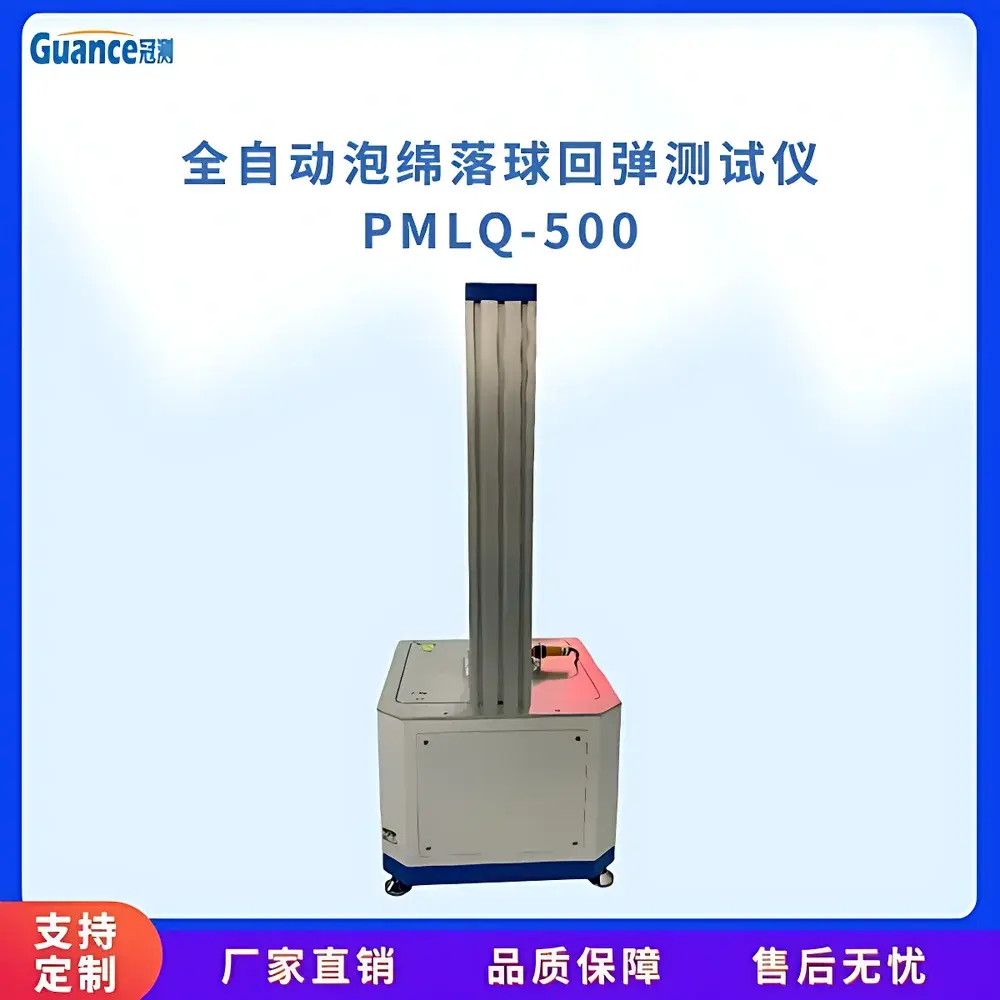
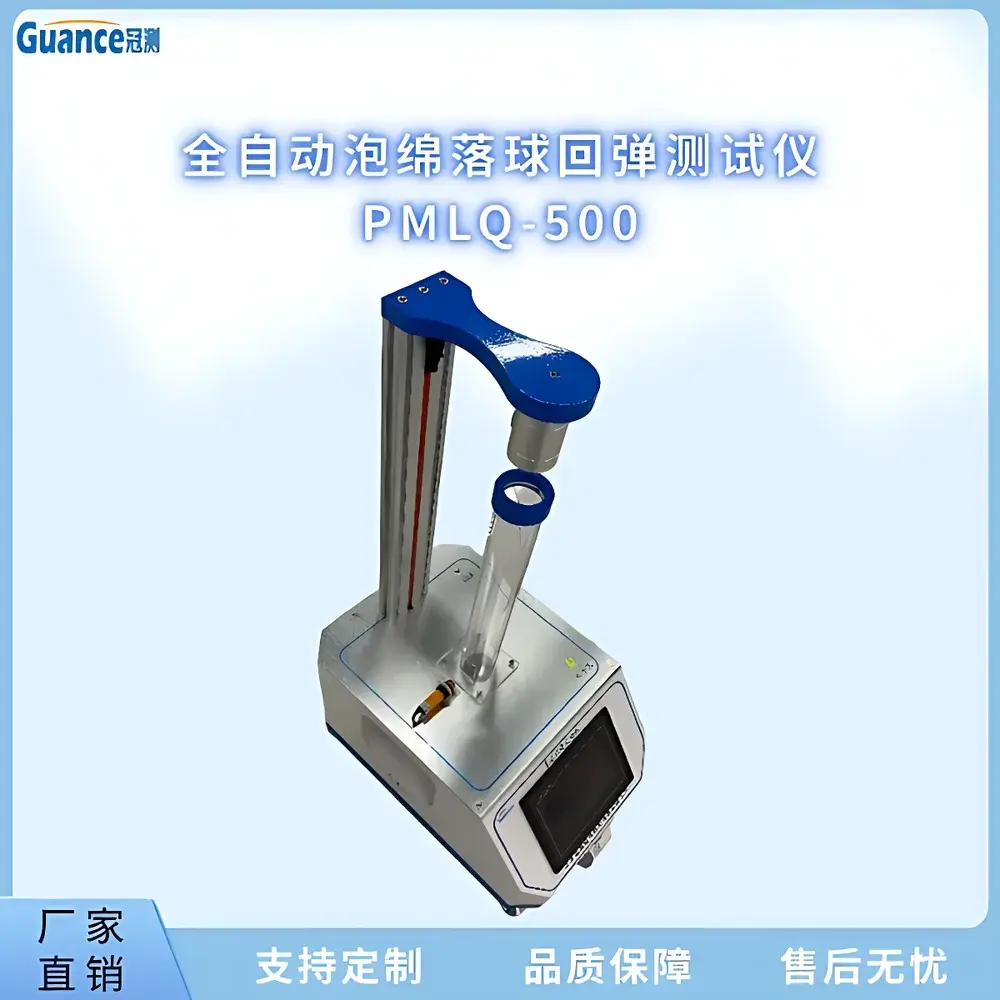
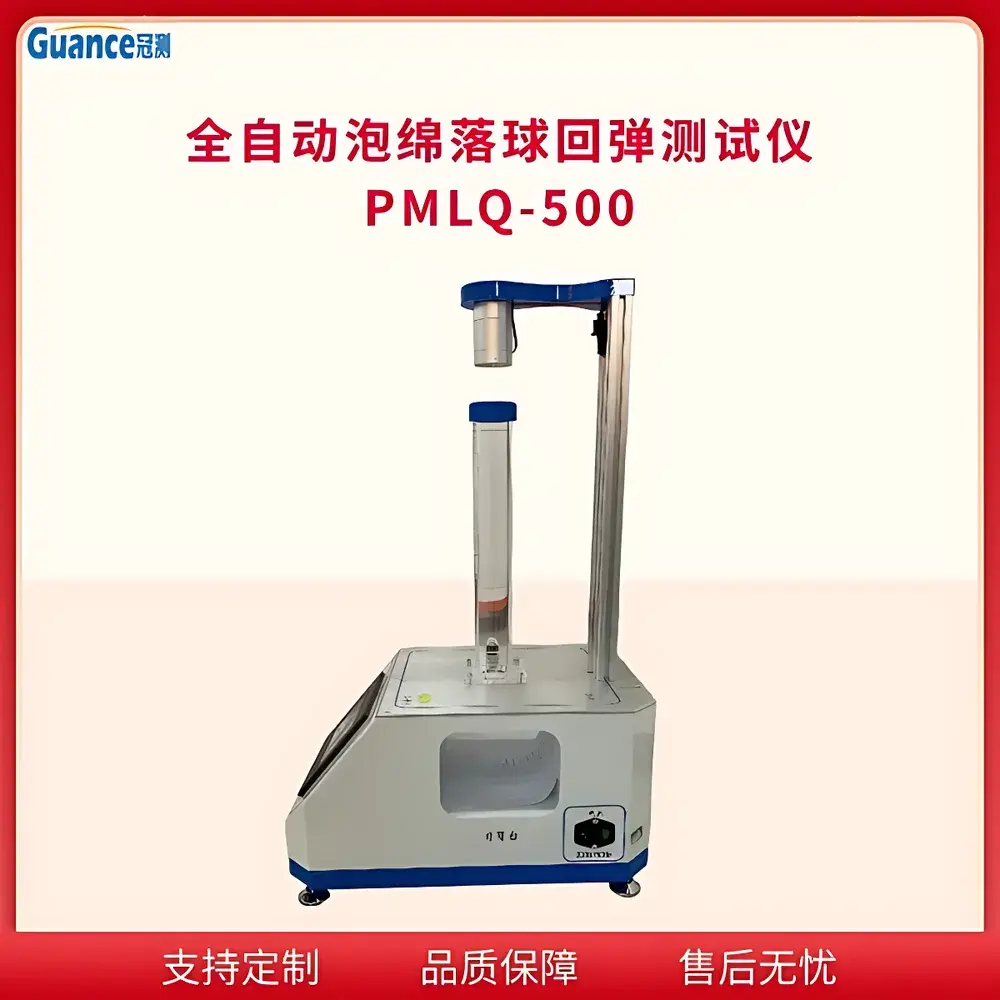
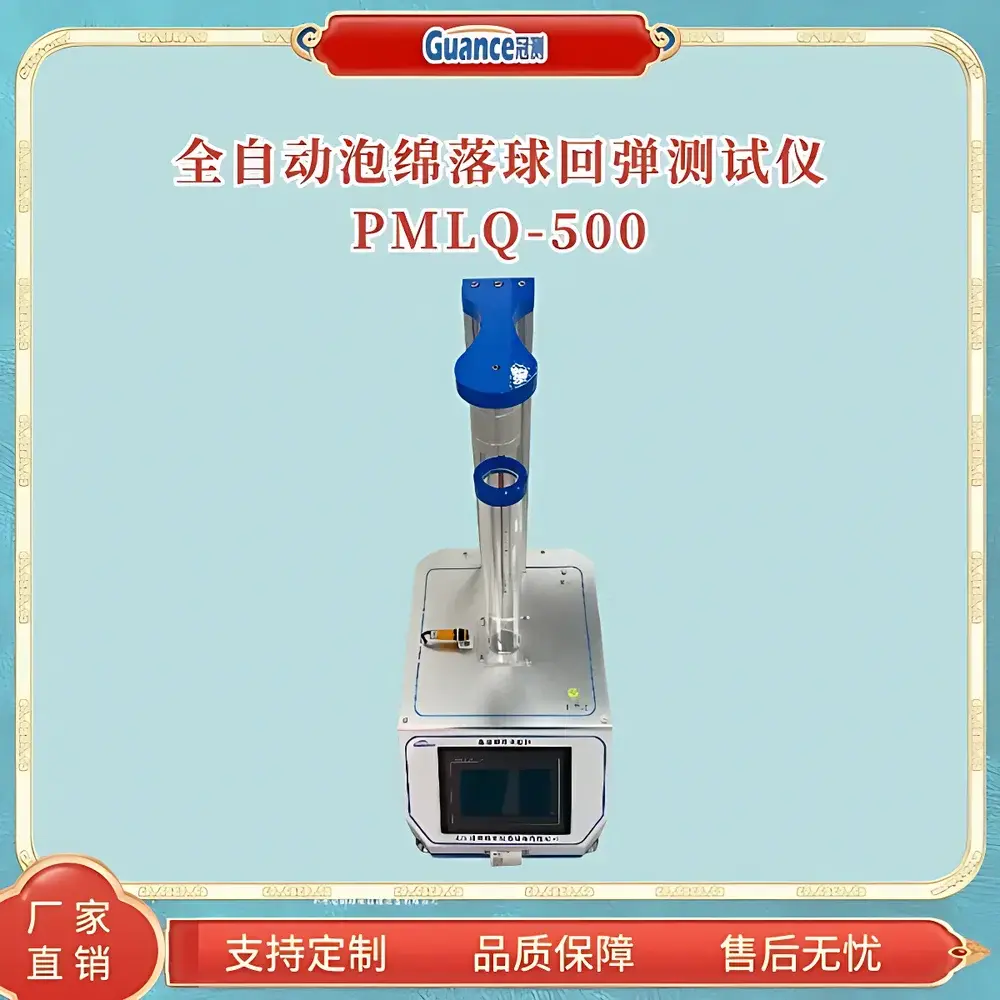
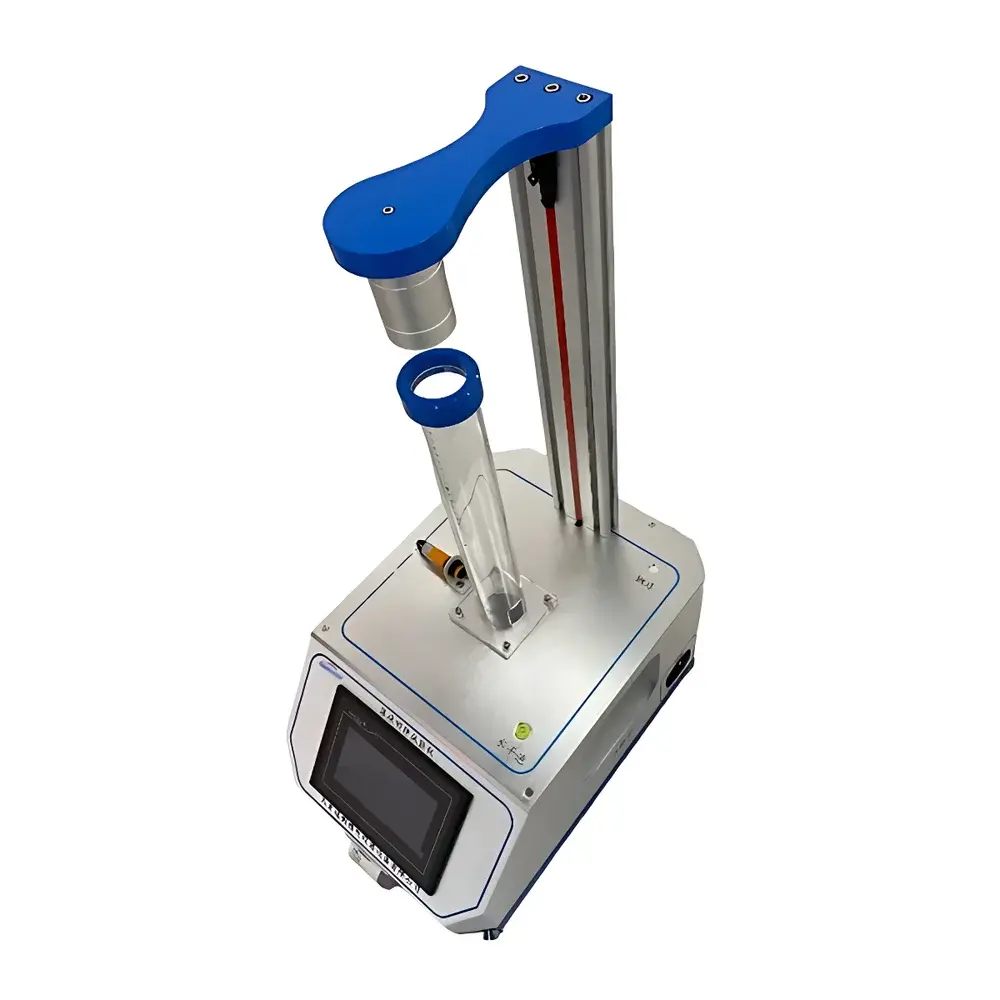
Guance Instrument PMLQ-500B Foam Ball-Rebound Elasticity Analyzer
| Brand | Guance Instrument |
|---|---|
| Origin | Beijing, China |
| Model | PMLQ-500B |
| Drop Height | 460 mm (GB/ISO) / 500 mm (ASTM) |
| Steel Ball Diameter | 16 mm |
| Sample Dimensions | 100 × 100 × 50–100 mm |
| Rebound Accuracy | <1% |
| Sample Capacity | 3 specimens per test group |
| Height Detection | Automatic optical height sensing with dual verification (auto + manual scale reference) |
| Control System | Siemens PLC with 7-inch HMI touchscreen interface |
| Power Supply | 220 V / 50 Hz |
| Dimensions (L×W×H) | 560 × 360 × 860 mm |
| Weight | 25 kg |
| Compliance | GB/T 6670–2008, GB/T 10652–2001, ISO 8307, ASTM D3574 |
Overview
The Guance Instrument PMLQ-500B Foam Ball-Rebound Elasticity Analyzer is a precision-engineered instrument designed for the quantitative assessment of resilience in flexible polymeric foam materials—particularly soft polyurethane foams used in automotive seating, furniture, bedding, and packaging applications. It operates on the standardized drop-ball principle defined in international material testing protocols: a calibrated steel sphere (Ø16 mm) is released from a fixed vertical height (460 mm per GB/T 6670–2008 and ISO 8307; 500 mm per ASTM D3574) onto a horizontally mounted foam specimen. The rebound height is optically captured and converted into a dimensionless rebound ratio—expressed as a percentage—representing the energy recovery efficiency of the cellular polymer structure under transient compressive loading. This parameter correlates directly with long-term comfort retention, fatigue resistance, and structural integrity in viscoelastic foams.
Key Features
- Electromagnetic ball release mechanism ensuring zero rotational deviation and strict central impact alignment—fully compliant with ASTM D3574 Section 5.3 and ISO 8307 Clause 6.2 requirements for controlled free-fall conditions.
- Dual-mode height measurement: high-resolution optical sensor for automated rebound detection, supplemented by a calibrated transparent acrylic guide tube (Ø50 mm) with engraved millimeter-scale markings for visual cross-verification.
- Siemens S7-1200 PLC-based control architecture integrated with a 7-inch industrial HMI touchscreen, enabling intuitive bilingual (English/Chinese) operation, real-time parameter monitoring, and secure data logging.
- Automated statistical processing per standard mandates: three specimens per test batch, three impacts per specimen, automatic outlier rejection based on ±5% deviation threshold, and calculation of mean rebound height and mean rebound percentage with traceable raw-data storage.
- Benchtop modular design (560 × 360 × 860 mm; 25 kg) optimized for laboratory integration, requiring no external vacuum, compressed air, or cooling systems.
Sample Compatibility & Compliance
The PMLQ-500B accommodates standard test specimens measuring 100 mm × 100 mm × (50–100) mm—compatible with both slab-cut and molded foam geometries. Its mechanical stability and repeatable impact geometry ensure consistent contact area and stress distribution across heterogeneous cellular structures. The system meets full conformance with:
- GB/T 6670–2008 “Flexible cellular polymeric materials — Determination of ball rebound resilience”
- GB/T 10652–2001 “High-polymer porous elastic materials — Determination of elasticity”
- ISO 8307:2019 “Flexible cellular polymeric materials — Determination of ball rebound resilience”
- ASTM D3574–22 “Standard Test Methods for Flexible Cellular Materials — Slab, Bonded, and Molded Urethane Foams” (Method B)
All firmware and calibration procedures are documented per GLP principles, supporting audit readiness for quality-controlled manufacturing environments subject to IATF 16949 or ISO 9001 certification.
Software & Data Management
Data acquisition and reporting are managed through embedded firmware with non-volatile memory storage (≥10,000 test records). Each test entry includes timestamp, operator ID, sample ID (user-definable alphanumeric batch codes), individual rebound heights, calculated percentages, pass/fail flags per specification tolerance, and statistical summaries (mean, SD, CV%). Export is supported via USB flash drive in CSV format for downstream analysis in Excel, Minitab, or LIMS platforms. While not natively 21 CFR Part 11-compliant, the system supports external validation protocols—including electronic signature integration and audit trail generation—when deployed within validated QA/QC workflows.
Applications
- Quality assurance of polyurethane foam batches in Tier-1 automotive suppliers (seat cushioning, headrests, door panels)
- R&D evaluation of novel elastomeric formulations, including bio-based polyols and flame-retardant additives
- Comparative resilience benchmarking between conventional HR foams and emerging microcellular or nanocomposite variants
- Supplier qualification testing against OEM material specifications (e.g., Ford WSS-M99P20-A1, GM GMW15624)
- Failure analysis of foam compression set or hysteresis degradation after thermal aging or humidity cycling
FAQ
What is the physical principle underlying ball rebound measurement?
The method quantifies the ratio of kinetic energy retained after elastic deformation, derived from the square root of the rebound-to-drop height ratio. It reflects the viscoelastic energy dissipation characteristics of open-cell foam networks under dynamic impact.
Why is electromagnetic release superior to manual release?
Manual release introduces uncontrolled torque, lateral displacement, and inconsistent release timing—violating ASTM D3574’s requirement for “freely falling without rotation.” Electromagnetic release guarantees verticality, repeatability, and metrological traceability.
Can the PMLQ-500B be used for non-PU foams such as latex or silicone sponge?
Yes—provided the material exhibits sufficient surface resilience and dimensional stability during impact. Users must validate specimen thickness and support rigidity per ISO 8307 Annex A for non-standard substrates.
Is calibration traceable to national standards?
Height sensors are factory-calibrated using NIST-traceable laser interferometry; steel ball mass and diameter are certified per ISO/IEC 17025-accredited metrology reports available upon request.
Does the system support multi-language UI beyond English and Chinese?
The current firmware supports only English and Simplified Chinese. Custom language packs (e.g., German, Spanish, Japanese) can be developed under OEM agreement with minimum order volume.



