
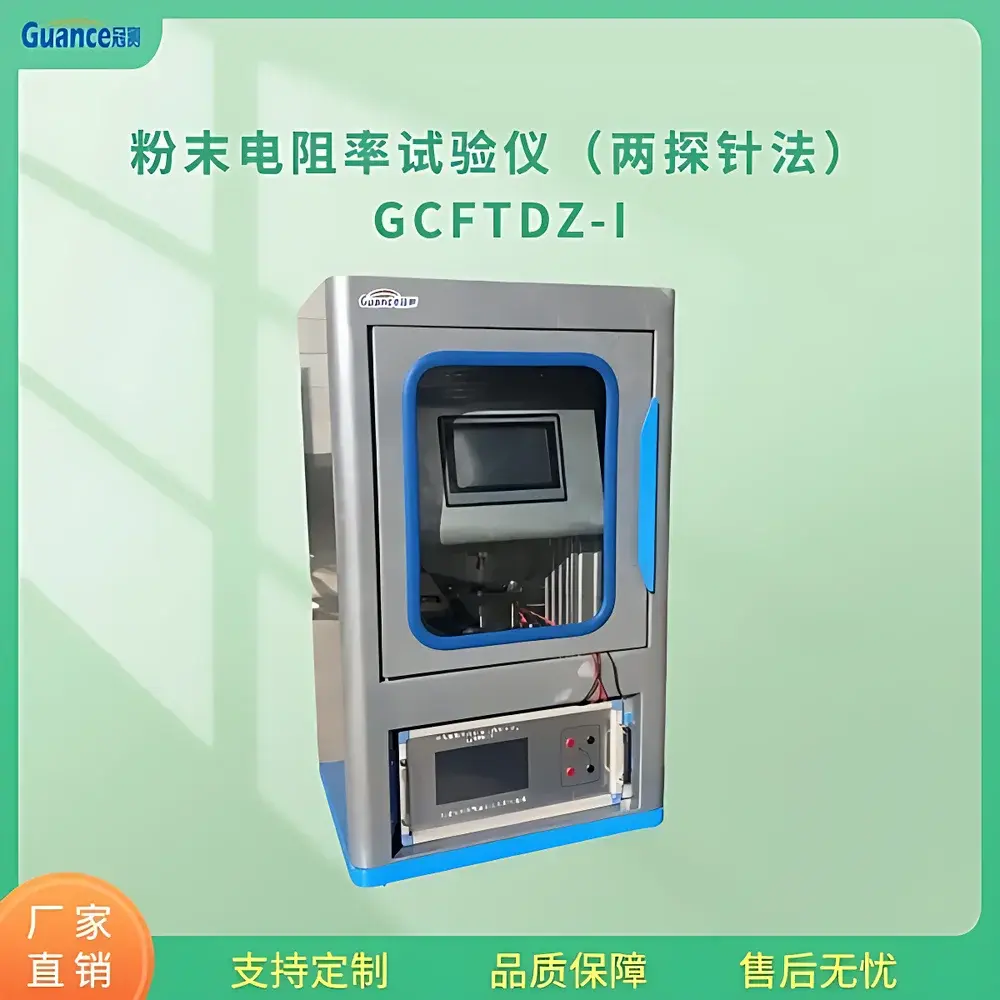
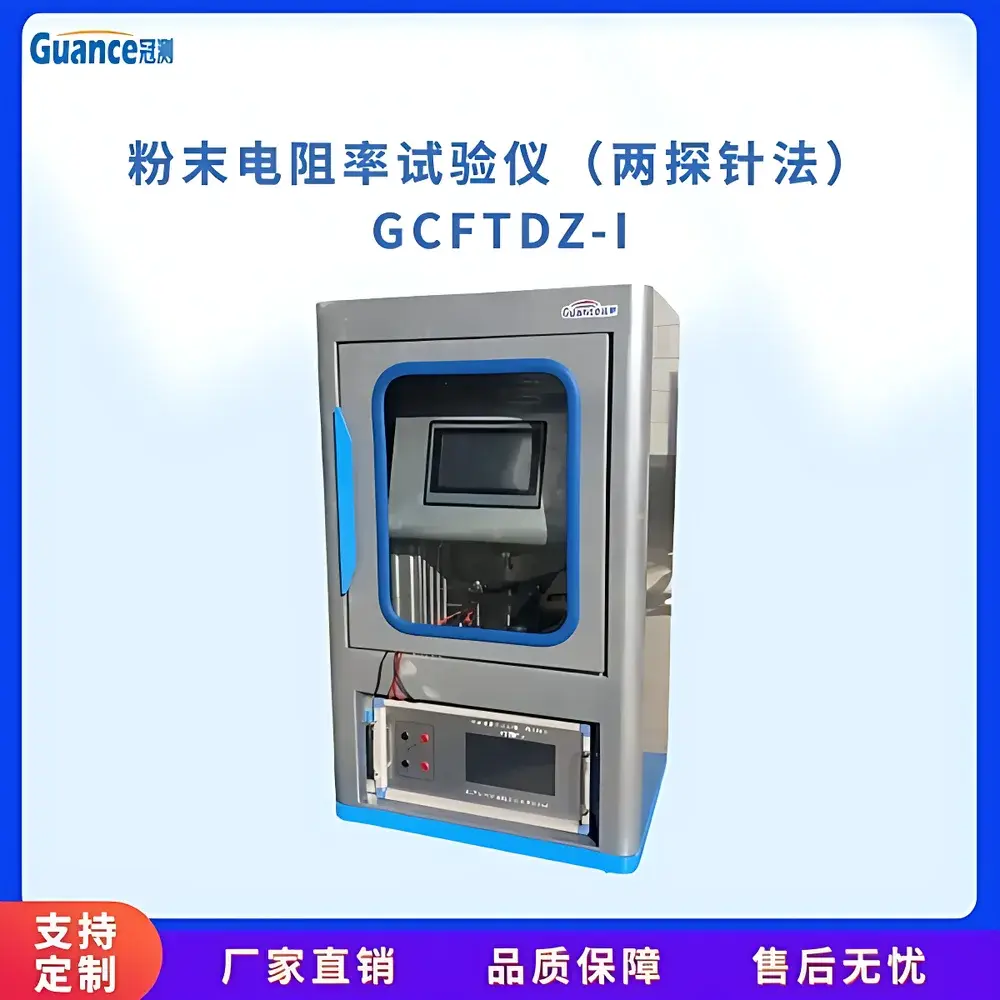
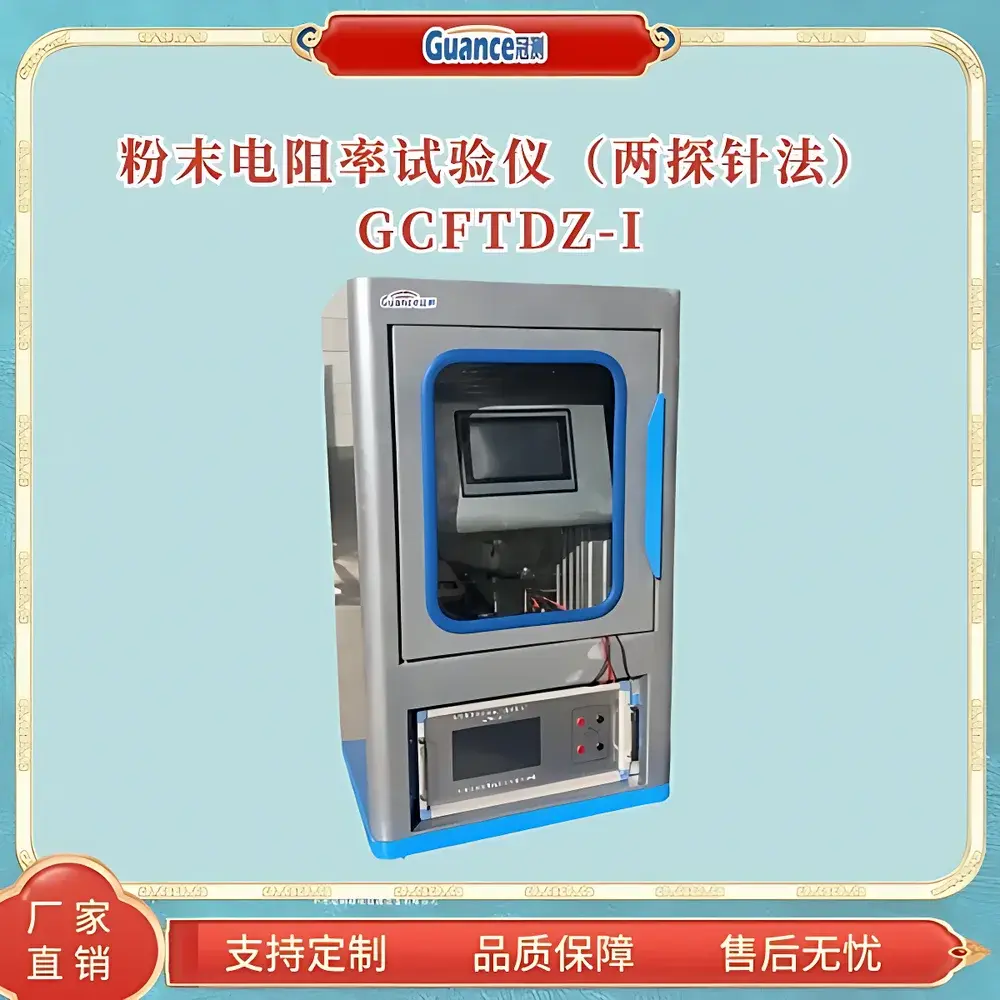
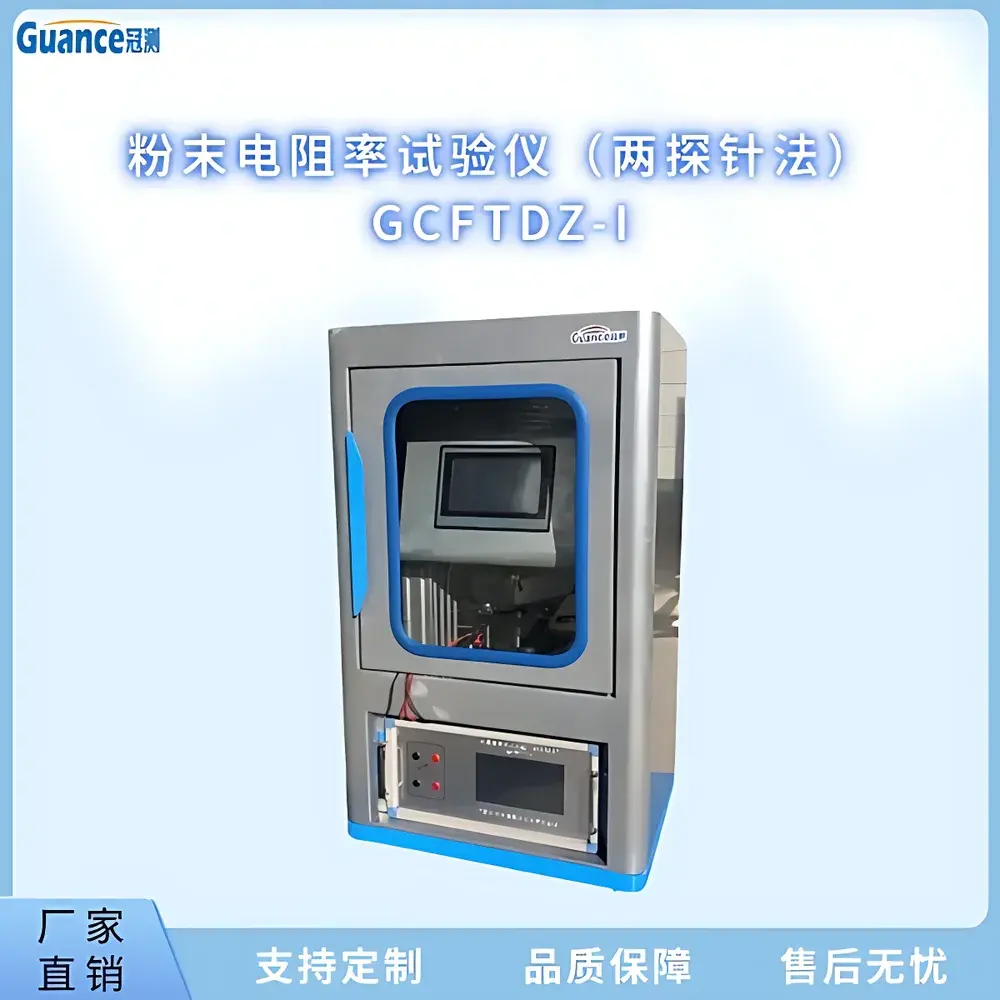
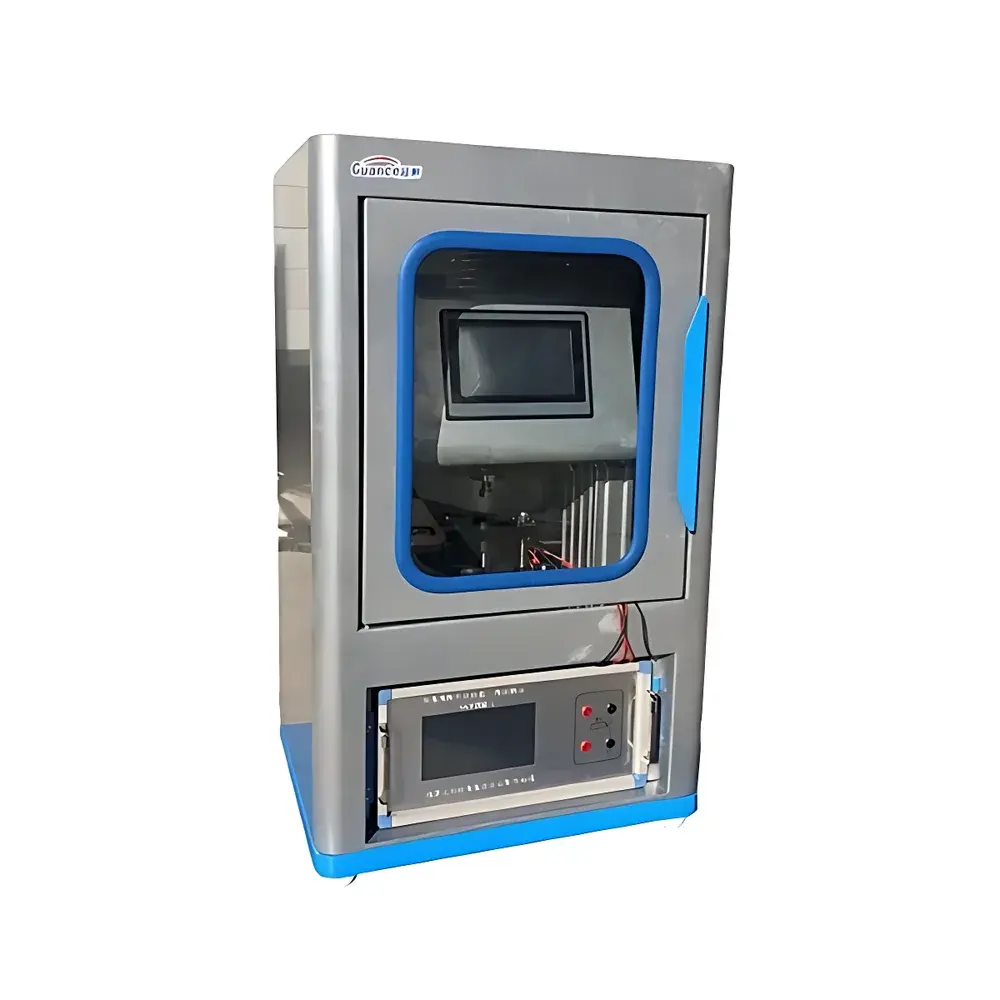
GuanCe GCFTDZ-I+ Dual-Probe Powder Resistivity Tester
| Brand | GuanCe Instruments |
|---|---|
| Origin | Beijing, China |
| Manufacturer Type | Authorized Distributor |
| Product Category | Domestic |
| Model | GCFTDZ-I+ |
| Price | USD 2,100 (approx.) |
| Max Applied Pressure | 3.9 MPa |
| Force Range | 0–5 kN |
| Force Accuracy | ±0.5% FS |
| Electrode Diameters | φ16.0 mm & φ30.0 mm |
| Resistivity Measurement Range | 10⁻⁶ – 10⁵ Ω·m |
| Resistance Resolution | 10⁻⁸ Ω |
| Current Sources | 10 μA to 10 A (8 ranges) |
| Voltage Range | 2 mV – 2 V |
| Voltage Accuracy | ±0.1% |
| Data Output | USB export & thermal printing |
| Control Interface | 10-inch industrial touch HMI with Siemens PLC |
| Sample Height Resolution | ±1 μm |
| Power Supply | 220 V / 50 Hz / 1 kW |
| Dimensions (L×W×H) | 550 × 450 × 960 mm |
| Weight | ~75 kg |
Overview
The GuanCe GCFTDZ-I+ Dual-Probe Powder Resistivity Tester is an automated, standards-compliant instrumentation system engineered for precise determination of electrical resistivity in granular carbonaceous materials—including calcined anthracite, petroleum coke, graphite, carbon black, baked anode scraps, graphitized coke, and needle coke. It operates on the two-probe (collinear electrode) DC resistivity measurement principle, conforming strictly to GB/T 24521–2018, “Test Method for Electrical Resistivity of Carbon Raw Materials and Coke.” The instrument applies controlled uniaxial compaction to dried, size-classified powder samples within a cylindrical die, followed by simultaneous application of a calibrated constant current and high-accuracy voltage measurement across the top and bottom electrodes. Resistivity (ρ) is calculated using ρ = R × A / L, where R is measured resistance, A is electrode cross-sectional area, and L is the compressed sample height—determined in real time via high-resolution linear displacement sensing (±1 μm). All mechanical loading, electrical excitation, data acquisition, and post-processing are fully automated under Siemens S7-1200 PLC control, eliminating operator-induced variability and ensuring method reproducibility across laboratories.
Key Features
- Fully automated compaction and resistivity measurement cycle—from sample loading to final report generation—executed without manual intervention.
- Dual-electrode compatibility: interchangeable φ16.0 mm (optimized for 0.315–0.5 mm particles) and φ30.0 mm (for 0.5–1.0 mm particles) stainless-steel electrodes, each with precision-machined flat contact surfaces and low-contact-resistance plating.
- Seven programmable test modes: constant force, constant pressure, stepped-force gradient, stepped-pressure gradient, and compression-ratio-based displacement control—enabling systematic study of porosity–conductivity relationships.
- Real-time synchronized display of 12 critical parameters: applied force, pressure, sample height, bulk density, current, voltage, resistance, resistivity, conductivity, compression rate, dwell time, and temperature-compensated deviation (via optional external sensor input).
- High-fidelity electrical subsystem: eight-step constant-current source (10 μA to 10 A), four-range nanovolt-grade voltage measurement (2 mV to 2 V), ±0.5% resistance accuracy, and 10⁻⁸ Ω resolution—validated per IEC 60584 and ASTM D257 practices.
- Industrial 10-inch capacitive touch HMI with intuitive icon-driven workflow, multi-language UI support (English default), firmware-over-the-air (FOTA) capability, and audit-trail-enabled operation logging.
Sample Compatibility & Compliance
The GCFTDZ-I+ is validated for use with dry, free-flowing powders meeting GB/T 24521–2018 particle size specifications. It supports routine QC testing in carbon anode manufacturing, graphite electrode production, and metallurgical coke quality assurance. Mechanical design complies with ISO 12100:2012 (safety of machinery) and IEC 61000-6-2/6-4 (EMC immunity/emission). Electrical safety conforms to IEC 61010-1:2010 (measurement/control laboratory equipment). Data integrity features—including timestamped raw-data capture, user-access logs, and non-erasable test records—support GLP/GMP-aligned workflows and facilitate FDA 21 CFR Part 11 readiness when integrated with secure network storage and electronic signature protocols.
Software & Data Management
The embedded control software provides real-time graphical visualization of force–displacement–resistance curves during compression. Each test generates a structured CSV file containing all acquired parameters, metadata (operator ID, date/time, sample ID, electrode type), and calculation flags (e.g., “density-corrected”, “temperature-normalized”). Data export is supported via USB 2.0 port; no proprietary drivers required. Optional PC-based analysis suite (sold separately) enables statistical batch reporting, trend charting across multiple pressure gradients, comparative resistivity mapping versus bulk density, and export to LIMS-compatible formats (ASTM E1482, ISO/IEC 17025 Annex A.2). Thermal printer output includes full traceability: instrument serial number, calibration due date, standard reference used, and digital signature field.
Applications
- Quality control of raw materials in aluminum smelting anode production lines.
- Process optimization of graphitization furnace feedstock selection based on pre-sintering resistivity profiles.
- R&D evaluation of novel carbon composites and binder-coated powders under variable compaction stress.
- Validation of particle size distribution effects on interparticle contact resistance in battery-grade graphite powders.
- Third-party certification testing per GB/T 24521–2018, ISO 11713:2019 (carbon electrode materials), and internal corporate specifications.
FAQ
Does the GCFTDZ-I+ comply with international standards beyond GB/T 24521–2018?
Yes—it implements measurement principles aligned with ISO 11713:2019 and ASTM D257 (Standard Test Methods for DC Resistance or Conductance of Insulating Materials), though formal certification for those standards requires site-specific validation per ISO/IEC 17025.
Can the instrument measure resistivity of wet or coated powders?
No. Per GB/T 24521–2018, samples must be dried to ≤0.5% moisture content prior to testing. Surface coatings (e.g., pitch, resin) require separate method development and are not covered by standard operation.
Is calibration traceable to national metrology institutes?
Force transducers are factory-calibrated against NIM (National Institute of Metrology, China)-certified deadweight standards; electrical modules are verified using Fluke 8508A reference multimeters. Full calibration certificates with uncertainty budgets are provided at shipment.
What maintenance is required for long-term accuracy?
Biannual verification of electrode surface flatness (optical interferometry), annual recalibration of load cell and voltage/current channels, and routine cleaning of die cavity with non-abrasive ethanol wipes. No consumables beyond thermal paper rolls.
Can test methods be locked to prevent unauthorized modification?
Yes. Administrator-level password protection restricts access to method editing, calibration, and system configuration. All parameter changes are logged with user ID and timestamp.



