
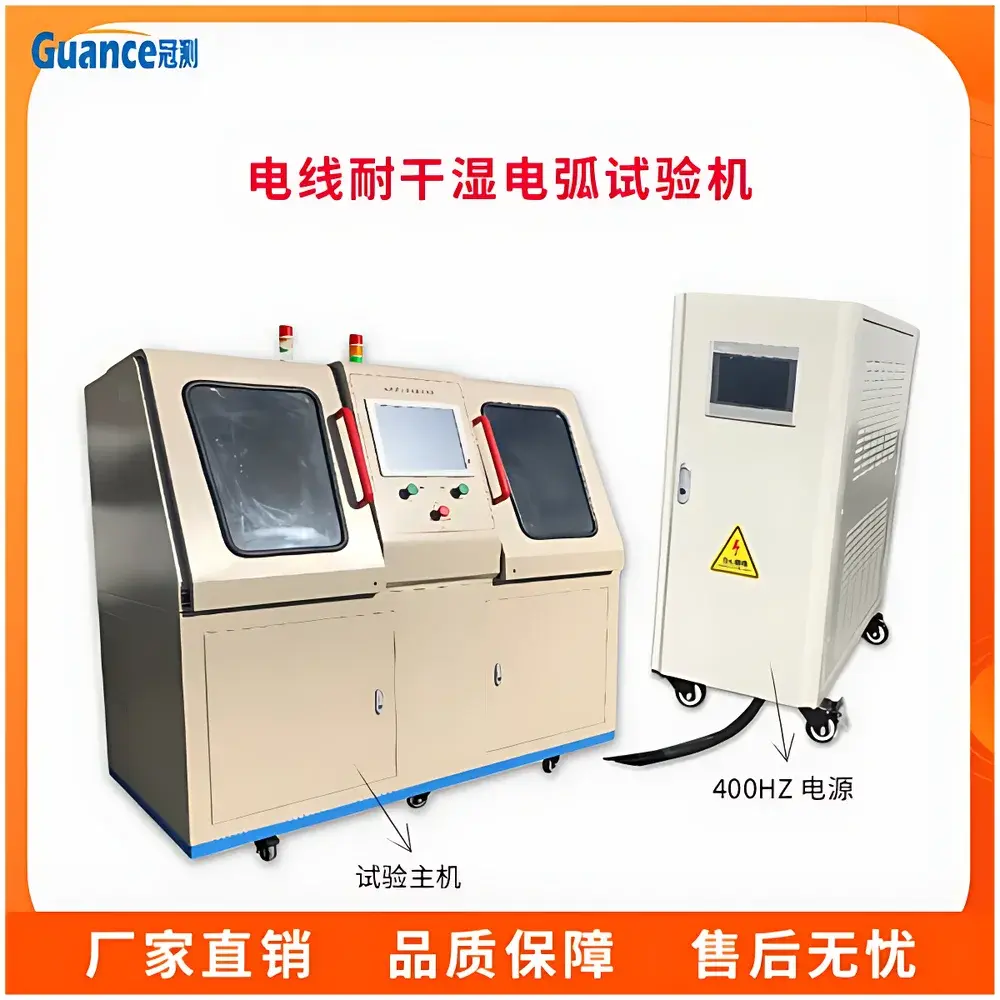
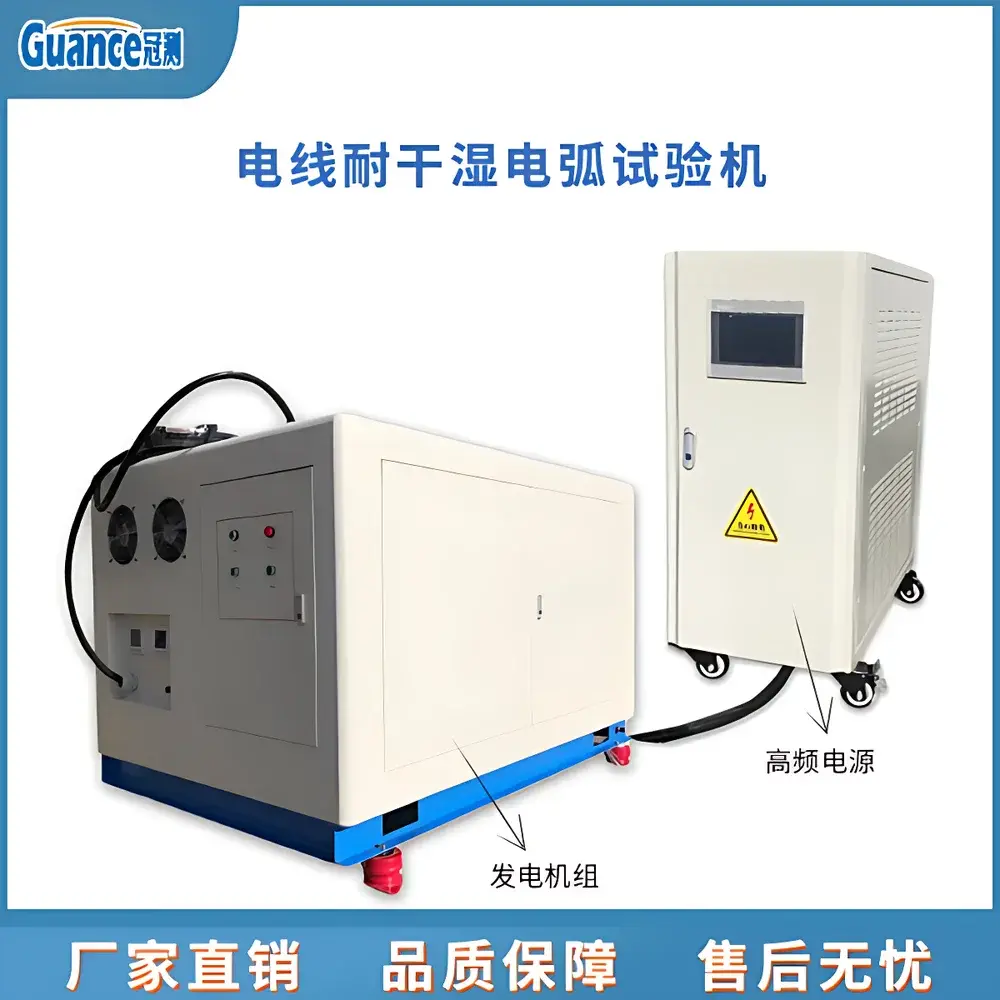
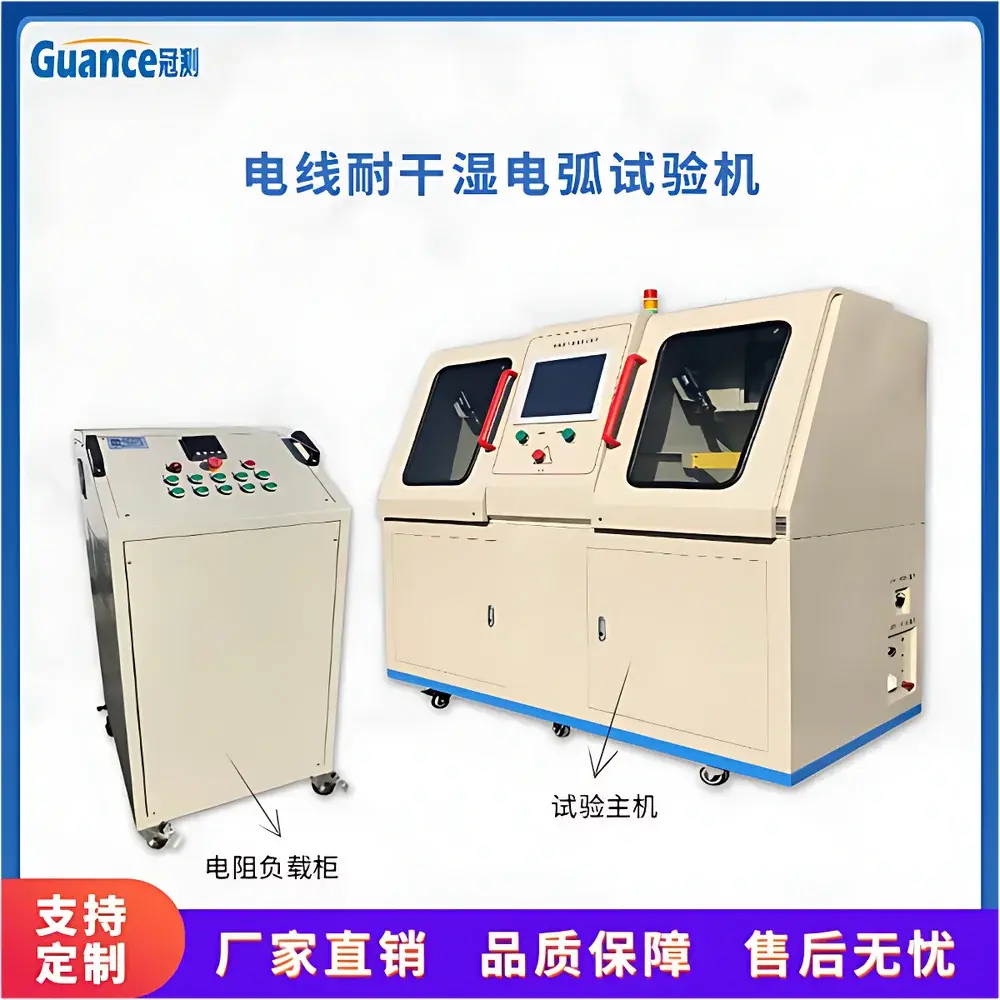
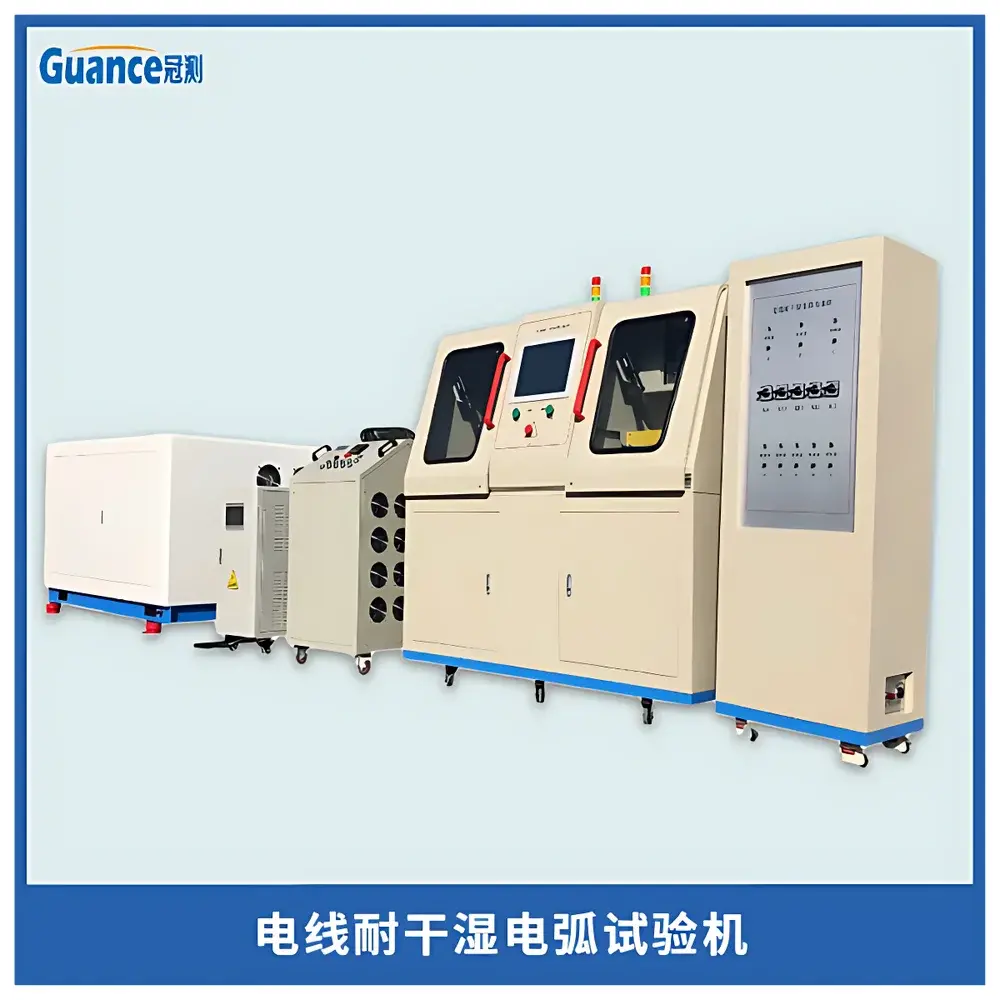
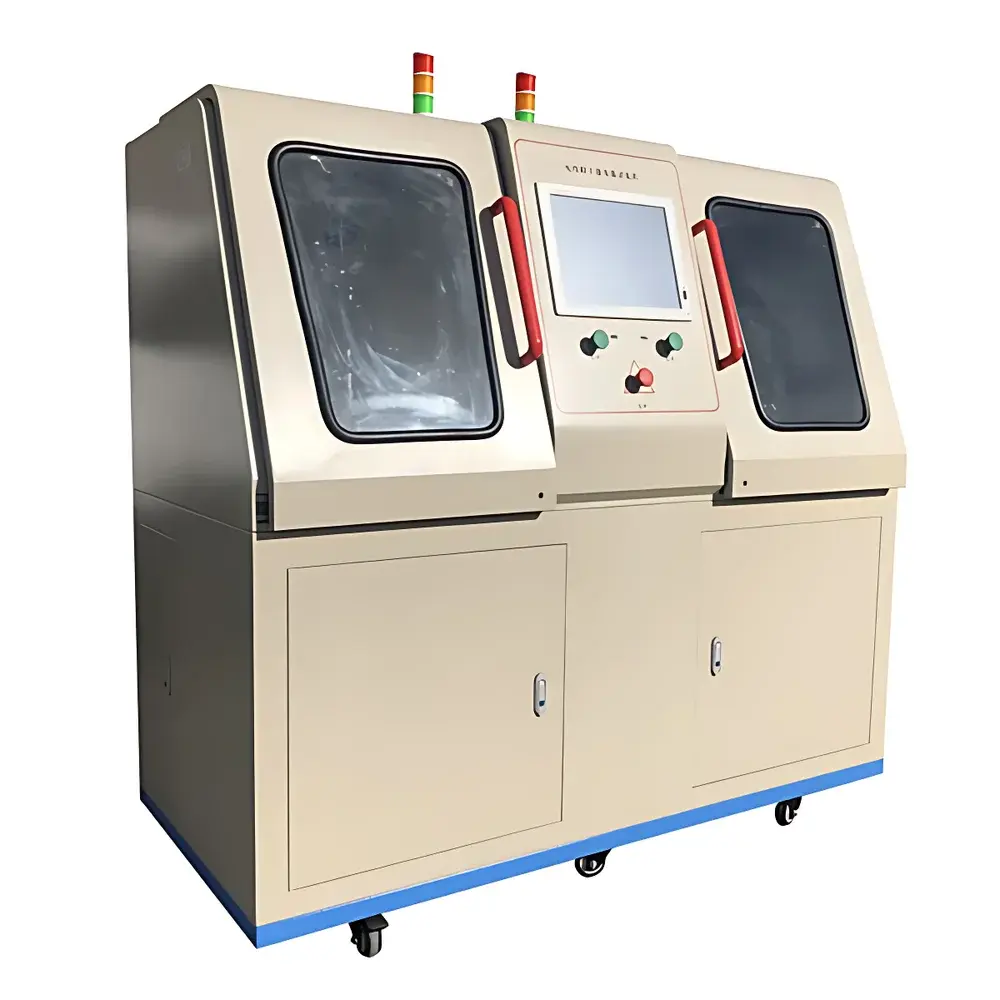
GuanCe YHT-RC100b Arc Resistance Tester for Electrical Wires
| Brand | GuanCe |
|---|---|
| Model | YHT-RC100b |
| Type | Electronic Universal Testing Machine |
| Input Power | AC 220 V ±10%, 50 Hz, 2 kW |
| Test Current | 1 A ±0.2 A |
| Voltage Accuracy | ±1% (0.1 V resolution) |
| Current Accuracy | ±1% (0.01 A resolution) |
| Test Duration Range | 1–99,999,999 s |
| Arc Mode | Dry & Wet |
| Dropping Rate | 100 ±10 mg/min (8–10 drops/min) |
| Friction Stroke | 1–10 cm (std. 3.81 ±0.3 cm) |
| Friction Frequency | 0.5 ±0.05 cycles per second |
| Weight Load on Blade | 250 ±25 g |
| PLC Controller | Siemens Original Import |
| HMI | MCGS 10-inch Capacitive Touchscreen |
| Compliance | AS4373D, GJB773A, ASD-STAN, PrEN 6059-502 |
| Dimensions (L×W×H) | 1400 × 830 × 1500 mm |
| Weight | 300 kg |
| Operating Altitude | ≤1000 m |
| Ambient Temp | −30 to +40 °C |
| Relative Humidity | ≤85% RH |
| Grounding Resistance | <1 Ω |
Overview
The GuanCe YHT-RC100b Arc Resistance Tester for Electrical Wires is an engineered system designed to quantify the arc resistance performance of aerospace-grade wire insulation under controlled high-current and low-current arcing conditions. It operates on the principle of sustained electrical arcing across a defined gap between conductive electrodes while subjecting the insulating material to mechanical abrasion and, optionally, electrolytic contamination via calibrated droplet application. The test simulates real-world failure mechanisms—such as tracking, carbonization, and surface erosion—that occur when aircraft wiring is exposed to arc faults in dry or humid environments. Unlike generic dielectric strength testers, the YHT-RC100b integrates synchronized mechanical motion (reciprocating blade), programmable liquid dosing, and precision power conditioning—including a dedicated 20 kVA generator, 400 Hz frequency conversion, and active current/voltage regulation—to replicate the transient overcurrent profiles specified in aviation standards. Its architecture conforms to the functional safety requirements of IEC 61508 SIL2 for critical test instrumentation.
Key Features
- Integrated Siemens S7-series PLC control system with deterministic scan cycle (<5 ms), ensuring repeatable timing for arc initiation, interruption, and fault detection.
- 10-inch MCGS capacitive touchscreen HMI enabling full parameterization: arc duration, blade stroke length (1–10 cm), reciprocation speed (0.5 ±0.05 cps), load mass (250 ±25 g), and droplet volume per minute (100 ±10 mg/min).
- Dual-mode operation: dry-arcing (no liquid) and wet-arcing (using standardized conductive solution delivered via保定 Leifu peristaltic pump with calibrated needle tip).
- Real-time analog signal acquisition: voltage (via precision voltage transducer, 4–20 mA output), current (via CT-based current transducer, 4–20 mA), and solution flow rate (pulse-counted from pump motor encoder).
- Dedicated 20 kVA onboard generator with integrated 400 Hz inverter—meeting the exact frequency and voltage stability requirements of MIL-STD-704F and DO-160 Section 16.
- Redundant protection architecture: five 7.5 A circuit breakers for individual load branches and one 30 A short-circuit breaker with sub-millisecond trip response.
- Modular mechanical subsystem: servo-driven linear actuator (with ball screw and linear guide rail) delivering repeatable blade displacement and force profile per ASTM D495 Annex A1.
Sample Compatibility & Compliance
The YHT-RC100b accommodates up to seven parallel wire specimens (five active, two dummy) mounted on dedicated dry/wet fixtures, supporting conductor cross-sections from 22 AWG to 12 AWG and insulation thicknesses up to 1.2 mm. Specimen holders comply with dimensional tolerances defined in AS4373D Clause 4.3.2 and GJB773A Method 3015. All wet-mode testing uses deionized water doped with ammonium chloride to achieve conductivity of 100 ±10 µS/cm—verified in situ by an integrated conductivity meter traceable to NIST SRM 3194. The system satisfies full conformance requirements for AS4373D (Aerospace Wire & Cable Test Methods), GJB773A (Chinese Military Standard for Aircraft Wiring), ASD-STAN PRF-502 (European Aviation Standards), and PrEN 6059-502 (Arc Resistance of Insulation Materials). Design documentation includes traceable calibration records for all transducers and compliance statements aligned with ISO/IEC 17025:2017 clause 6.5 for test equipment verification.
Software & Data Management
Data acquisition and test sequencing are managed entirely within the Siemens PLC runtime environment, with no external PC dependency. All operational parameters—including time-stamped voltage, current, and flow rate waveforms—are logged at 100 Hz to internal non-volatile memory (≥16 GB) and exportable via USB 2.0 to CSV format. The HMI supports user-level access control (three-tier password protection), audit trail logging (per FDA 21 CFR Part 11 Annex 11 principles), and automatic generation of test reports compliant with GLP/GMP documentation templates. Raw data files include embedded metadata: operator ID, sample ID, ambient temperature/humidity, grounding resistance verification timestamp, and pre-test calibration confirmation flags. Optional Ethernet/IP interface enables integration into centralized lab management systems (e.g., LabWare LIMS or Thermo Fisher SampleManager) using standard OPC UA protocol.
Applications
- Evaluation of fluoropolymer (e.g., ETFE, FEP), polyimide, and silicone-based wire insulation for military and civil aviation platforms (Boeing BAC 5016, Airbus ABD0031).
- Qualification testing of new insulation formulations prior to MIL-PRF-81381 or SAE AS22759 certification.
- Root cause analysis of in-service wire failures involving arc-induced tracking or dendritic carbon growth.
- Comparative aging studies: accelerated arc exposure followed by dielectric withstand testing per IEC 60243-1.
- Supporting DO-160 Section 22 (Lightning Induced Transient Susceptibility) test plan development through controlled arc source characterization.
FAQ
Does the YHT-RC100b meet FAA AC 20-152A requirements for arc track resistance validation?
Yes—the system implements all physical and procedural elements referenced in AC 20-152A Appendix B, including 400 Hz power conditioning, calibrated droplet delivery, and blade motion synchronization. Full traceability documentation is provided with shipment.
Can test parameters be exported for third-party verification or regulatory submission?
All raw waveform data, configuration logs, and calibration certificates are exportable in timestamped, tamper-evident CSV and PDF formats, compatible with EASA Form 1 and FAA Form 8130-3 workflows.
Is the peristaltic pump compatible with alternative test solutions beyond ammonium chloride?
The Leifu pump supports viscosity ranges of 1–100 cP and is chemically resistant to common test electrolytes (e.g., NaCl, KCl, synthetic seawater); compatibility must be verified per ASTM D495 Annex C for non-standard solutions.
What maintenance intervals are recommended for long-term metrological stability?
Voltage/current transducers require annual recalibration against certified reference standards; servo drive firmware updates and touchscreen calibration are recommended every 18 months; mechanical backlash inspection (ball screw/guide rail) every 2,000 test cycles.
How is grounding integrity verified during operation?
A dedicated ground continuity monitor continuously measures resistance between chassis and earth point (100 ms—logged in the audit trail with timestamp and operator alert.



